

Learning Disability Independent Living: Skills and Options
By Mobile Occupational Therapist • 3 November 2026 • 14 min read
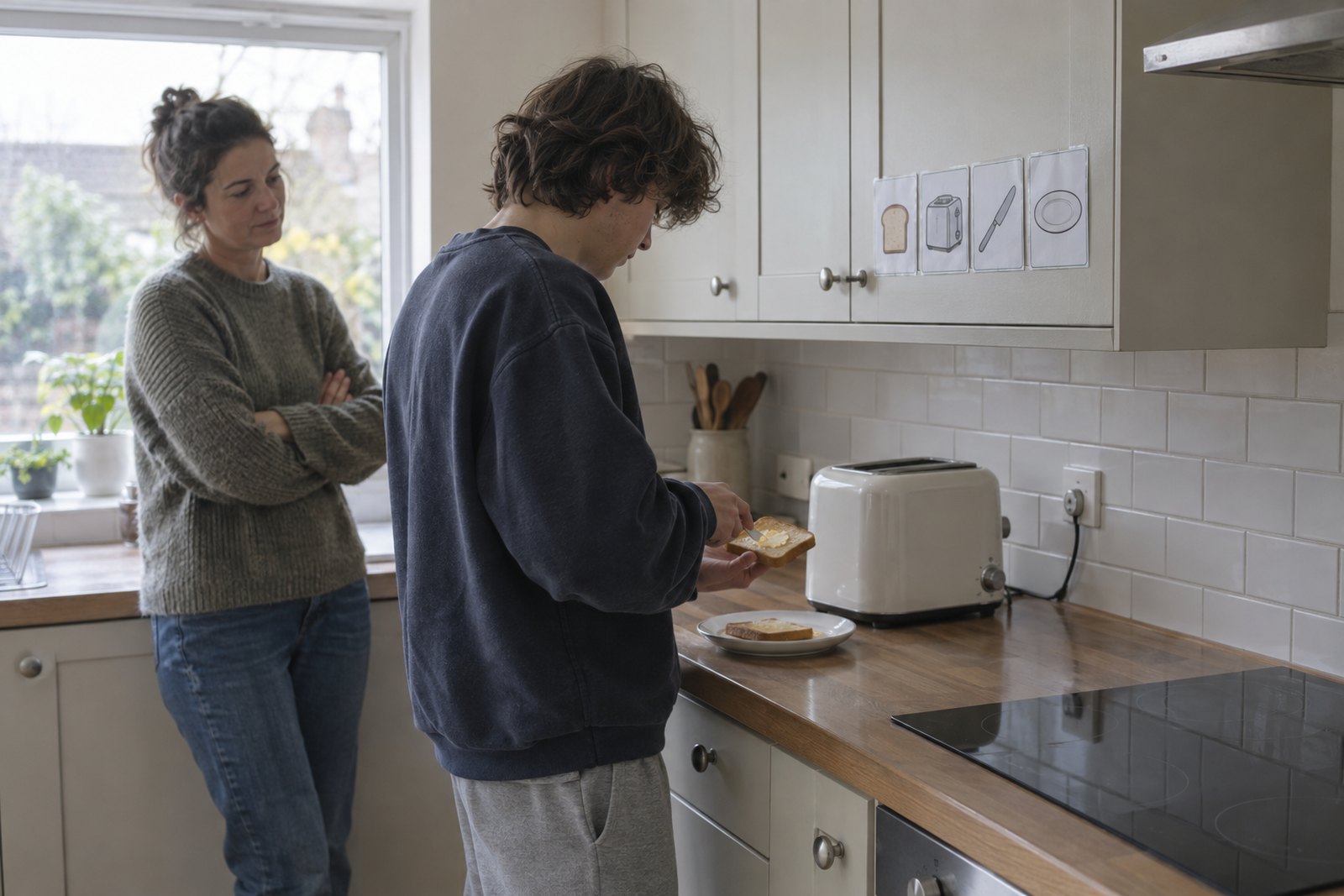
Independent living skills are the everyday things most adults do without thinking. Washing and dressing, making a meal, handling money, getting from place to place, keeping safe and getting through a day. For a young person with a learning disability, almost all of these can be learned, or partly learned, with the right teaching. It usually takes longer, more repetition and more structure. The end point may be "does it with a bit of support" rather than "does it alone". That still counts, and it can make a big difference to the life they lead.
Here is the short version for families. Start in the teenage years, not the month before their 18th birthday. Teach one skill at a time, broken into small steps, in the real place it will be used. Use pictures and routines rather than spoken instructions. And ask your council for a transition assessment, so that support after 18, including options like supported living, is planned rather than scrambled together. The rest of this page explains how to do each of those.
The skills that matter most
Families often think first about the big, visible skills like cooking or travelling alone. In practice, how independent someone can be often depends on quieter things. Knowing what to do when something goes wrong. Being able to get through a day with a routine. Knowing who to ask for help.
Personal care
Washing, showering, cleaning teeth, shaving, managing periods, using deodorant, choosing clean clothes, and knowing when to ask for help with things like nails. Many young people can do the actions but not the judgement: when hair needs washing, when clothes need changing, how hot the water should be. Judgement can be taught too, usually by building it into a routine (shower every morning before breakfast) rather than expecting someone to notice for themselves.
Cooking and food
Start with food that needs no heat: cereal, a sandwich, a cold drink, fruit cut up. Then the microwave, then the kettle, then the hob and oven. Include the jobs around cooking as well: checking dates, putting shopping away, washing up and wiping the side. A young person who can safely make a hot drink and three reliable meals is in a strong position.
Money
Recognising every coin matters less than it used to, because most payments are now by card. More useful is knowing roughly what everyday things cost, paying with a card, checking a receipt, keeping a card and PIN private, and understanding that money runs out before the week does if you spend it all on Monday. A set weekly amount on a basic bank card is a good training ground. If someone will need help managing benefits as an adult, that can be arranged formally later.
Getting about
Travel is often the skill that unlocks everything else: college, work, friends, clubs. It includes knowing the route, using a ticket or pass, knowing what to do if the bus does not come, and who to phone. Some councils and colleges offer travel training, so ask. Practise one route until it is completely secure before adding a second.
Staying safe
Kitchen and fire safety, answering the door, what to do if lost, using a phone, and the hard one: recognising people who are not really friends. Young adults with learning disabilities can be targeted for money, sex or criminal exploitation, sometimes by someone pretending to be a friend. Talk about it plainly and often, using concrete examples. Practise what to say and who to tell.
Routines and time
Getting up, knowing what is happening today, getting ready in time, remembering appointments and taking any medicines. Many young people manage well inside a familiar routine and struggle when it changes. A visible daily plan does a lot of the remembering for them.
Relationships
Friendships, being part of a group, relationships and sex, privacy, consent, and what is and is not okay to say or post online. Young people with learning disabilities have the same feelings and wishes as anyone else and have a right to accessible information about relationships. Avoiding the subject does not protect them. It leaves gaps that other people can exploit.
How to teach a skill so it sticks
Explaining how to do something and then watching it go wrong is frustrating for everyone. These approaches tend to work better.
Break the task into small steps
Write down every step of the task as you actually do it. Making a cup of tea turns into a dozen steps once you include filling the kettle to the right level, checking the lid is shut, and carrying the hot mug to the table. Teach the steps in order and praise each one. You will often find the problem is one particular step, not the whole task.
Try backward chaining
For some tasks it helps to do every step yourself except the last, and let your young person finish. When the last step is secure, they do the last two, then the last three. They always end with success and a finished result. This works well for dressing, making a bed and simple meals.
Use visual supports
Photos of each step, stuck up where the task happens, are often more useful than words that vanish as soon as they are spoken. A picture sequence above the sink, a daily timetable on the fridge, a checklist by the front door. Our guide to visual timetables and now and next boards explains how to make them. For many young adults, a phone with photo checklists, reminders and alarms becomes the grown-up version, and it does not look any different from what everyone else is doing.
Practise in the real place
Skills learned at a classroom table often do not carry over to a real shop or a real bus. Practise in the actual supermarket, at the actual bus stop, in the kitchen they will actually use. Go at quiet times first, then busier ones.
Fade your help
Start with as much help as is needed, then reduce it gradually: doing it together, then pointing, then a quick reminder, then standing nearby, then being in the next room. The aim is that your young person relies on their routine and their pictures, not on your voice. Families often get stuck at the reminder stage for years without noticing, because it is quicker in the moment.
Allow safe mistakes
Burnt toast, the wrong change, getting off a stop early. This is how everyone learns. Plan for the likely mistakes in advance (what to do if you miss your stop, what to do if the card is declined) so that a mistake becomes something they know how to handle rather than a crisis.
A simple way to start this week
- Pick one skill that would make the biggest difference to daily life, ideally one your young person actually wants.
- Watch yourself do it and write every step down.
- Take a photo of each step and print them or save them on their phone in order.
- Practise at the same time each day, in the real place, for a few weeks.
- Note which steps they do alone and which still need help. Reduce your help on one step at a time.
- When it is reliable, change one thing, such as a different shop or a different meal, to check the skill holds up.
Supported living and other options, in plain terms
Independent living does not have to mean living alone with no help. It means having as much choice and control over your own life as possible. The main options are these.
- Living in the family home with support. College, day opportunities, personal assistants and short breaks can all be part of this. It suits many young adults for a while, but it is worth planning for the day parents can no longer do it.
- Supported living. The person lives in their own home, often a flat or a shared house with a few others, and usually holds their own tenancy. Support staff visit, or are on site, for agreed hours to help with what the person cannot yet manage. Housing and care are normally arranged and paid for separately.
- Shared Lives. The person lives with, or regularly stays with, an approved Shared Lives carer in the carer's own home, a bit like being part of another household. These schemes are arranged locally, often through the council.
- Residential care. A registered care home where accommodation and care come together as one package. It tends to suit people with high or complex needs who need staff around the clock.
- Residential college. Some young people spend time at a specialist college with residential places, which can be a stepping stone to living away from home.
Which option fits depends on the person's needs and wishes, what exists locally, and what the council agrees to fund. Availability varies a lot between areas, which is another reason to start the conversation early. Mencap has clear, plain information on housing options for people with a learning disability.
Transition at 18: assessments, rights and capacity
In England, the Care Act 2014 requires councils to carry out a transition assessment for a young person who is likely to need care and support after 18, where doing it before then would be of significant benefit. The point is to plan adult support before children's services end, rather than leaving a gap. You can ask for one. You do not have to wait to be offered it. The detailed rules are in the Care Act and its statutory guidance on GOV.UK, and your council's adult social care team can explain their own process. Wales, Scotland and Northern Ireland have their own laws, so check locally if you live there.
Our guide to the Care Act needs assessment explains how to prepare. Bring concrete examples. Not "needs help with cooking" but "can make toast in the toaster, but has twice left the hob on and did not notice the smoke". Specific examples are much harder to overlook.
If your young person has an Education, Health and Care Plan, it can continue up to age 25 in England while they are in education or training and still need it, and preparing for adulthood, including independent living, should be part of their reviews from Year 9 onwards. See our guide to the EHCP and what an occupational therapy report adds. As a parent carer, you are also entitled to ask for a carer's assessment of your own needs.
Mental capacity, in one sentence: under the Mental Capacity Act 2005, which applies in England and Wales from age 16, a person is presumed able to make their own decisions unless shown otherwise, capacity is judged one decision at a time, and making a choice others think is unwise does not on its own mean someone lacks capacity. In practice, parents of an adult child do not automatically have the right to decide for them, and everyone involved should help the young person make as many of their own decisions as they can.
Where an occupational therapist fits
An occupational therapist looks at what a person needs and wants to do each day, what gets in the way, and how to close the gap. For a teenager or young adult with a learning disability, a private occupational therapist visiting at home can:
- assess everyday skills in real settings, such as watching them make a meal, get ready in the morning, use the shower or go to the local shop
- work out exactly which steps cause difficulty and why, whether that is planning, sequencing, coordination, sensory difficulties, attention or safety awareness
- build a teaching plan, with task breakdowns and visual supports, that family, college or support staff can all follow the same way
- suggest equipment or simple changes, such as easier kitchen tools, timers, or a safer kitchen layout
- write a report describing what the person can and cannot do safely, which can be useful evidence for a Care Act assessment, an EHCP review or a housing application (see functional assessments and reports)
- give a view on whether a particular home or supported living set-up is likely to suit them
It is worth being clear about what an occupational therapist does not do. They do not decide what support the council funds. The council does that. Speech and language therapists lead on communication and on eating and swallowing difficulties. Your GP is the starting point for any health worry, and anyone aged 14 or over on their GP's learning disability register is entitled to a free annual health check. Many areas also have an NHS community learning disability team, which may include nurses, psychologists, psychiatrists and occupational therapists; your GP or council can usually refer. Where behaviour that challenges is a major part of daily life, a psychologist or positive behaviour support specialist usually leads, with others contributing.
Frequently asked questions
At what age should we start teaching independent living skills?
As early as you can. Small jobs in childhood, like laying the table or putting washing in the basket, build the habits that bigger skills sit on. From the early teens, it helps to choose a few specific goals each year and link them to school or college planning, so everyone works on the same things.
What is the difference between supported living and residential care?
In supported living, the person usually has their own tenancy and their support is arranged separately, so they have more say over their home and day. In residential care, the home and the care come together in a registered care home. Neither is better in every case. It depends on how much support the person needs and what they want.
Who pays for supported living?
Usually the care and the housing are funded separately. The council may fund the support after an assessment, and most people also have a financial assessment to see if they contribute. Rent is often covered by benefits such as the housing element of Universal Credit or Housing Benefit, depending on circumstances. Check the details with your council and on GOV.UK, as individual situations vary.
Can my child still make their own decisions after 18?
Yes. The law presumes they can unless it is shown that they cannot make a particular decision, even with support. Parents do not automatically gain the right to decide for an adult child. If someone cannot manage their own benefits, a family member can apply to the Department for Work and Pensions to become their appointee, and for some other decisions the Court of Protection may be involved. Mencap and GOV.UK explain the options.
What if my young person does not want to learn?
Start with what matters to them. Learning to make their favourite snack or travel to a club they love is far more motivating than learning to hoover. Anxiety often looks like refusal, so keep steps small, keep sessions short and make success very likely at first. If refusal is strong and constant, it is worth talking to the school, college or community learning disability team about what might be behind it.
Can we get occupational therapy free on the NHS?
Sometimes. Community learning disability teams, council occupational therapists and some schools or colleges can provide it, although what is available varies by area. Families sometimes go private when they need a detailed home-based assessment or a report for an assessment or review and cannot wait. Ask your GP or council what is available locally first.
Next steps
If you are planning a move or looking at supported living, see our housing and rehousing page, or current guide prices, and choose your area below.
Talk to an occupational therapist near you
This guide is general information. For advice about your own situation - or someone you look after - a local occupational therapist can visit you at home and see it for themselves.
Choose your area: