

Home Improvement Agency And Handyperson Help For Adaptations
By Mobile Occupational Therapist • 25 September 2026 • 14 min read
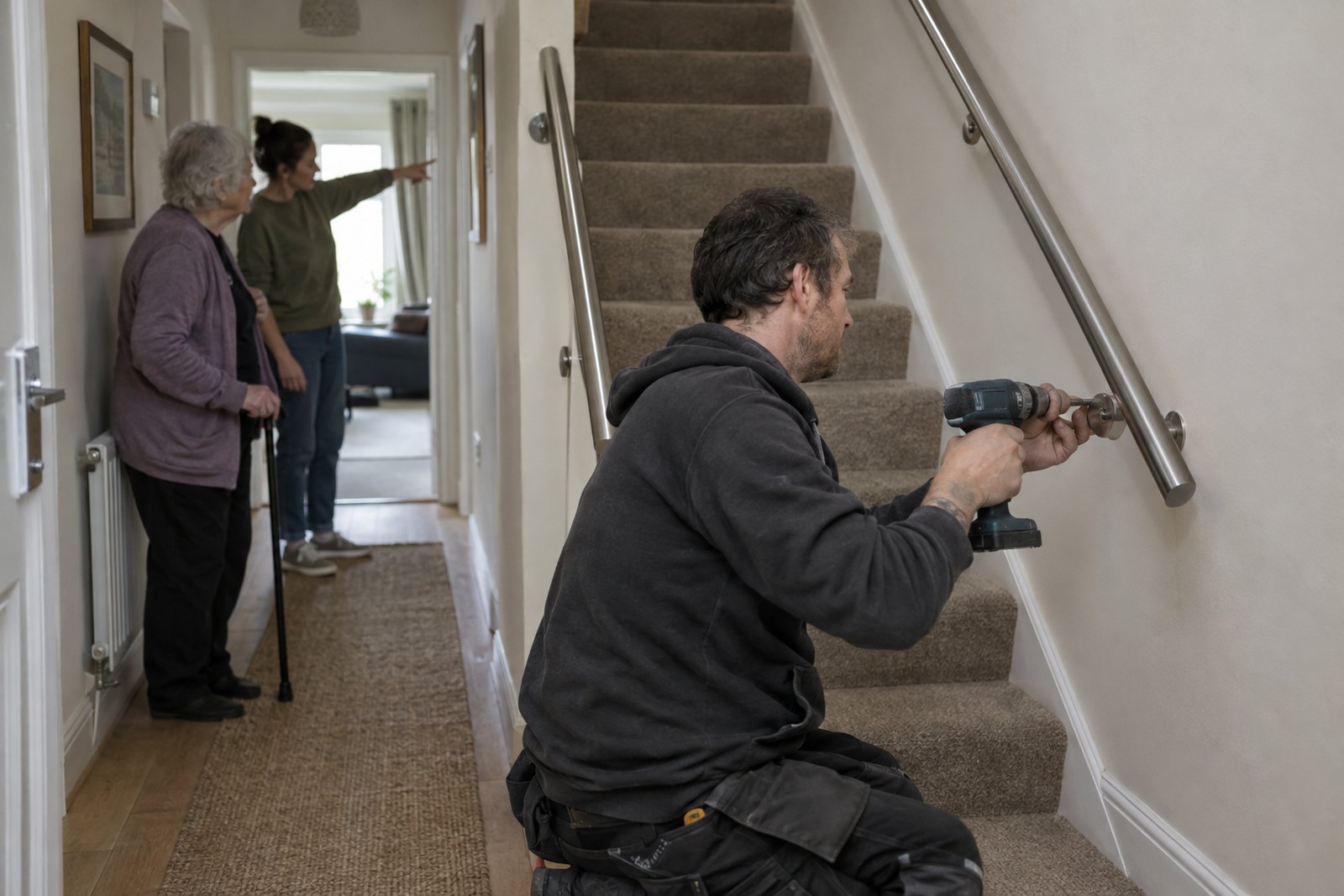
A home improvement agency (often shortened to HIA) helps older and disabled people make their home safer and easier to live in. They can help you plan and arrange small adaptations and repairs, find trusted tradespeople, and sometimes help you through local authority processes like an occupational therapy (OT) assessment and, in England and Wales (and Northern Ireland), a Disabled Facilities Grant (DFG).
A handyperson service is the practical end of that support: someone who comes out and does the small jobs that make daily life safer, like fitting grab rails, improving stair safety, or sorting minor hazards that increase the risk of falls. What is available and what it costs varies a lot by area, but there are reliable ways to find out what is offered where you live.
What a home improvement agency is (and what it is not)
A home improvement agency is usually a local service, often linked to the council, a housing association, or a charity. The aim is straightforward: help you live independently at home by getting the right work done, properly, without you having to project manage it all when you are already tired or worried.
It is not the same as a builder. It is also not usually an emergency repair service. Think of it as a bridge between you (or your family), the council, and the people who actually do the work.
What HIAs typically do
- Listen to what is difficult and help you work out what would make it easier or safer at home.
- Visit your home to look at access, stairs, bathrooms, lighting, hazards, and how you manage day to day.
- Help you plan the work, including drawings or specifications for contractors where needed.
- Help you apply for funding or navigate the process if a grant or council support might be relevant.
- Arrange quotes and contractors, and in some areas help with checking that the work is completed properly.
- Coordinate with other professionals such as council OTs, housing teams, and social care.
Some HIAs only help with adaptations. Others also help with home repairs, heating issues, security, or help after a hospital stay. The name varies too. You might see "home improvement agency", "care and repair", "housing support", "independent living service", or "handyperson service".
What they can help with in real life
People often imagine adaptations as major building works. Sometimes they are. But often it is the smaller, sensible changes that keep someone safe and reduce the stress for everyone.
Small adaptations and safety improvements
These are the kinds of jobs that may be arranged through an HIA or a handyperson scheme, depending on what exists locally:
- Grab rails near steps, at the front door, or by the toilet and bath or shower (positioning matters, a lot).
- Extra stair rails, a second banister, or repairs to wobbly rails.
- Minor threshold solutions for small steps at doorways that catch toes or walking aids.
- Improved lighting in halls, stairs and entrances, including changing difficult-to-reach bulbs.
- Basic home safety checks, such as spotting loose carpets, trailing cables, and trip hazards.
- Simple storage changes, like moving frequently used items to waist height to reduce bending and over-reaching.
If you are specifically thinking about rails, it is worth reading grab rails: where they go, what they hold and what not to grab and stair rails, second banisters and half steps before anything is fitted. Rails work best when they are in the right place for the person using them, and fixed to something solid.
Repairs that reduce risk
Small repairs can be "health and safety", not "home improvement". Examples include:
- Fixing uneven flooring, loose thresholds, or lifting carpet edges.
- Repairing damaged steps or unstable handrails.
- Adjusting doors that stick and make it hard to get out quickly.
- Making sure commonly used rooms are accessible, for example freeing up space to use a walking frame.
If there is a serious electrical, gas, or structural problem, you need the right professional urgently. If there is an immediate danger, do not wait for a handyperson slot.
Bigger adaptations and grant supported work
HIAs also often support larger adaptations, especially where council processes and funding are involved. This might include level access showers, access ramps, widening doorways, or changes needed for a wheelchair. These jobs usually need a clearer "clinical rationale" from an OT and may involve a DFG application in England and Wales, or the equivalent local authority funding route in Scotland.
If you live in England or Wales (or Northern Ireland) and a Disabled Facilities Grant might be relevant, see the Disabled Facilities Grant: how OT assessments support your application. The key point is that a grant is not automatic, and it is not the HIA deciding. It is usually a mix of OT recommendations, council decision making, funding rules, and what is considered reasonable and practicable for that property.
Handyperson services for small jobs
A handyperson service is often part of an HIA, but not always. In some areas it is run by the council, a charity, a local housing provider, or a community organisation.
The best handyperson services are problem solvers. You tell them what is worrying you, and they look for small, practical changes that make day to day life safer and less exhausting.
Typical handyperson jobs
- Fitting grab rails where the person can actually reach and use them safely.
- Fitting or moving stair rails, or adding a second rail where there is only one side.
- Minor changes to reduce falls risk, like securing loose flooring or removing a small trip edge where possible.
- Home safety checks and advice about furniture layout to create clear walking routes.
- Simple security improvements, such as fitting a key safe or improving door locks, depending on local policy.
- Small practical jobs that are hard when you have pain, breathlessness or poor balance, like changing bulbs or putting up a curtain rail.
Some handyperson services will not do certain tasks (for example anything that needs a qualified electrician), and that is a good sign. Clear boundaries usually mean safer work.
Charges and eligibility
Availability and charges vary by area. Some schemes are free for people who meet certain criteria. Others charge a call-out fee, an hourly rate, or ask you to pay for materials. Some only work with owner occupiers, some include private tenants, and some focus on specific groups such as people returning home from hospital.
When you phone, ask two simple questions: "Who is this service for?" and "How do you charge?" If the person on the phone cannot tell you clearly, treat that as useful information.
Care and Repair, HIAs, and who runs what in Great Britain
The language gets confusing because the UK does not have one single system.
England
In England, many local HIAs are linked through Foundations, which is the national body for home improvement agencies. But your local service might not be called an HIA, and it might be run by a council, a charity, or a housing provider.
Wales and Scotland
In Wales and Scotland, "Care and Repair" is a common name for services that support older and disabled people with repairs and adaptations. In some areas, Care and Repair services are well established and can be a first port of call if you are supporting an older parent at home.
Wherever you live, the practical point is the same: start local, because eligibility, waiting times, and what they will do depends on your area.
How to find your local home improvement agency or handyperson service
If you Google "home improvement agency" you will often land on a generic description, not the service that covers your postcode. Use one of these routes instead.
- If you live in England, Scotland or Wales, try your local council website first. Search the council site for "home improvement agency", "handyperson", "care and repair", "housing adaptations", or "disabled facilities grant". If you cannot find it, phone the council and ask to be put through to housing adaptations or private sector housing. In Northern Ireland, start with the Northern Ireland Housing Executive (NIHE) (or your housing association or landlord) for the right route.
- Contact adult social care if there are care needs. If the main issue is safety, falls, washing, toileting, or getting in and out of bed, ask for an OT assessment through your council (or in Scotland, your local Health and Social Care Partnership). In Northern Ireland, ask your local Health and Social Care Trust about an OT assessment. The HIA route and the OT route often join up, but they start in different places.
- Ask your local Age organisation. In England this is usually Age UK, in Wales Age Cymru, in Scotland Age Scotland, and in Northern Ireland Age NI. They often know what is available nearby and how people actually access it in practice.
- Ask the GP surgery only if you need signposting. GP practices are not usually the gateway for adaptations, but they may know the local falls team, community OT contacts, or local charities.
If you are stuck, write down your postcode and ask a simple question: "What is the local service that helps arrange small adaptations like grab rails, and who refers into it?" You are trying to get to the right front door, not have a long conversation.
Before you call: what to prepare (it saves time)
Whether you are phoning for yourself or for your mum or dad, having a few details to hand makes it easier for the person on the phone to work out what help fits.
Write down the problems, not the products
Instead of "we need a rail", try:
- "He has had two near falls stepping into the bath."
- "She cannot manage the front step safely with a stick."
- "The stairs are fine going up, but coming down is scary."
- "He cannot reach the second stair rail because the wall is too far away."
This matters because the "right" adaptation depends on strength, balance, sensation, fear of falling, vision, and how the person moves. Two people can have the same diagnosis and need completely different solutions.
Note what the home is like
- Do you own, rent privately, or rent from a housing association or council?
- Are there steps to get in, internal stairs, or a downstairs toilet?
- Is the bathroom upstairs? Is there a shower or only a bath?
- Is there space to use a walking frame safely?
You do not need measurements at this stage, just the broad picture.
Ask what happens next
Useful questions include:
- Do you need a referral, or can I self-refer?
- Will someone visit the home?
- Do you fit equipment, or do you only advise?
- If it is chargeable, how do you tell me the cost in advance?
- Who checks the work is safe and finished properly?
Choosing a trader safely if you are arranging work yourself
Sometimes there is no local scheme, or the waiting list is too long, or you want something done next week. If you are arranging work yourself, it is worth slowing down for half an hour and thinking about safety and scams.
A simple checklist that protects you
- Use a recognised scheme where possible, for example TrustMark, or ask your council, housing association, or a local charity for suggestions. If someone "just happens to be in the area", treat that as a warning sign.
- Get a written quote. It should say exactly what will be done, what is included, and when.
- Be cautious about large upfront payments. It is normal to pay something for materials for bigger jobs, but do not hand over a large sum because you feel pressured.
- Do not be rushed. If someone tries to hurry you into deciding today, stop. Genuine traders expect you to compare quotes.
- Be careful with cash. Paying cash makes it harder to prove what was agreed if something goes wrong.
- Do not accept "quick fixes" for safety critical items. Grab rails, stair rails, and anything weight-bearing needs proper fixings into a suitable surface.
If you are supporting an older relative, you may need to be quite direct. Doorstep scams work because they create urgency and embarrassment. "We never agree work on the doorstep" is a perfectly fine family rule.
Where an occupational therapist fits
HIAs and handyperson services are practical. Occupational therapists are practical too, but in a different way. An OT looks at how someone manages everyday tasks, what is getting in the way, and what changes will make the biggest difference safely.
When an OT assessment is worth it
Consider an OT if:
- Falls have happened, or "near misses" are happening regularly.
- The person is avoiding washing, stairs, or cooking because it feels unsafe.
- You are considering spending money on adaptations but are not confident what will actually help.
- The situation is changing quickly after illness, surgery, or a new diagnosis.
- You are heading towards bigger work, like a level access shower, and want a clear plan.
If you want to understand what an OT looks at in a home, see home adaptations: how an OT assessment works.
What an OT recommendation adds
- Better targeting. The goal is not "more equipment". The goal is the right change in the right place, so the person can do the task more safely.
- Safe positioning. For example, grab rails need to match the person's reach, grip, and movement pattern, not just be "near the toilet".
- Joined-up thinking. An OT will look at footwear, lighting, routines, fatigue, and how a person transfers, not just the physical environment.
- Evidence for funding routes. If you are going down the DFG route, OT evidence often forms part of what the council needs to see. The process is explained in our DFG guide.
An OT does not replace a qualified trade. They should not be doing electrical or structural decisions. But they can make sure the work you commission is actually the work you need.
Council OT or private OT?
A council OT assessment is usually the route into publicly funded adaptations and may be needed for a DFG application. A private occupational therapist visiting at home can be useful if you want quicker advice, a second opinion, or a detailed plan you can use to brief an HIA or contractor. It is not either or. Many families use both at different points.
Frequently asked questions
Is a home improvement agency the same as the council?
Not always. Some HIAs are council-run, some are charities or housing organisations that work closely with the council. What matters is that they understand local systems and can connect you to the right route for repairs, adaptations, or grants.
Do you have to be a homeowner to get help?
No, but the options may differ. Some services focus on owner occupiers, some include private tenants, and social housing often has its own adaptations route through the landlord. If you rent, ask early who needs to give permission for changes.
Will a handyperson fit grab rails and stair rails?
Often yes, if that is part of the local scheme. The important part is that rails are fitted safely, with suitable fixings, in a position that matches how the person moves. If you are unsure what "good" looks like, read our grab rails guide and our stair rails guide before you book work.
How much do home improvement agencies and handyperson services cost?
It depends on your area and on what you need. Some services are free for eligible people, some charge fixed fees, and some charge for labour and materials. Ask for costs in advance, and ask what happens if the job turns out to be more complex than expected.
Can an HIA help with a Disabled Facilities Grant?
In many areas, yes. They may help with forms, gathering quotes, project managing the work, or coordinating with the council OT and housing teams. The grant rules and process vary and can change, so check your local authority or housing body website and the relevant national guidance (for example GOV.UK, GOV.WALES, mygov.scot, or nidirect.gov.uk).
What if my parent refuses help or will not let anyone in?
This is common. Start with the problem they care about (for example, "getting to the toilet safely at night") rather than talking about adaptations. If they are worried about strangers, ask whether the service offers ID checks and whether you can be there for the visit. If refusal is putting them at serious risk, speak to the GP or the council adult social care team for advice.
Next steps
If you want clear, practical recommendations before you start arranging work, see our home adaptations page, or current guide prices, and choose your area below.
Talk to an occupational therapist near you
This guide is general information. For advice about your own situation - or someone you look after - a local occupational therapist can visit you at home and see it for themselves.
Choose your area: