

Home Care vs Care Home: How Families Decide
By Mobile Occupational Therapist • 23 September 2026 • 16 min read
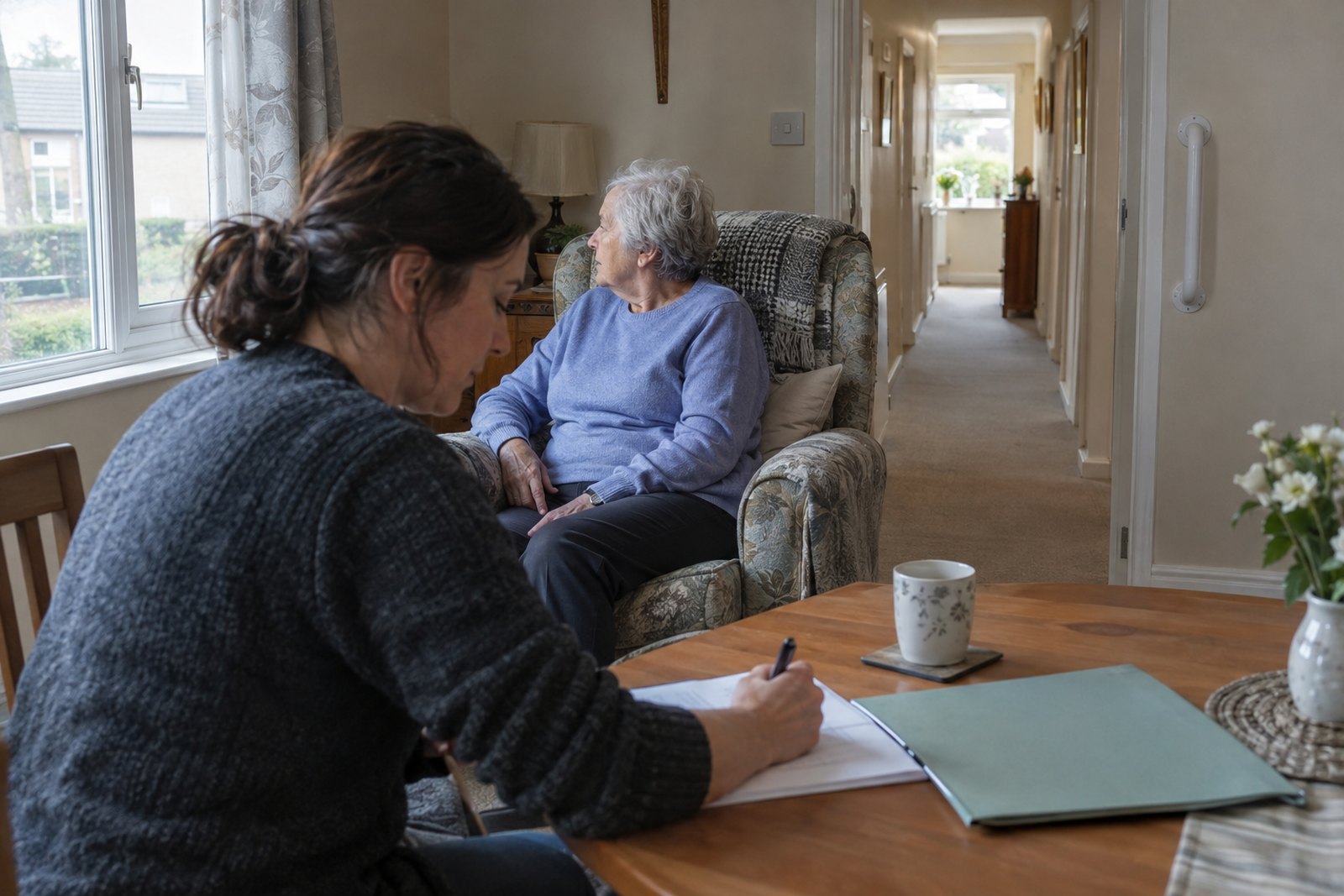
If you are weighing up home care vs a care home, you are usually trying to answer one hard question: can we keep this person safe and reasonably well at home without breaking them or the family? There is rarely a perfect option. There is usually the least bad option for now.
In practice, families decide based on a handful of factors: what the person wants, whether nights are safe, how many people it takes to help them move, how much supervision is needed, the carer's stamina, and whether the home can realistically be adapted. This article walks you through those questions, explains what each option actually provides, and shows where an occupational therapist (OT) can help you work out what is possible at home.
what each option really offers
It helps to separate the idea of an option from the day-to-day reality. Many families think they are choosing between two neat boxes. In reality, the gaps between care needs and what is available are where things get messy.
home care visits (domiciliary care)
Home care visits are timed calls from paid carers, often 30 to 60 minutes, sometimes longer. They can cover personal care, meals and drinks, prompting medication (carers may not be allowed to administer certain medicines), light domestic tasks, and support with getting in and out of bed where this has been assessed and agreed in the care plan (including any equipment or two carer support needed).
What home care visits are good for:
- Routine support at set times, especially mornings and evenings.
- Keeping someone in their own home with familiar surroundings and neighbours.
- Reducing pressure on family for specific tasks, even if family still does a lot.
Where home care visits can struggle:
- Unpredictable needs (toileting urgency, agitation, falls risk, confusion at night).
- Gaps between calls. If someone is unsafe alone for several hours, short visits do not fix that.
- Two-person assistance. If the person needs two people to help them move safely, staffing can be harder to arrange.
live-in care
Live-in care is where a paid carer lives in the home. It can offer continuity, supervision and help spread across the day, and reassurance overnight (depending on what is agreed). It is not the same as having two or three people available at once, and it is not automatically 24 hour waking cover.
If you are considering this route, read live-in care: what it is and how to decide if it suits. It is a good option for some families, but it only works when the home set-up, the tasks required, and the expectations all match.
residential care homes
A residential care home provides accommodation, meals, personal care, and staff on site. This can be a huge relief when someone is no longer safe alone, especially at night, or when family care has become physically or emotionally unmanageable.
Residential care is often a better fit than home care when:
- The person needs frequent help throughout the day and evening.
- There is high falls risk or wandering and getting lost.
- They are very isolated at home and struggle to engage, eat or drink.
Residential care is not the right answer for every problem. Some people decline after a move, especially if it is rushed or against their wishes. And if someone has complex medical needs, residential care may not be enough.
nursing homes
Nursing homes are care homes with nursing, which means a registered nurse is on duty 24 hours a day. They support people who need nursing care, for example complex wound care, frequent clinical monitoring, or more complex medical conditions. Not everyone who is frail needs a nursing home, and some people who look physically OK may still need one because of medical complexity. The right choice depends on assessed needs.
If you are unsure, ask the person's GP, district nurse team, hospital team (if involved), or social worker what level of care is being considered and why.
the decision questions families can use today
Families often get stuck because everyone is arguing different points. One person focuses on safety. Another focuses on mum's wishes. Another focuses on cost. The way through is to agree the questions first, then gather information.
1) what does the person want (and what do they understand)?
Start with the person, even if their communication is poor or their memory is failing. Ask simple, concrete questions: "Do you feel safe here at night?" "What do you miss?" "What worries you about a move?"
If the person has capacity to decide, their choice matters even if the family disagrees. If capacity is unclear, do not assume. Get advice and keep notes of what was discussed.
2) what happens at night?
Nights are where home care plans often break.
- Toileting: can they get to the toilet safely in the dark, half asleep? If not, what is the least risky alternative for now?
- Falls: do they fall trying to get out of bed, rushing, or because they are confused?
- Confusion or wandering: are external doors opened? Are neighbours calling you?
- Breathlessness or pain: are symptoms controlled enough for sleep?
If you are regularly up multiple times a night, or you are afraid to sleep because you might not hear them, that is information. Not guilt. Information.
3) how many people are needed to help them move, every time?
This is one of the clearest tipping points.
- If someone needs one person and a steady set-up (right chair height, grab rail, walking aid), home care can often work.
- If someone needs two people for transfers (bed to chair, toilet, shower), home care becomes harder and family carers are at higher risk of injury.
- If someone is non-weight bearing, very unsteady, or collapses, you may need specialist equipment and a properly planned moving and handling approach.
Do not "just lift" because you are in a hurry or they are embarrassed. If moving and handling is becoming unsafe, that is a reason to pause and get professional input.
4) what is the carer's health doing?
Families often talk as if the only relevant person is the one receiving care. In reality, carer health is part of the safety plan.
- Are you getting back pain, shoulder pain, or exhaustion?
- Are you making mistakes because you are tired?
- Are you becoming short-tempered, tearful, or numb?
- Are you missing work or using annual leave to provide care?
It is not a moral failure to say: "I cannot do nights anymore." It is risk management.
5) is the person lonely, bored, or stuck?
Some people are physically safe at home but psychologically shrinking. They stop washing, stop cooking, stop going out, and stop speaking to anyone other than a carer on a rushed call.
Ask:
- How many meaningful conversations did they have this week?
- Do they eat better when someone sits with them?
- Are they safe but not living?
Home can be the right place, but it needs structure: visitors, routine, prompts, and purposeful activity. A care home can sometimes improve wellbeing simply because there are people around all day.
6) can the home be made workable?
Many "it's time for a care home" moments are really "the house no longer works". Before you decide, look at the layout with fresh eyes.
- Is the bathroom upstairs with steep stairs?
- Is the bed low, the sofa deep, the chair too soft?
- Is there space for equipment if it becomes needed?
- Are there steps, thresholds, narrow doors, or a tiny hallway?
This is where adaptations can change what is possible. See home adaptations: how an OT assessment works for what an OT looks at and how recommendations are usually made.
7) what is happening in the "in-between" time?
Families often plan for best days. The decision should be based on the worst days, because those are the days that cause crises.
A practical exercise: for one week, write down what help was needed and when. Include:
- Any falls or near misses
- How many toileting assists
- Confusion episodes
- Calls to family, NHS 111, GP, or A&E
- How many hours family were actively "on duty"
At the end of the week, ask: is this sustainable for three more months?
trying changes without committing to a permanent move
When emotions are running high, a "trial" can lower the temperature. It also produces real evidence about what works.
try respite first (if you can)
Respite might be in a care home for a short period, or extra support at home so the family can rest. It can be a planned break or a stepping stone after illness.
Respite is not only for carers. It is also a way to test how the person copes away from home and how the family copes when they are not providing constant care. See respite care and short breaks for family carers for the practicalities and the awkward bits people do not always say out loud.
increase support at home in stages
If the person wants to stay at home, consider staged changes rather than an all or nothing leap.
- Add a morning call first, then a lunchtime call, then evenings.
- Trial overnight support if nights are the problem.
- Change the environment: better lighting, clearer pathways, a safer chair, a downstairs set-up.
This approach works best when you are honest about the aim: you are not "proving" anything. You are testing whether home is still safe and workable.
agree the "red lines" in advance
Families cope better when everyone knows what will trigger a change. Examples of red lines might be:
- Two falls in a month
- Carer injury or carer becoming unwell
- Unsafe nights continuing despite added support
- Repeated missed meals or dehydration because no one is there
Write the red lines down and share them. It stops the decision becoming a fresh argument every week.
getting the right assessments and understanding the system
Even if you plan to arrange care privately, the NHS and your local council can still be part of the picture. Getting the right assessment can clarify needs and unlock support.
the needs assessment (adult social care)
In England, a local authority must assess an adult who appears to have needs for care and support. The assessment looks at day-to-day outcomes (washing, dressing, meals, safety, relationships, managing the home) and what matters to the person.
If you are preparing for this, care act needs assessment: what to expect and how to prepare explains what usually happens and how to make sure the real problems are heard. Scotland, Wales and Northern Ireland have different legal frameworks and processes, so check your nation's guidance.
the financial assessment (means test)
If the council is arranging care, there is usually a financial assessment to decide what the person contributes. The rules vary depending on whether care is provided at home or in a care home, and on the person's circumstances.
Because these rules change and details matter, treat online summaries with caution. Your local council should explain how it works, and organisations such as Age UK can also help you understand the general principles.
carer's assessment
If you are providing care, ask for a carer's assessment. This is about your needs, your health, and what support would make caring sustainable (or whether it is not sustainable). Many families do not request this until they are already at breaking point.
capacity and best interests (England and Wales)
If the person can understand, retain, weigh up and communicate a decision about where they live, they have capacity for that decision. If they do not, a "best interests" decision-making process should be followed, involving the person as much as possible and considering their past and present wishes.
This is a big area, and other nations differ. If you are in England or Wales and there is disagreement, or you are unsure whether the person has capacity, ask the GP, social worker, or hospital team how capacity will be assessed and recorded. If safeguarding concerns exist, raise them clearly.
how to choose a care home if that is the route
Choosing a home is not like choosing a hotel. You are looking for safe, kind, consistent care, and you are trying to judge it on a visit when everyone is on their best behaviour. Go in with a plan.
start with needs, not brochures
Make a short list of must-haves based on the hardest parts of the week. For example:
- Help with transfers and toileting
- Support with eating and drinking
- Dementia care and supervision
- Access to a lift, step-free routes, or ground floor rooms
- Ability to respond quickly at night
Ask directly: "Can you meet these needs day and night?" If they hesitate, listen to that.
visit at different times if possible
If you can, visit once at a planned time and once more informally. Notice:
- Do residents look comfortable and cared for?
- Are staff talking to people, not about them?
- Do people have drinks within reach?
- Is the place calm in a good way, or quiet because everyone is parked?
- Do you see prompt responses when someone needs help?
There will be smells sometimes. That is normal in settings providing personal care. What you are looking for is whether the home feels clean, whether call bells are answered, and whether residents are treated with dignity.
ask practical questions that reveal the reality
- What happens if someone falls in their room?
- How do you support someone who needs the toilet frequently overnight?
- How do you manage continence with dignity?
- Can couples stay together if one needs more help?
- What is your approach to activities for people who cannot join in groups?
- How do you involve families, and what are visiting arrangements?
read the inspection report, but use your own eyes too
In England, care homes are regulated by the Care Quality Commission (CQC). In Wales it is Care Inspectorate Wales (CIW). In Scotland it is the Care Inspectorate. In Northern Ireland it is the Regulation and Quality Improvement Authority (RQIA).
Inspection reports are useful for patterns and concerns, but they do not replace a visit. A home can look warm and caring and still struggle with consistency. A home can also have a dated building and be excellent at care. Hold both truths until you have enough evidence.
where an occupational therapist fits
An OT helps you join the dots between a person's abilities, the environment, and the support available. In this decision, that usually means answering: "What would need to change for home to be safe and workable?" and "If home is not workable, what needs should a care setting be able to meet?"
A private occupational therapist visiting at home can:
- Assess transfers, stairs, toileting, washing, kitchen tasks and fatigue in the real setting.
- Recommend practical changes and equipment, and explain what will make the biggest difference first.
- Look at risks at night and suggest ways to reduce them (without pretending risk can be removed completely).
- Advise on whether one person can realistically assist, or whether two people are needed for safety.
- Support planning for adaptations, including what is realistic in your property and what to prioritise.
If you want to understand what an OT does in your home, see home assessments.
What an OT does not do: provide hands-on care visits, diagnose medical conditions, or prescribe medication. If new symptoms appear (new confusion, sudden weakness, chest pain, severe breathlessness), contact your GP urgently, call NHS 111, or call 999 in an emergency. If the main issue is rebuilding strength and walking outdoors, physiotherapy may be the lead profession, although OTs and physiotherapists often work alongside each other.
Frequently asked questions
when is it time for a care home?
It is usually time to consider a care home when safety cannot be managed at home even with increased support, or when the level of supervision needed is constant (especially overnight). Another common tipping point is when family carers are becoming unwell or injured.
Try to base the decision on the hardest days, not the best ones. If crises are frequent, a planned move is usually kinder than an emergency move after a fall or hospital admission.
is live-in care the same as 24 hour care?
Not automatically. Live-in care usually means a carer is in the home and available, but there still need to be clear agreements about breaks, sleep, and what happens overnight.
If someone needs two people to assist, or needs frequent help through the night, you may need a different package than standard live-in care.
can we keep someone at home if they have dementia?
Sometimes, yes, especially when the home is set up to reduce confusion and risk, and when there is enough supervision. The challenge is often night-time waking, wandering, safety in the kitchen, and declining ability to use the toilet safely.
If dementia is progressing, plan early. Last-minute decisions tend to be driven by crisis rather than choice.
what if mum or dad refuses help at home?
Refusal is often about fear, loss of control, embarrassment, or not recognising what is happening. It helps to talk about specific problems ("getting washed is hard") rather than labels ("you need carers").
If there are serious safety risks and the person may not understand them, ask the GP or adult social care about a capacity assessment and what support is available.
what is the difference between residential and nursing care?
Residential care provides accommodation and personal care. Nursing care includes registered nurses on site to meet additional health needs. The right setting depends on assessed needs, and needs can change over time.
If you are unsure, ask the healthcare team or social worker to explain what needs are driving the recommendation.
will the council pay for care at home or a care home?
It depends on assessed eligible needs and a financial assessment. The rules are different for care at home and care in a care home, and personal circumstances matter.
Start with a needs assessment, then ask the council to explain the charging process in writing for your situation.
Next steps
See our home assessment page or older people independence, read current guide prices, and choose your area below.

Talk to an occupational therapist near you
This guide is general information. For advice about your own situation - or someone you look after - a local occupational therapist can visit you at home and see it for themselves.
Choose your area: