

Hoist Slings: Types, Sizing and Safety Checks for Carers
By Mobile Occupational Therapist • 29 October 2026 • 15 min read
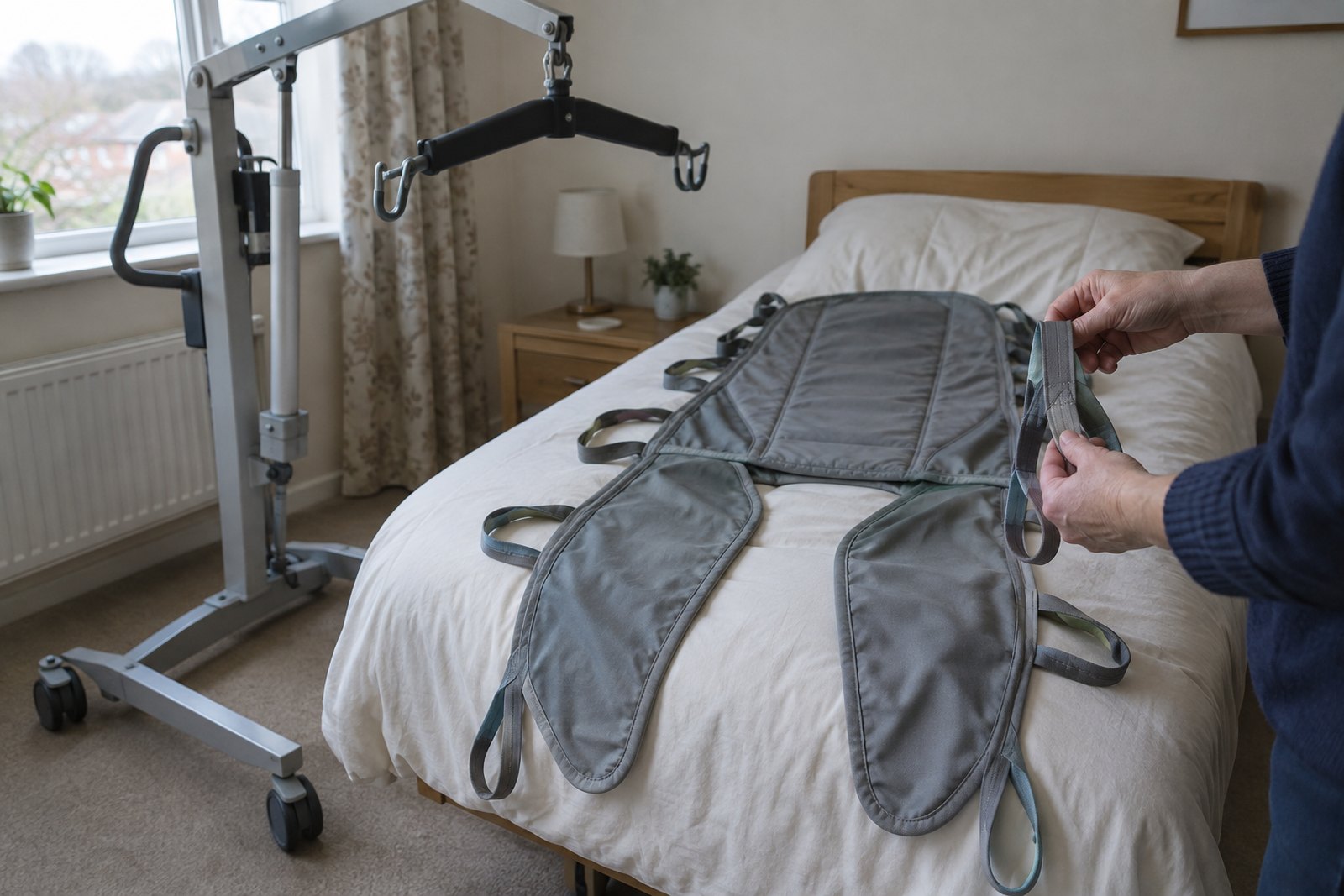
A hoist sling is the fabric part that holds the person while they are lifted. The hoist does the lifting, but the sling decides whether they are held safely, comfortably and in the right position. Get the sling wrong and a perfectly good hoist becomes dangerous. That is why slings come in different types and sizes, why they must be chosen and sized by someone trained to assess, and why you check them every single time you use one.
If you are a family carer who has just had a hoist delivered, or you are wondering whether the sling your mum has used for two years is still the right one, this guide covers the main types, how sizing works, the checks to do before each lift, washing, servicing, and what to do if something feels wrong partway through a lift. It will not replace hands-on training. Nothing written can. But it should help you spot problems and ask the right questions.
Why the sling matters as much as the hoist
Most people think about the hoist first: mobile or ceiling, whether it fits in the bedroom, whether the battery lasts. If you are at that stage, our guides to hoists at home and ceiling hoists cover it. But the sling is the part touching the person. It carries their whole weight, it sets the angle they sit at, and it is where a lot of things go wrong: a person slipping down through a sling that is too big, skin rubbed or pinched by one that is too small, a worn loop giving way, or a sling that does not attach properly to the hoist.
A sling is not a generic item either. Slings are designed to work with particular attachment systems. Some have fabric loops that hook over the hoist's spreader bar, others use clips or keyhole fittings. Whoever assesses will check that the sling and hoist are compatible. Do not assume that because a sling looks as if it fits the hoist, it does.
The main types of hoist sling
Manufacturers use different names and there are plenty of variations, but most slings fall into a few broad groups. Which one suits depends on the person's body, how much head and trunk control they have, what the lift is for, and the condition of their skin.
Full body slings
The general-purpose sling for moving someone between bed, chair, wheelchair and commode. It supports the back and has separate leg pieces that go under each thigh, sometimes crossed or threaded through each other. Some versions have a high back with head support for people who cannot hold their head up; others stop at the shoulders for people with good head control. You may hear them called universal or divided leg slings.
Access or toileting slings
These have a large opening around the bottom so clothing can be adjusted and the person can use a toilet or commode without the sling being removed. The trade-off is less support. They generally suit only people with reasonable upper body strength and trunk control who can cooperate with the lift, because the person is held mainly around the chest and under the thighs. Used for the wrong person, there is a real risk of them slipping out. This is one sling that especially needs a proper assessment.
Hammock slings
The leg sections are joined, or the sling is one continuous piece under the bottom and thighs, so the person sits in it more like a hammock. These are often used for people with very little control of their body, people with strong muscle tone or spasms that make separate leg pieces hard to place, or people who have had a leg amputation. They tend to hold someone in a more reclined, curled position.
In-situ slings
Designed to stay under the person while they sit in their chair, so they do not have to be rolled or leaned forward to get a sling in and out several times a day. They are made from materials and with seams intended to sit against the body for longer. Only a sling designed and assessed for this should be left in place. Leaving an ordinary sling under someone for hours can damage their skin, and anyone at risk of pressure sores needs their skin checked regularly whatever sling they use.
Bathing slings
Made from mesh or quick-draining fabric for use in the bath or shower. Water drains through and the sling dries faster. Wet fabric and wet skin behave differently from dry, so a bathing sling still needs to be the right size and type, and assessed for the bathroom it will be used in.
There are also belts and slings made for stand aids, which support someone who can take some weight through their legs. These are a different piece of equipment and are not interchangeable with hoist slings.
Sling sizing: why you must never guess
Slings come in sizes, often from extra small to extra large, and many are colour coded by size. Here is the catch: sizes and colours are not consistent between manufacturers. A medium from one maker can be quite different from a medium from another, and a colour that means one size on one make may mean something else on another. Sizing is not about clothes size or weight alone. It depends on height, build, body shape, where the person carries their weight, and how the sling is meant to hold them.
What goes wrong:
- Too big: the person sits low and loose and can slide down and out, especially through the leg openings or the bottom of an access sling.
- Too small: it digs in under the arms and thighs, pinches skin, concentrates pressure on small areas, and can hold the person awkwardly or tip them backwards.
The assessor will usually measure the person, try a sling, lift them a short way off the surface to see how they sit, and adjust or change size. Manufacturers produce sizing guides for their own slings, but the trial lift is what confirms the fit.
Never use someone else's sling. Not a neighbour's, not one left over from a relative who has died, not one borrowed from a care home 'just for the weekend'. Slings are assessed for one person, and in care settings they are normally issued to one named person for fit and for infection control. If the person's body changes, for example they lose or gain weight, their posture changes, they become weaker or they have surgery, the size and type need reviewing.
Loop settings: decided by the assessor, not on the day
Many slings have several loops on each strap, often in different colours. Which loop goes on the spreader bar at the shoulders and which at the legs changes how the person sits: more upright or more reclined, legs higher or lower. Too reclined and some people feel they are falling backwards. Too upright and some slip down.
The loop settings should be chosen by the person who assesses, tested in a trial lift, and written down in the handling plan: which colour at the shoulders, which at the legs, and whether the leg pieces are crossed. Then everyone uses the same settings every time. If a family member or paid carer thinks a different setting would be better, that is a conversation for the assessor, not an experiment on the day. Keep a copy of the plan near the hoist.
Checks before every use
Once you know what you are looking for, this takes under a minute. Do it every time, even if the sling was fine yesterday.
- Is this the right sling? Right person, right type for this lift, right size as stated in the plan.
- Label. Is it there and readable? It usually shows the size, the maximum safe working load, the manufacturer's details, a serial or batch number and washing instructions. If the label is missing or too faded to read, do not use the sling until you have checked with whoever supplied it.
- Stitching and seams. Run your eye and fingers along the seams, especially where straps join the main body. Look for loose, broken or pulled threads.
- Fabric. Look for fraying, holes, tears, thin patches, stiffness, scorch marks or bleach damage.
- Loops, straps or clips. Check every loop for wear or fraying. If the sling has clips or plastic fittings, check for cracks, bends or anything that will not sit properly on the hoist.
- Padding and stiffeners. If there is padding in the leg pieces or a stiffener in the back, check it is intact and in place.
- The hoist too. Battery charged, castors and brakes in good condition, emergency stop and emergency lowering device present and you know how to use them, spreader bar hooks or fittings in good condition, and any required servicing or LOLER thorough examination is in date.
If anything is wrong, take the sling out of use, put it where nobody will pick it up by mistake, and contact the supplier. A sling with a small tear is not 'fine for now'.
Once the person is in the sling, there is one more check. Lift just enough to take their weight off the surface, then pause. Check every loop or clip is still attached, the person is sitting as expected, and they are comfortable. If anything looks wrong, lower them back down and sort it out before going any further.
Washing, labelling and looking after slings
- Follow the washing instructions on the label exactly: temperature, whether it can be tumble dried, and anything to avoid. Too much heat and bleach can weaken fabric in ways you cannot see.
- Remove any detachable padding or stiffeners first if the instructions say so.
- Inspect the sling after washing, before it goes back into use.
- Ask whether a spare can be supplied, so there is always a clean, dry sling available.
- If more than one person is hoisted in the house, mark each sling clearly with the person's name in a way that does not cover or damage the manufacturer's label.
- Store slings away from radiators, direct sunlight, pets and sharp edges.
Slings wear out. Manufacturers give guidance on lifespan, and the supplier or service engineer can tell you when one should be replaced.
Servicing and the six-monthly thorough examination
In workplaces, including care homes and wherever employed care workers use a hoist, the Lifting Operations and Lifting Equipment Regulations 1998 (usually called LOLER) apply. HSE guidance is that equipment used for lifting people, which includes hoists and their slings, should have a thorough examination by a competent person at least every six months, or in line with a written examination scheme. That is separate from routine servicing.
At home, how this works depends on who owns the equipment and who uses it. If the hoist and sling were loaned by the NHS or council community equipment service, the service normally arranges examinations, and there is usually a sticker showing the date of the last and next check. If agency care workers use the equipment, their employer will want to know it has been examined. If you bought it privately, arranging checks may fall to you. If the equipment is used by paid carers as part of work, it should have a LOLER thorough examination at least every six months, or in line with a written examination scheme. If it is only used privately by unpaid family at home, follow the manufacturer’s instructions and your supplier’s advice on inspection and servicing, and arrange a competent inspection if you are unsure about its condition.
One carer or two?
Do not assume you can hoist alone. Many hoisting plans require two people, particularly where the person moves unpredictably, has spasms, or needs someone to guide their legs and head during the lift. Some assessments do conclude that one trained person can hoist safely with the right equipment and setup. The decision belongs to the assessment, and it should be written down. If you find yourself regularly hoisting alone because the second carer did not turn up, tell whoever wrote the plan. That is a problem to solve, not a habit to settle into.
Training matters as much as the plan. If nobody has shown you how to use this hoist and this sling with this person, ask. Our guide to moving and handling training for family carers explains where to get it.
If the person seems unsafe in the sling
Most problems show up in the first few seconds, which is why the pause matters. Stop if the person is slipping down, an arm is coming out through the side, leg pieces are riding up or sliding off, a loop or clip has come loose, they cry out in pain, they become very frightened or distressed, or they are tipping backwards.
- Stop moving the hoist. Do not keep going to 'just get there'.
- Lower them to the nearest safe surface, such as the bed or chair, or if you cannot reach one safely, lower them to the floor in a controlled way and keep your hands and feet clear. Use the normal controls, or the emergency lowering if the controls fail.
- Do not try to catch or hold their weight. You will not manage it, and you may both be hurt.
- Reassure them, check them over, and work out what went wrong before trying again. Usually that means rechecking sling position, size and loop settings.
- If they are injured, have hit their head, are in severe pain or you think a bone may be broken, call 999 and do not hoist them.
Afterwards, contact the assessor or the supplier and ask for a review, even if nobody was hurt. A near miss is useful information.
Where an occupational therapist fits
Occupational therapists are among the main professionals who assess for hoists and slings at home. The assessment looks at the person (size, shape, strength, head and trunk control, skin, pain, understanding, and how they feel about being hoisted), the transfers they need, the rooms and furniture, the hoist itself, and who will be doing the hoisting. The occupational therapist chooses the sling type and size, carries out a trial lift, sets and records the loop configuration, writes a handling plan and shows family carers how to follow it.
On the NHS or through council adult social care, this is usually a community occupational therapist, and in some areas a physiotherapist or specialist moving and handling adviser does it instead. Equipment is often loaned free through community equipment services. A private occupational therapist visiting at home can also assess, advise on slings and hoists and train family members, which some families choose when buying equipment privately or when they need advice sooner. Our equipment and aids page explains more.
Be clear about what an occupational therapist does not do. Mechanical faults and examinations are for the supplier or service engineer. Sore or broken skin should be seen by a district nurse or GP. And if the person's condition changes suddenly, for example new weakness, confusion or pain, contact the GP or NHS 111 first, because that may need medical attention before any equipment question.
Frequently asked questions
How do I know what size hoist sling someone needs?
You find out through an assessment that includes measuring the person and a trial lift. Sizes and colour codes differ between manufacturers, so you cannot read across from one make to another or go by clothing size.
Can I buy a hoist sling online myself?
You can, but buying without an assessment is risky. The sling must be the right type and size for the person and compatible with your hoist. If you are buying privately, get an assessment first and buy what is recommended.
How often should hoist slings be checked?
Visually before every single use, and after every wash. HSE guidance for lifting equipment used to lift people is a thorough examination by a competent person at least every six months. If you are unsure who arranges this for your equipment, ask the supplier.
Can a sling be left under someone in their chair?
Only if it is a sling specifically designed for staying in place and the assessment says it is suitable for that person. Ordinary slings should be removed after the transfer, and the person's skin should be checked regularly either way.
Do I need two people to use a hoist?
It depends on the assessment. Many plans need two people. Some conclude one trained person is safe. Follow what the written plan says, and ask for a review if the plan cannot be followed in practice.
What do the coloured loops on a sling mean?
They let you adjust how upright or reclined the person sits. The assessor should choose and record which loops to use at the shoulders and legs, and everyone should use the same settings each time.
Next steps
If you are not sure the sling you are using is the right type or size, or nobody has shown you how to use it, ask for an assessment and training before the next lift. See our equipment and aids and home assessment pages, or current guide prices, and choose your area below.

Talk to an occupational therapist near you
This guide is general information. For advice about your own situation - or someone you look after - a local occupational therapist can visit you at home and see it for themselves.
Choose your area: