

Ceiling Hoists at Home: When They Help and What to Check
By Mobile Occupational Therapist • 21 September 2026 • 14 min read
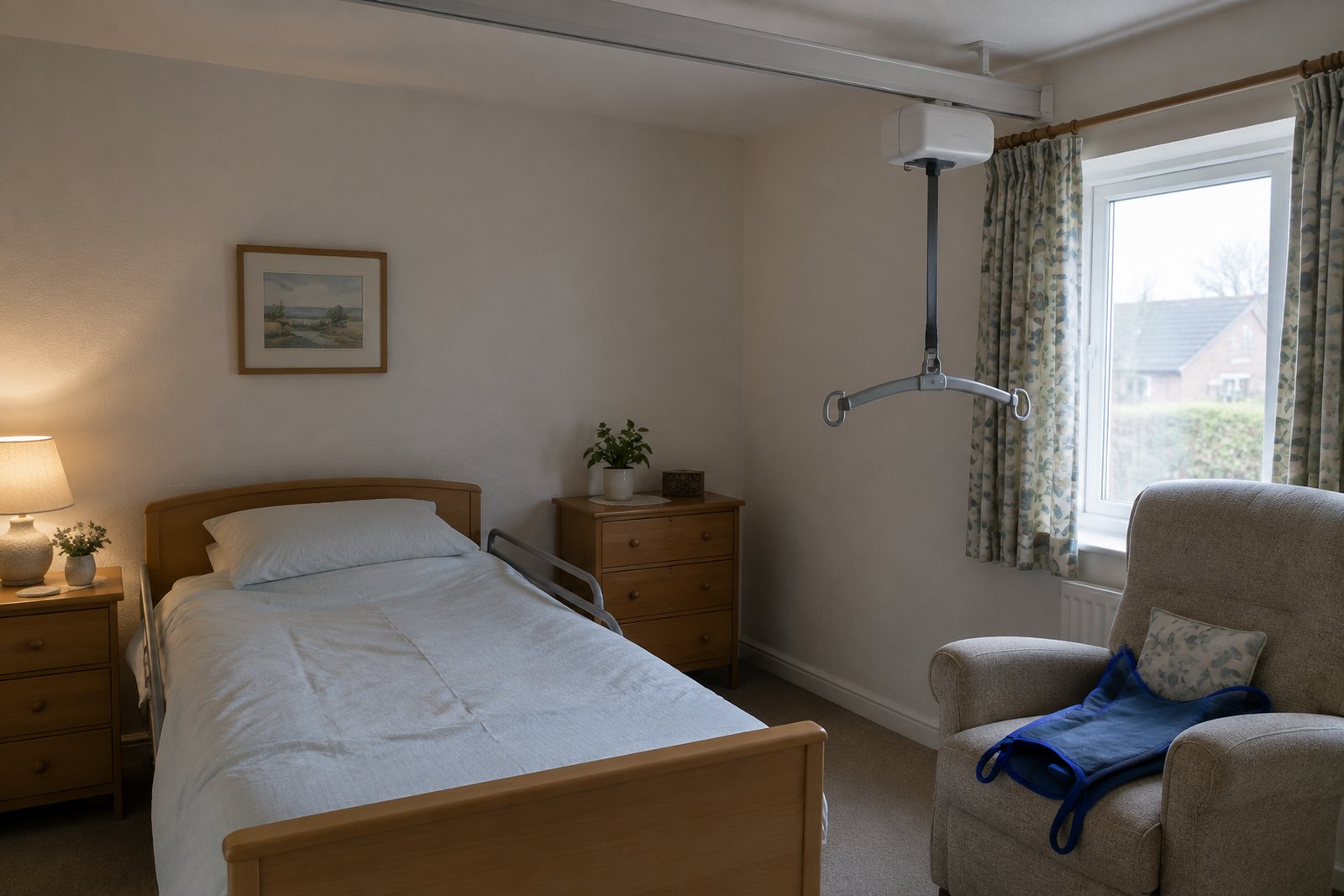
A ceiling hoist is a lifting motor that runs along a track fixed to the ceiling. It lets someone who cannot stand or take weight be lifted in a sling from bed to chair, commode, wheelchair or bath without anyone taking their weight. It helps most when transfers are needed several times a day for the long term, when the room is too small for a mobile hoist, or when pushing a hoist across carpet is wearing out the people doing it.
The things to check are simple to list and harder to get right. The person needs a proper assessment. The ceiling, or a freestanding frame, must be able to take the load. The sling must be the right one for that person and that hoist. Everyone using it needs training. And the hoist needs servicing and examining on schedule. Get those right and a ceiling hoist can make daily care calmer and safer for everyone. Get them wrong and it is an expensive way to have an accident.
How a ceiling track hoist works
The system has a few parts. A rail, usually aluminium, is fixed into the ceiling joists, a steel beam or a frame. A lifting unit (sometimes called the motor or carriage) hangs from the rail and travels along it. A strap or tape comes down from the unit to a spreader bar, and the sling attaches to the spreader bar by loops or clips.
A handset raises and lowers the person. On some systems you push the lifting unit along the track by hand once the person is lifted. On others a motor moves it along at the press of a button, which is easier on the carer's shoulders and back. Most lifting units run on a rechargeable battery, topped up at a charging point on the track.
Ceiling hoist or mobile hoist?
We cover mobile hoists, stand aids and the assessment process in our guide to hoists at home, so here is just the short version of the difference.
A mobile hoist is on wheels. It needs floor space, its legs need to fit under the bed and chair, and pushing it with someone in the sling is hard work, especially on carpet. The person can swing as it moves. A ceiling hoist takes up no floor space, glides along the track and usually gives a smoother ride. The trade-off is that it only goes where the track goes, it costs more, it needs installing, and it cannot come with you to your daughter's house for Christmas. Plenty of households end up with both: a ceiling hoist in the bedroom and a mobile hoist for everywhere else.
Who a ceiling hoist suits
A ceiling hoist is usually worth considering for:
- People who cannot stand or take weight through their legs at all, even with help or a stand aid. This might be because of advanced multiple sclerosis, motor neurone disease, a spinal cord injury, a severe stroke, or towards the end of life.
- People whose needs are long term or expected to increase, so hoisting will be part of daily life for months or years.
- Small bedrooms and bathrooms where a mobile hoist cannot turn or reach.
- Households where transfers happen many times a day and the carers, paid or family, are struggling.
- Children and young people with complex physical disabilities who are getting too heavy to lift, now or soon.
- Some adults with good arm strength and control who can operate the hoist themselves for some transfers, if an assessment shows this is safe.
It may not be the right answer for someone in short-term recovery, for example after a hip fracture, where the goal is to get back on their feet. Hoisting someone who could stand with the right help can take away the practice they need to get stronger. A person who can take some weight might do better with a stand aid or a transfer board. This is exactly what an assessment is for.
The main types of system
Straight and curved tracks
The simplest system is a single straight rail, for example from above the bed to above a chair or commode. A curved track can bend round to reach a second spot. These work well when the person only needs to move between two or three fixed points, but everything has to be directly under the line of the rail.
H-frame systems
An H-frame (sometimes called an X-Y system) has two parallel fixed rails with a third rail running across between them. The cross rail slides along the fixed rails, and the lifting unit slides along the cross rail, so the hoist can reach almost any point in the rectangle the frame covers. This gives far more flexibility. You can reposition the bed, reach both sides of it, or move the wheelchair without having to line everything up under one rail.
Room-to-room systems
Many people need to get from the bedroom to the bathroom. A room-to-room system lets the track continue through a doorway. Usually this means the section of wall above the door is opened up to ceiling height so the rail can pass through. Some systems use a gate or transfer unit so two separate tracks can be linked, and some allow the lifting unit to be handed from one track to another. Room-to-room tracks can make a big difference to dignity and to the carer's workload, but they often involve more building work.
Freestanding gantries
A gantry is a frame on legs with a track across the top, so nothing is fixed to the ceiling. It can be useful in a rented home, where the ceiling is unsuitable, while waiting for a permanent installation, or for short-term needs. Gantries take up some floor space and cover a smaller area, and they must be put together and checked by someone competent.
Structural checks and installation
A ceiling hoist carries a person's full weight, plus the moving forces of lifting and travelling. The fixings matter as much as the hoist.
- A proper survey. Before anything is quoted, the installer should check which way the joists run, their size and condition, and whether there is loft access to fix into them. Some homes need a steel beam, wall-mounted posts or a freestanding frame instead.
- Ceilings that need extra thought. Suspended ceilings, old lath and plaster, concrete ceilings in flats and newer buildings with engineered joists all need the right approach. A responsible installer will tell you if your ceiling is not suitable rather than making it fit.
- Older textured ceilings. Some older textured ceiling coatings can contain asbestos. An installer should ask about this before drilling, and you should mention it if you know or suspect it.
- Doorways. Opening up the wall above a door can be structural work. Depending on what is involved, building regulations may apply, so ask the installer who is responsible for that.
- Rented homes. You will need your landlord's permission. Councils and housing associations have their own processes for adaptations, so ask them early.
Plan the layout before anyone drills. The track needs to reach over the middle of the bed, the chair, the commode or toilet and the wheelchair position. Think ahead too. Will a profiling bed arrive later? Will needs change if a condition progresses? Moving a track afterwards is far harder than getting it right first time.
Once it is installed, ask for evidence that the system has been checked before first use, a written handover, the user manual, and details of who to call if it breaks down.
Paying for a ceiling hoist
Funding depends on where you live and on the person's circumstances. In general terms:
- Council adult social care (or children's services) can assess needs and may provide a hoist. Some councils treat ceiling hoists as equipment, others as an adaptation, so the route varies.
- A Disabled Facilities Grant is available in England, Wales and Northern Ireland for adaptations, and a ceiling hoist often qualifies. Grants for adults are usually means tested, while in England and Wales applications for a disabled child are not. Maximum amounts differ between the nations and can change, so check GOV.UK or your council for current figures. In Northern Ireland the grant goes through the Housing Executive. Our Disabled Facilities Grant guide explains how an occupational therapy assessment fits into the application.
- In Scotland there is no Disabled Facilities Grant. Councils provide help with adaptations under their own schemes, and some equipment comes through social work services. Ask your council what applies.
- Buying privately. If you are buying for a disabled person's own use, the hoist and its installation may qualify for VAT relief. See our guide to VAT relief on disability equipment.
Whoever pays, get more than one quote and ask exactly what is included: survey, building work, slings, training, the first thorough examination, servicing, and the warranty.
Slings and training
The sling is not an accessory. It is the part that actually holds the person, and the wrong one is a common cause of hoisting injuries.
- The sling should be assessed for the person. There are different types for general transfers, toileting, bathing, full head support and people with amputations, and they come in sizes. The right choice depends on the person's body, posture, skin and what the transfer is for.
- It must match the hoist. Slings attach by loops or clips and are designed for particular spreader bars. Only use a sling with a hoist if the manufacturer confirms they are compatible.
- Check it every time. Look for fraying, damaged stitching, worn loops and a readable label showing the size and safe working load. If in doubt, do not use it.
- Keep it personal. Ideally each person has their own slings. Wash them as the label says, because some cleaning methods weaken the fabric.
Everyone who uses the hoist, family included, should be trained on that hoist with that sling before doing it for real. That means learning how to fit the sling, how to position the person, where the emergency stop and emergency lowering controls are, and what to do if something goes wrong. Our guide to safe moving and handling for family carers covers the wider principles.
Whether one or two people are needed for each transfer should be decided by a risk assessment and written down, not guessed. A ceiling hoist sometimes makes single-carer transfers possible, but not always.
And the basics: never use a hoist you have not been shown how to use, never swap in a sling that has not been assessed for that person, and never leave someone hanging in a sling unattended.
Servicing and thorough examination
Two different things are needed: servicing, which is routine maintenance, and thorough examination, which is a detailed safety inspection by a competent person who then writes a report.
When a hoist is used by people at work, such as care agency staff, the Lifting Operations and Lifting Equipment Regulations 1998 (LOLER) apply. In general terms, equipment used for lifting people must be thoroughly examined after installation and before first use, and then at least every six months, unless a written examination scheme sets a different interval. This includes the slings. It should also be examined after anything that could affect its safety. The organisation providing the equipment or employing the carers has duties here. The HSE website explains the details.
If only family members use the hoist, LOLER may not apply in the same way, but the same checks are just as sensible. A person in a sling does not care who the regulations cover. If you employ a personal assistant directly, you may have responsibilities as an employer, so check the HSE guidance or ask your council's direct payments support service.
Keep the reports somewhere easy to find. If the council provided the hoist, it or its contractor usually arranges examinations and repairs, so make sure you know who to ring and that they have your up-to-date contact details.
Power cuts, batteries and breakdowns
Because most ceiling hoists run on a battery, a power cut does not usually stop a lift that is already happening. But a battery that has been left off charge can.
- Park it on charge. After each use, return the lifting unit to the charging point, unless your system charges anywhere along the track.
- Know the warnings. Learn what the low-battery light or beep looks and sounds like, and act on it.
- Find out how many lifts a full charge gives. It varies between models, so check the manual and plan for a power cut lasting a day.
- Learn the emergency lowering. Most hoists have a way of lowering someone safely if the motor or battery fails. Ask the installer to show you, and practise it.
- Have a plan B. Know who to call for urgent repairs, and think about how the person would be cared for if the hoist were out of action for a day or two.
- Tell your energy supplier. Households that rely on powered medical equipment can usually join their energy supplier's Priority Services Register, which can mean warnings about planned power cuts and extra support during outages.
If someone is stuck in the sling and you cannot lower them safely, call the hoist's emergency number. If they are hurt, unwell, struggling to breathe or in danger, call 999.
Where an occupational therapist fits
An occupational therapist is usually the professional who decides whether a ceiling hoist is the right answer at all. They look at how the person moves now, what is likely to change, the layout of the home and who is doing the caring. They can then recommend the type of system, where the track should run, and which slings are needed.
An occupational therapist can also write a report to support a council or grant application, train family members and carers, and review things as needs change. A private occupational therapist visiting at home can often do this sooner than a council waiting list allows, but check with your council first whether it will accept a private report for funding. Some councils will want their own assessment.
Other people have their part too. The installer or a surveyor is responsible for whether the structure is safe. A physiotherapist can advise on positioning and whether rehabilitation could reduce the need for hoisting. District nurses help with pressure care and skin checks. And see the GP if the person's health changes, especially if they become suddenly weaker or more confused.
Frequently asked questions
How much does a ceiling hoist cost?
It varies widely. A single straight track in a room with good joists costs far less than an H-frame or a room-to-room system that needs a steel beam and work above doorways. Slings, servicing and examinations are ongoing costs. Get written quotes from more than one installer after a proper survey.
Can a ceiling hoist be fitted in a rented flat or council house?
Often yes, but you need the landlord's permission first. Councils and housing associations usually have their own process for adaptations. If permanent fixings are not allowed or the ceiling is unsuitable, a freestanding gantry may be an option.
Can one carer use a ceiling hoist alone?
Sometimes. A ceiling hoist can make single-handed transfers possible for some people, but it depends on the person, the sling, the transfer and the carer. The decision should come from a risk assessment and be written into the care plan.
How often does a ceiling hoist need checking?
Where it is used by paid carers, LOLER generally requires a thorough examination at least every six months for equipment that lifts people, including slings, unless an examination scheme says otherwise. Servicing should follow the manufacturer's schedule. Whatever the arrangement, check the hoist and sling yourself before every use.
Can we take the hoist with us if we move?
The lifting unit can usually be moved, and some tracks can be taken down, though they rarely fit a new home exactly. If a grant or the council paid for it, there may be conditions, so ask before you plan to take it.
Can a ceiling hoist reach into a bathroom?
Yes, with a room-to-room system or a separate track in the bathroom. Make sure the hoist is suitable for use in a bathroom, and that the person has a sling designed for bathing or toileting if that is what it will be used for.
Next steps
If you are wondering whether a ceiling hoist is right for your home, start with an assessment of the person and the space before any quotes. See our home adaptations and equipment and aids pages, or current guide prices, and choose your area below.

Talk to an occupational therapist near you
This guide is general information. For advice about your own situation - or someone you look after - a local occupational therapist can visit you at home and see it for themselves.
Choose your area: