

Getting Up From a Chair: Easier Ways and the Right Chair Height
By Mobile Occupational Therapist • 25 October 2026 • 13 min read
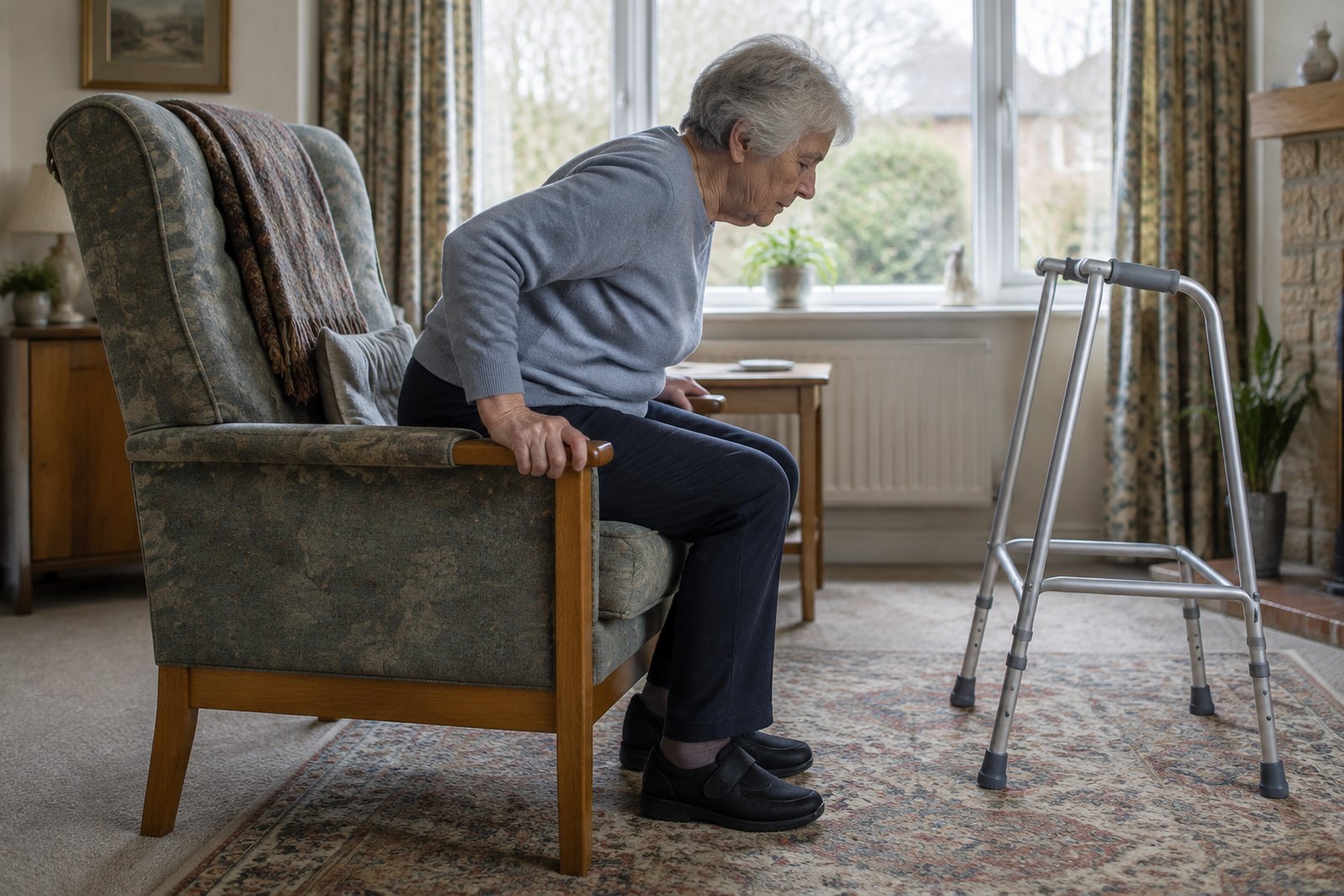
If getting up from a chair has become a struggle, for you or for someone you look after, three things are usually involved: the technique, the chair and leg strength. The technique is the quickest fix. Shuffle to the front of the seat, put your feet back and slightly apart, lean forward until your nose is over your toes, push down on the armrests and stand up. Then pause for a moment before you walk anywhere.
The chair matters almost as much. A seat that is too low, too soft or too deep makes standing far harder than it needs to be, however strong you are. And if it keeps getting harder over weeks or months, that is worth mentioning to a GP, because it is linked to a higher risk of falls and there is often something that can be done about it. The rest of this page goes through each of these in practical detail.
Why standing up gets harder
Standing up from sitting looks simple. It is actually one of the more demanding things we do in a day. You have to move your weight forward over your feet, then straighten your hips and knees against gravity, while keeping your balance as your body changes shape. Most people do it without thinking dozens of times a day.
With age, illness or a spell in bed, a few things tend to slip at once. The big muscles at the front of the thighs and in the buttocks get weaker. Hips and knees may be stiff or painful. Balance can become less reliable. And people often develop a habit of leaning back and trying to push straight up, which is the hardest possible way to do it.
The result is the familiar picture: several attempts, rocking, a hand on the coffee table, sometimes a thump back down into the seat. None of that is a reason to give up. It is a reason to look at how you stand, what you are standing from, and how strong your legs are.
How to get up from a chair: the steps
This is the method physiotherapists and occupational therapists teach most often. Read it through, then try it slowly.
- Shuffle forward. Move your bottom towards the front edge of the seat. Do it one buttock at a time if that is easier, rocking gently side to side. You cannot stand well from the back of a chair.
- Feet back and apart. Bring your feet back so they are slightly behind your knees, flat on the floor, about hip width apart. If one leg is stronger, put that foot a little further back.
- Hands on the armrests. Place your hands at the front of the armrests. If the chair has no arms, put your hands on the edge of the seat beside you.
- Nose over toes. Lean well forward from the hips until your nose is roughly over your toes. This is the bit most people skip. Your weight needs to be over your feet before your legs can lift you.
- Push and stand. Push down through your hands and your feet at the same time and straighten up. Some people find counting helps: lean forward on one, two, and stand on three.
- Stand and pause. Once you are up, stand still for a few seconds. Let your balance settle and check you do not feel dizzy. Then reach for your walking aid, if you use one, and set off.
One important point: do not pull yourself up on a walking frame. Frames tip. Push up from the chair, stand, then put your hands on the frame.
Sitting down again safely
Sitting down is the reverse, and it is where a lot of bumps and falls happen. Walk right up to the chair, turn round until you feel the seat against the backs of both legs, reach back for both armrests one at a time, then lean forward a little and lower yourself slowly. Avoid the drop. If you find you can only sit down by landing heavily, that is a sign the chair is too low or your legs need some work.
Why low, soft chairs make it so much harder
A low chair puts your hips below your knees. From that position your thigh muscles have to work at their weakest angle, and you have further to travel to get upright. A soft seat or sagging cushion makes it worse: you sink in, your bottom is lower still, and there is nothing firm to push from.
Deep seats are the other culprit. Many sofas and armchairs are designed for lounging, so when you sit right back your feet barely reach the floor and you cannot get your weight forward. Armrests that are set back, low or soft give you nothing useful to push on. Put those together, which many comfortable living room chairs do, and even a fairly strong person will struggle.
This is why someone can stand perfectly well from a firm dining chair but get stuck in their favourite armchair. It is not always about strength. Often it is the furniture.
Choosing the right chair
There is no single correct chair height in numbers, because it depends on the length of your lower legs. What you are looking for, when you sit right back in the chair, is this:
- Feet flat on the floor, without the front of the seat pressing into the back of your thighs.
- Hips level with your knees or slightly higher. If your knees are noticeably higher than your hips, the seat is too low for you.
- A seat depth that fits. With your back against the backrest, there should be a small gap between the front of the seat and the backs of your knees.
- Firm cushions that do not sink a long way when you sit down.
- Sturdy armrests that come forward to roughly the front of the seat, at a height where you can push down comfortably.
- A stable chair that does not tip or slide when you lean on the arms. Chairs on castors or swivel bases are generally best avoided for anyone who is unsteady.
Our guide to choosing the right chair goes through seat height, width, depth and back support in more detail, including what to check in a shop.
You may not need a new chair at all. A chair you already like can often be brought up to the right height with chair raisers, which fit under the legs or base. They need to be the right type for the chair and fitted properly, which our guide to chair raisers and furniture raisers explains. A firm cushion can add a little height but can also slide, so treat that as a short-term fix rather than an answer.
Riser recliners, which tilt and lift you towards standing at the press of a button, can help people who genuinely cannot stand from an ordinary chair, but they are expensive, they do not suit everyone and relying on one can mean your legs do less work, so it is worth getting advice before buying.
Practising sit to stand to build strength
The sit to stand movement is also one of the best leg strengthening exercises there is, and it is one that NHS strength exercise guidance for older people includes. Practising it regularly can make the real thing easier.
Do it safely:
- Use a firm chair with arms, pushed back against a wall so it cannot slide.
- Wear supportive shoes, not loose slippers or socks.
- Have something sturdy in front of you, such as a kitchen worktop, or someone nearby, in case you feel unsteady.
- Use the steps above: shuffle forward, feet back, nose over toes, stand, pause, then sit down slowly and with control.
- Start with a few repetitions and build up gradually over the weeks. Slow and controlled is better than fast.
- As you get stronger, try using your hands less, or folding your arms across your chest. Only progress when the easier version feels steady.
Stop if you feel dizzy, short of breath, or have chest pain or new joint pain. If you have had recent hip, knee or back surgery, follow the exercises your surgical team or physiotherapist gave you rather than starting new ones.
A physiotherapist can set exercises at the right level for you and add balance work. Strength on its own helps, but strength and balance together is what reduces falls.
Helping someone stand without pulling their arms
If you care for someone, your instinct when they are stuck is to take their hands and pull. Please do not. Pulling on someone's arms can injure their shoulders, especially if they are frail, have had a stroke or have arthritis. It also pulls their weight backwards, which is the opposite of what they need. And it puts your own back at real risk.
What helps instead:
- Talk them through it. Clear, calm prompts are often all that is needed. "Bottom forward. Feet back. Hands on the arms. Lean forward. Ready, steady, stand."
- Give them time. Rushing makes people tense and lean back.
- Check the set-up first. Shoes on, feet flat, walking aid within reach but not in front of them to pull on.
- Stand to the side, slightly in front, rather than directly in front where you block them leaning forward. A light guiding hand on their lower back or hip can help them move forward and up.
- A gentle rock. Rocking forward and back a couple of times before "stand" can give some momentum.
What not to do
- Do not pull on arms, hands or clothing.
- Do not let them put their arms around your neck.
- Do not lift them. If they cannot take most of their own weight, you are no longer helping them stand, you are lifting a person.
Our guide to safe moving and handling for family carers covers this in more depth.
When helping is no longer safe
If they need a lot of physical help every time, or you are hurting your back, things have changed and you need a proper assessment. There is equipment designed for exactly this, from frames that give a stable thing to push up on to stand aids and hoists, but it must be chosen and taught by someone qualified. Ask your GP or council adult social care for an assessment, or get a private one.
When it is getting harder: GP, physio and falls
A gradual change over months is common, but it is not something you simply have to accept. See your GP if:
- standing up has become steadily harder and you are not sure why
- you feel dizzy, light-headed or faint when you stand up
- pain in your hips, knees or back is stopping you
- you have had a fall, or nearly fallen, getting up or sitting down
- it started after a change in your medicines (tell your GP or pharmacist; do not stop anything on your own)
Your GP can look for treatable causes and refer you to physiotherapy or a local falls service. A physiotherapist leads on strength, balance and walking. An occupational therapist leads on how you manage everyday tasks at home and the chairs, beds, toilets and equipment you use.
Get help urgently if things change suddenly. If someone suddenly cannot stand, or has new weakness in an arm or leg, a drooping face or slurred speech, call 999, as these can be signs of a stroke. If they have become suddenly much weaker, confused or unwell over a day or two, call NHS 111 or their GP the same day. Infections are a common cause of sudden decline in older people.
Difficulty getting out of a chair also goes hand in hand with falls. Our guide to preventing falls at home covers the other changes worth making.
Where an occupational therapist fits
An occupational therapist looks at the whole picture: you, the chair, the room and the way you actually move through your day. On a home visit they can watch you stand from the chairs you really use, measure what height would suit you, and suggest whether raisers, a different chair or a small change in technique will solve it. They can do the same for the bed, toilet and bath, which often cause the same problem.
For carers, an occupational therapist can show you how to prompt and guide safely, and judge whether equipment such as a stand aid is needed. They can also write a report if you are applying for council help or adaptations.
What they do not do is replace a GP when something medical is going on, or a physiotherapist for a structured strength and balance programme. Often the best outcome comes from both. You can get an occupational therapist through council adult social care or the NHS, or privately if you prefer.
Frequently asked questions
What is the right chair height for an elderly person?
It depends on leg length, so there is no single figure. As a guide, when sitting right back their feet should be flat on the floor and their hips level with or slightly above their knees. If their knees are higher than their hips, the chair is probably too low.
Is a chair with arms better?
For most people who find standing hard, yes. Firm armrests that reach to the front of the seat give something to push on. Without them, people tend to grab furniture or walking frames, which is less safe.
Should we buy a riser recliner?
Sometimes they are the right answer, but not always. They are costly, take up space and can reduce how much the legs are used. Try the technique, a firmer chair or chair raisers first, and get advice from an occupational therapist before buying.
Why does mum feel dizzy when she stands up?
Dizziness on standing can have several causes, including a drop in blood pressure, dehydration or medicines. Encourage her to pause after standing before she walks, and mention it to her GP. If she has chest pain, faints and does not come round quickly, or has trouble breathing, call 999. If she seems suddenly unwell in another way, call NHS 111 or her GP the same day.
How often should I practise sit to stand?
Little and often works well, but the right amount depends on your health. Start with a few slow repetitions and build up gradually. A physiotherapist can set a programme that suits you, especially after surgery or with heart or lung conditions.
Can I get chair raisers free?
Sometimes. Councils and community equipment services may provide some items after an assessment, depending on your needs and local arrangements. Contact your council adult social care team to ask.
Next steps
If standing from a chair is getting harder at home, see our independence for older people page, or current guide prices, and choose your area below.
Talk to an occupational therapist near you
This guide is general information. For advice about your own situation - or someone you look after - a local occupational therapist can visit you at home and see it for themselves.
Choose your area: