

Gardening With Arthritis or Limited Mobility: Keep Growing
By Mobile Occupational Therapist • 4 November 2026 • 15 min read
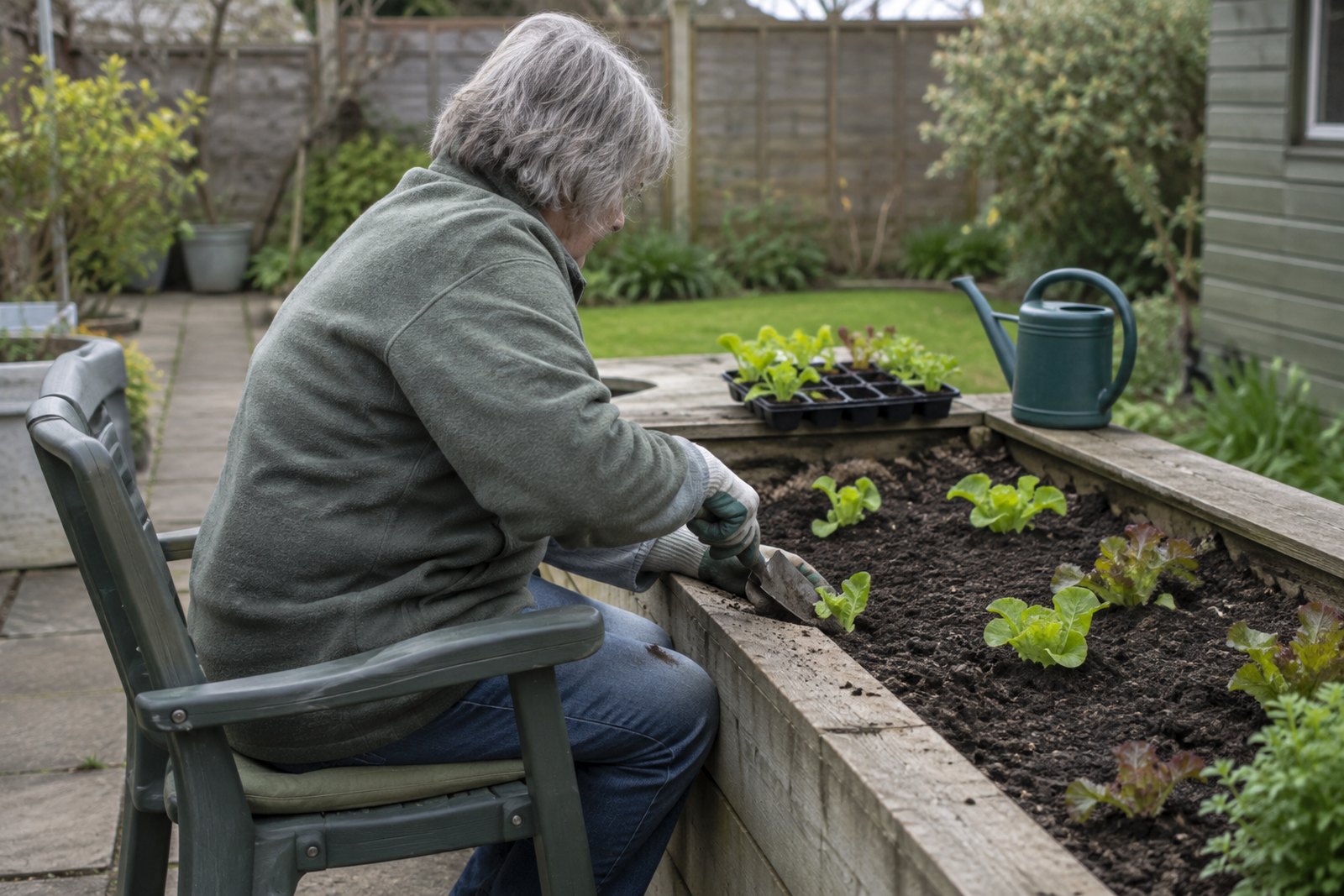
Yes, you can keep gardening with arthritis, a long-term condition or limited mobility. Most people who stop do so not because they can no longer garden, but because the way they used to garden no longer works. Kneeling for an hour, hauling full watering cans, digging a whole bed in one afternoon. Change the height, the tools and the pace, and a surprising amount of what you love comes back.
The short version: bring the soil up to you with raised beds and containers, use lighter and longer tools with thicker grips, sit down more, keep paths firm and level, and plan the work in short sessions rather than one heroic push. The rest of this page goes through each of those in practical detail, along with gardening from a wheelchair, staying safe in the heat, and where an occupational therapist can help.
Why it is worth the effort
Gardening is rarely just about plants. It gets you outside and into daylight. It gives the day a shape and the week something to look forward to. It moves your joints gently, in a way that does not feel like exercise. It is a reason to chat over the fence, swap cuttings and keep an eye on the weather. The national gardening charity Thrive has built its whole work around the idea that gardening supports health and wellbeing for disabled people and people with long-term conditions, and anyone who has felt better after an hour pottering among pots will not need persuading.
When someone gives up the garden, they often lose more than the borders. So it is worth fighting for, even if the garden has to change. Smaller, higher, simpler and closer to the back door is not failure. It is how you keep doing it for years rather than months.
Pacing: the most useful tool you will not find in the shed
The classic pattern with arthritis and other painful or tiring conditions is boom and bust. A sunny morning, you feel good, you do everything. Then you pay for it for three days. Pacing breaks that cycle. It is dull advice and it works.
- Decide what you will do before you go out, and stop when it is done, even if you feel fine. Especially if you feel fine.
- Work in short sessions with proper breaks. A kitchen timer or phone alarm stops you losing track of time with your hands in the soil.
- Swap positions and tasks. Weed seated for a while, then pot up standing at a table, then walk round deadheading. Holding one position for a long time is usually what stiffens joints.
- Match jobs to your best time of day. Many people with arthritis are stiff first thing and better by late morning. Others tire by afternoon. Do the harder jobs in your good window.
- Warm up first. A few minutes of gentle movement indoors before you start is kinder than going straight into pruning.
- Stop before it hurts, not after. Pain that builds during a task is a signal to change something, not to finish quickly.
If fatigue rather than pain is your main problem, our guide to fatigue management and pacing goes into the method in more depth.
Plan the year, not just the day
Gardens have rush seasons, and spring is the worst. Write a list of jobs for the season and spread them out. Then be honest about which jobs are heavy, one-off and not much fun: cutting a tall hedge, turning a compost heap, shifting bags of compost, clearing a neglected corner. Those are the ones to hand to family, a neighbour, a local volunteer scheme or a paid gardener, so your energy goes on the parts you actually enjoy. Sowing seeds and potting on are far more satisfying than lugging rubble.
Bring the garden up to you: raised beds and containers
Bending and kneeling are what most people with arthritis, back problems or poor balance find hardest. Raising the growing area solves a lot of that in one go.
Getting the height right
There is no single correct height, because people and bodies differ. Test it instead. Stand, or sit on the seat you will actually use, and reach forward as if you were weeding. You want to work with your back fairly straight, shoulders relaxed and elbows slightly bent, without stooping or reaching up. For standing work, the top of the bed is usually somewhere around the height where your hands rest comfortably. For seated work it needs to be lower.
Width matters as much as height. You should be able to reach the middle of the bed without leaning far or twisting. A bed you can get to from both sides can be wider. One against a wall or fence needs to be narrower. A wide, flat top edge is useful as somewhere to perch, lean or rest a tray of seedlings.
Practical points on building and filling
- Rounded or smoothed corners are kinder to hips and hands than sharp edges.
- Deep beds take a lot of filling. Many people put coarser material in the bottom so less compost is needed, and have bulk compost delivered as close to the bed as possible.
- Leave enough space around beds for a walking aid, stool or wheelchair to get alongside.
Containers, troughs and stands
- Pots on stands, tables or shelves bring plants to a comfortable height without building anything.
- Troughs on legs are good for herbs, salad leaves and strawberries.
- Hanging baskets on a lowering bracket or pulley can be brought down to water and deadhead, then raised again.
- Wall-mounted planters at chest or eye height suit people who cannot bend at all.
- Wheeled pot stands let you move larger pots around, but put the stand in place before you fill the pot.
Containers dry out fast in summer, so group them near the tap or water butt. Fewer, larger pots need less frequent watering than lots of small ones, and self-watering containers with a built-in reservoir can cut the job down further.
Kneelers, seats and getting down safely
Kneelers with handles
A garden kneeler is a light folding frame with a padded kneeling pad and a tall handle on each side. You kneel on the pad and push down on the handles to get back up. Turn it over and it becomes a low seat. For people who can still kneel but struggle to rise, it can make a big difference.
Use it on firm, level ground. Push down through the handles rather than pulling on them, and check it does not tip as you rise. If you cannot get up from kneeling without a real struggle, even with the handles, garden seated or at height instead.
Seats and stools
- A garden stool or perching stool lets you work at a low bed or bench without bending double. One with arms is easier to get up from.
- A seat on wheels that you shuffle along a row can save a lot of getting up and down, but the wheels can roll away as you stand. Only use one on a firm, level surface, and steady yourself on something fixed before rising.
- Benches or chairs placed around the garden act as rest stops, so a trip to the far end does not have to be done in one go.
If you have a kneeling pad without handles, keep something solid nearby, such as the edge of a raised bed or a sturdy garden chair, to help you up.
Tools that do more of the work
Long-handled and lightweight tools
Long-handled trowels, forks, hoes, weeders and cultivators let you work at ground level while standing or sitting. Telescopic handles can be set to suit you. Long-reach pruners and snips help with plants that are up high or at the back of a border, and a grabber is handy for picking up weeds and rubbish without bending.
Look for handles made from lighter materials, and remember that a long handle magnifies the weight of the head at the end. A tool that feels fine in the shop can feel heavy after twenty minutes. Try before you buy if you possibly can.
Grips that are kinder to your hands
- Thick, padded grips spread the pressure and mean you do not have to clench so hard. Foam tubing slipped over existing handles does the same job cheaply.
- Add-on second handles, clipped partway down a spade or rake, let you use both hands and keep your wrists straighter.
- Arm-support cuffs fixed to a tool let your forearm take some of the load instead of your wrist and fingers.
- Ratchet secateurs cut in stages, so they need much less grip strength. Spring-opening snips save you prising the blades apart.
- Gloves with padded palms protect skin and soften the grip.
The same principles apply in the garden as indoors: use bigger joints, avoid tight pinching and twisting, and let leverage do the work. Our guide to arthritis and joint protection for your hands covers this in more detail.
Watering without carrying
A full watering can is heavy. Use smaller cans filled more often, or a lightweight hose on a reel with a trigger that locks on so you are not squeezing the whole time. A long spray wand reaches hanging baskets and the backs of beds. Soaker hoses or simple drip systems on a timer can take watering off your list altogether. A water butt raised on a stand means you can fill a can without bending.
Carrying and moving things
A garden trolley, a two-wheeled barrow (more stable than one wheel), or a bag on wheels saves your back and hands. Buy compost in smaller bags, or have it delivered to where it is needed. One firm rule: a walking aid is for walking. Do not hang heavy bags on a rollator or push a barrow while relying on it for balance.
Paths, steps and level access
A lovely garden you cannot get round safely is not much use. Loose gravel is hard work with a stick or frame and very hard in a wheelchair. Paths should be firm, even and non-slip, and wide enough for whatever you use to get about.
- Clean moss and algae off paving and decking, which become slippery when damp.
- Fix lifted slabs and loose edging.
- Keep hoses on a reel, not across the path.
- Add a handrail beside garden steps, or replace a step with a gentle slope if there is room.
- Outdoor lighting helps if you are out at dusk.
Often the hardest bit is simply getting out of the back door. A high threshold or a single step down can be the thing that keeps someone indoors. Our guide to ramps, rails and thresholds explains the options.
Lower-maintenance planting, in general terms
You do not have to turn the garden into gravel and conifers. A few general principles make it far less demanding:
- Favour shrubs and hardy perennials that come back each year over bedding that has to be replanted.
- Use ground cover plants and a thick layer of mulch to keep weeds down.
- Avoid plants that need staking, frequent deadheading or constant cutting back.
- Keep thorny and prickly plants away from paths and seats.
- Put herbs and things you pick often close to the back door.
- Shrink the lawn, or give it a hard edge so you are not trimming by hand.
Local garden centre staff and gardening clubs are often good on what grows well with little fuss in your area and soil.
Gardening from a wheelchair
Most of the above applies, with a few extra points:
- Table-style planters with knee space underneath let you roll right up and work facing forward. Without knee space you will be working side-on, which means more twisting, so keep those beds narrow.
- Keep things in your comfortable reach range, roughly between knee and shoulder height when seated. Very low and very high both cause strain.
- Paths need turning space at ends and junctions, not just width.
- Raised watering points, such as a tap or water butt at seat height, save a lot of awkward reaching.
- A bag or tool belt on the chair keeps tools to hand. Long-handled tools extend your reach.
- Greenhouses and sheds need a level threshold, a wide enough door and staging at a workable height.
Always put the brakes on before leaning forward or reaching, and if you transfer onto a garden seat, make sure it is stable and at a sensible height.
Sun, heat and other safety basics
- In summer, garden early or in the evening. The NHS advises keeping to shade between 11am and 3pm on hot days.
- Wear a hat, cover up and use sunscreen.
- Take water out with you and drink regularly, even if you are not thirsty.
- Some medicines and health conditions make people more sensitive to sun or heat. Your pharmacist or GP can tell you if yours do.
- Signs of heat exhaustion include headache, dizziness, feeling sick, cramps and heavy sweating. Get somewhere cool, drink water and rest. If you or someone else is still unwell after about 30 minutes, is confused, has a fit or loses consciousness, call 999.
- Wear gloves. If you get a deep or dirty cut from soil, call NHS 111 or speak to your GP practice if you are not sure your tetanus protection is up to date.
- Carry a phone or wear a personal alarm if you garden alone.
For your joints, see your GP if pain in the garden is new and does not settle, or keeps getting worse. A joint that suddenly becomes hot, red and swollen, especially if you feel feverish or unwell, needs same-day advice from NHS 111 or your GP.
Where an occupational therapist fits
An occupational therapist looks at what you want to do and what is getting in the way. In the garden, a private occupational therapist visiting at home can watch you work and suggest practical changes: the right height for a bed or bench, which tool types suit your hands, how to get up and down more safely, how to pace a gardening session, and what would make the back door and paths easier. They can also suggest equipment types to try and, where it helps, write a report to support adaptations.
They are not a garden designer or a landscaper, and they will not build anything. A physiotherapist leads on exercise programmes for strength, balance and recovery after joint surgery. Your GP or rheumatology team deals with diagnosis, flares and medication. Council occupational therapy services tend to focus on essential safety and access, so help for the garden itself may not be a priority for them. If arthritis affects more than the garden, our arthritis page explains how occupational therapy can help with daily life more widely.
Frequently asked questions
What is the best height for a raised bed if I have arthritis?
The one that lets you work without stooping or reaching up. Stand or sit as you will when gardening and reach forward: you want a fairly straight back and slightly bent elbows. Try mocking it up with boxes or a table before you build.
Is gardening good for arthritis or does it make it worse?
Staying active is generally good for arthritis, and gardening is a pleasant way to do it. Problems usually come from long spells in one position, heavy lifting and overdoing it on a good day. Pace yourself, change positions and use tools that protect your joints.
How can I keep gardening if I can no longer kneel?
Raise the growing area with beds, troughs and pots on stands, and use long-handled tools for anything at ground level. A garden stool or perching stool lets you work at lower beds. Plenty of people garden happily without ever kneeling again.
What helps if my grip is weak?
Thick padded grips or foam tubing over handles, ratchet secateurs, spring-opening snips, add-on second handles and arm-support cuffs all reduce the strength needed. Padded gloves help too.
Can I get help paying for garden changes?
Grants such as the Disabled Facilities Grant are aimed at essential access and facilities rather than planting features. Ask your council whether safe access to and from the garden could be considered. Some equipment for disabled people may qualify for VAT relief; check GOV.UK for the current rules.
Should I give up the garden and move somewhere smaller?
Not necessarily. Many people simply make the garden smaller and easier: a patio of raised beds and pots near the back door can give most of the pleasure with a fraction of the work. If you are thinking of moving anyway, a manageable outdoor space is worth putting on your list.
Next steps
If you would like someone to look at your garden, your tools and how you get in and out, an occupational therapist can help you keep growing safely. See our equipment and daily living aids page, or current guide prices, and choose your area below.

Talk to an occupational therapist near you
This guide is general information. For advice about your own situation - or someone you look after - a local occupational therapist can visit you at home and see it for themselves.
Choose your area: