

Discharge to Assess: What It Means When the Hospital Says It
By Mobile Occupational Therapist • 17 September 2026 • 7 min read
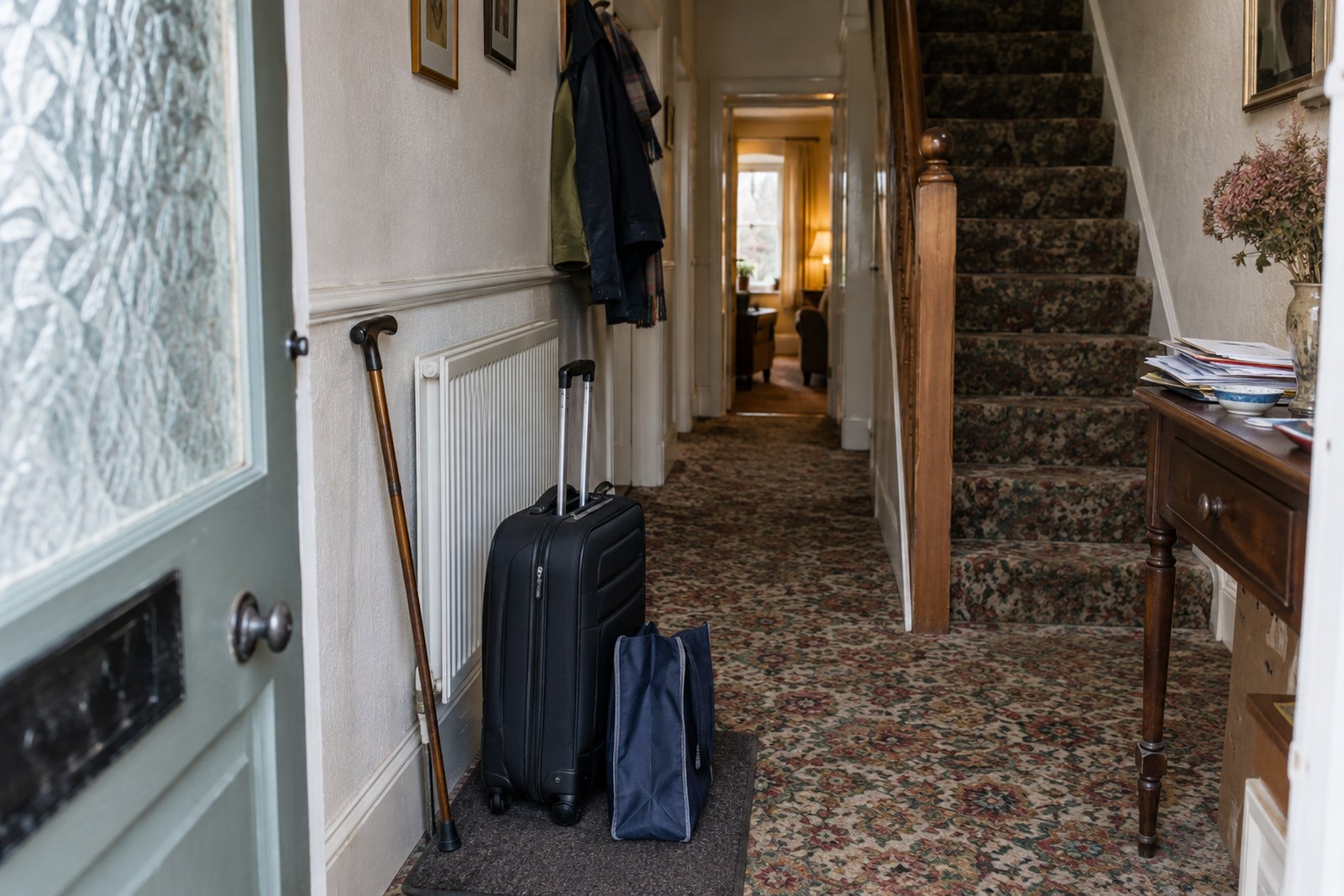
"We're going to discharge to assess." It is said briskly, usually by someone with a folder, and it often lands as though a decision has been taken to send a frail person home before anyone has worked out whether home is safe.
That is not what it means, though the wording does it no favours. Discharge to Assess means the assessment of what someone needs at home is done at home, rather than on a ward. You may also hear it called Home First, or D2A, or a pathway with a number attached to it.
Why hospitals do it this way
Two reasons, and both are genuinely in the patient's interest more often than not.
A ward is a terrible place to judge what someone can do at home. Everything is at the wrong height, there are handrails everywhere, the floor is flat and smooth, and there are no stairs, no bath, no kettle, no back step and no cat. A person who looks dependent on a ward is sometimes entirely capable in their own kitchen, and - the other way round - someone who manages the ward corridor can be stuck the moment they meet their own staircase.
Staying in hospital does active harm once the medical need has passed. Muscle is lost quickly at rest, particularly in older people. Sleep is poor, appetite drops, confusion is common and hospital infections are real. Getting someone out once they are medically ready is not cost-cutting dressed up as policy; the deconditioning is measurable.
So the model is: get the person home, then assess them where they actually live, with support in place while that happens.
What should be in place on the day
This is the part worth being firm about, because Discharge to Assess done properly is good and Discharge to Assess done as a bed-clearing exercise is not. Before someone goes home you should expect:
- Interim support arranged - usually care visits or a therapy team, starting that day or the next, not "someone will be in touch"
- Any urgent equipment delivered, or a delivery time confirmed. A raised toilet seat and a frame are same-day items in most areas
- A named team and a phone number for the first few days, and clarity on who to ring out of hours
- Medication sorted, with enough to last, and someone clear on who is giving it
- Getting in the front door solved - keys, a key safe, and whether the person can manage their own front step
- A date for the assessment at home, not just an intention
If several of those are missing, the plan is not ready, and saying so is not being difficult. Our family guide to discharge planning covers the wider conversation, and key safes is the small practical thing that holds up more discharges than you would think.
What happens after they are home
Within a few days someone - often an occupational therapist, physiotherapist or social worker - assesses what is needed longer term. That usually leads to one of:
- A short period of free intensive help to get back to independence. See our guide to reablement and intermediate care - free, and usually up to six weeks
- A longer-term care package, which is means-tested
- Equipment and adaptations, with the bigger items needing their own assessment
- Nothing further, because they are managing
The honest weakness of the model is the gap between the two. The interim support is meant to bridge it. When it does not - the visits do not start, or the assessment slips - a family absorbs the difference, and that is the point at which people ring us.
You can disagree with the timing
Being medically fit for discharge is a clinical judgement and it is not really negotiable. Whether the arrangements at home are adequate is a different question entirely, and on that you are entitled to be heard.
If you believe the plan is unsafe: say so to the ward or discharge team, plainly and early, and ask for it to be recorded. Ask specifically what has been arranged for the first 48 hours. If that does not resolve it, the hospital's PALS service exists for exactly this. It is much easier to raise the day before than the hour of.
What does not usually work is refusing to collect someone. It rarely improves the arrangements and it can sour the relationship with the team you need on side.
Where a private occupational therapist fits
Not to duplicate the NHS assessment. If a community OT is coming on Thursday, wait for Thursday.
Where families do use one:
- Before discharge, to get the house ready when the hospital cannot send anyone out first and the discharge is moving quickly
- In the gap, when interim support has not materialised and nobody can say when the assessment will happen
- Afterwards, for the things that were not finished - which is most often bathing, stairs and getting out of the house
- For a written opinion, when a decision is being made about whether home is still viable and you want it assessed properly rather than argued about
A private OT can usually visit within days, and the assessment is the same kind of assessment. Our guide to NHS or private occupational therapy sets out the trade-off without pretending private is always better.
Frequently asked questions
Is Discharge to Assess the same as Home First?
Close enough in practice. Home First is the broader principle - that home is the default place to recover and be assessed - and Discharge to Assess is how it is delivered. Different areas favour different words, and some use numbered pathways as well.
Can they discharge someone with dementia this way?
Yes, and it is often better than a longer stay, since unfamiliar surroundings tend to worsen confusion. What matters is that the interim support genuinely accounts for the dementia rather than assuming someone will follow instructions or remember a visit. Say clearly what your relative can and cannot reliably do alone.
Who pays for the support in the meantime?
The short-term intermediate care is free. Any long-term package that follows is means-tested. If you are being asked to pay during what is supposed to be the interim period, ask which of the two you are in.
What if there is nobody at home to help?
Living alone is not a barrier to this pathway, but it does change what has to be arranged - and it should be said explicitly rather than assumed. Make sure the team knows there is no one in the house overnight.
How long until the assessment at home happens?
It varies by area and it should be given to you as a date or a window rather than left open. If it has not happened and nobody can tell you when, chase the named contact you were given, and ask adult social care directly if that fails.
Next steps
If a discharge is coming quickly, or the assessment at home has not arrived and things are not safe in the meantime, an occupational therapy visit can usually be arranged within days. See our hospital discharge support and home assessment pages, or current guide prices, and choose your area below.
Talk to an occupational therapist near you
This guide is general information. For advice about your own situation - or someone you look after - a local occupational therapist can visit you at home and see it for themselves.
Choose your area: