

Dementia Friendly Garden: Ideas for a Safe Space Outdoors
By Mobile Occupational Therapist • 15 October 2026 • 13 min read
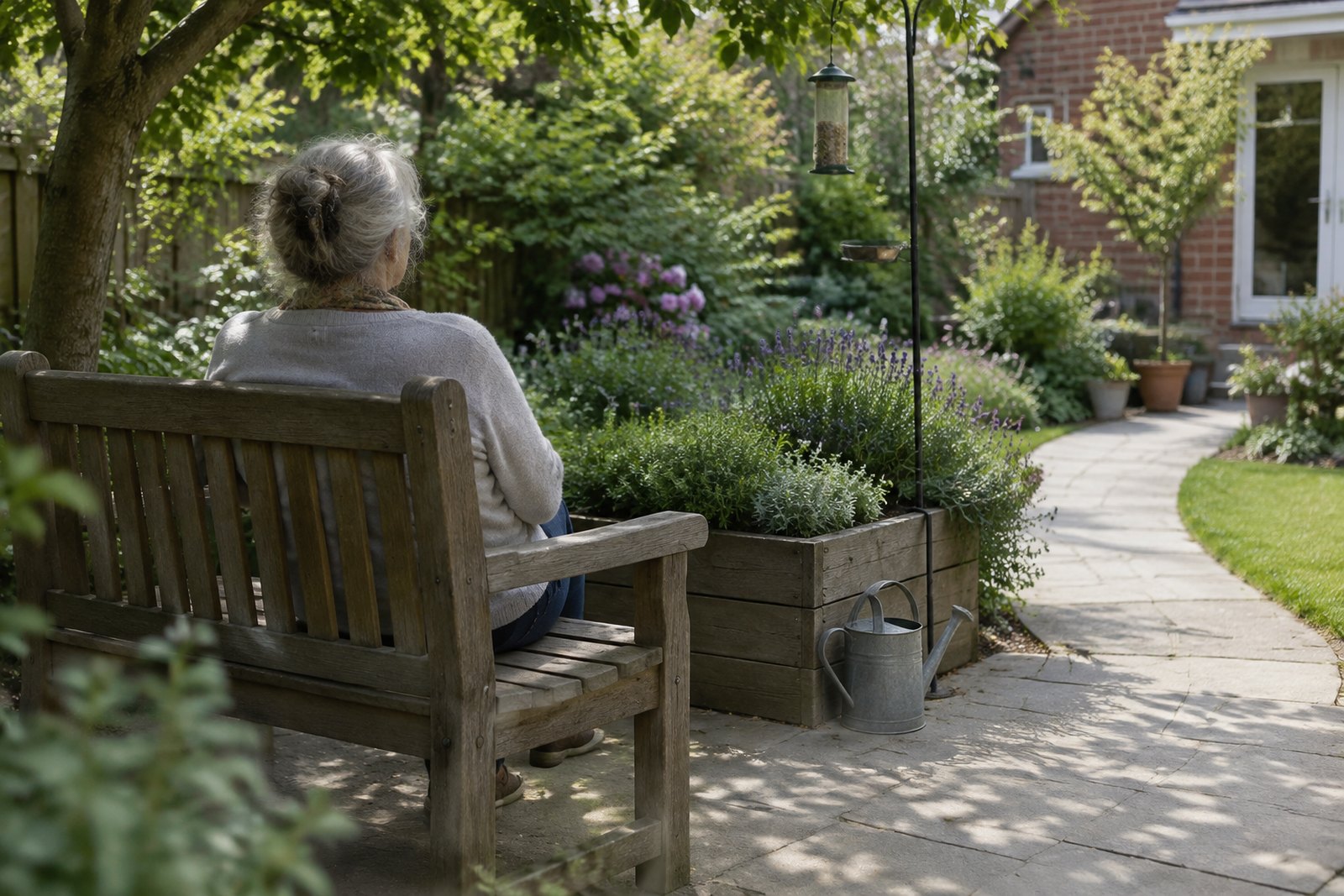
A dementia friendly garden is one a person can get into, walk around, sit in and come back from without getting lost, falling or feeling shut in. In practice that usually means a path that leads back to the house, somewhere comfortable to sit in the shade, plants they recognise, and the obvious hazards dealt with quietly. It does not need to be big, expensive or redesigned by a landscaper. A small yard with a sturdy bench, a bird feeder and a few pots can do the job.
Why bother? Because time outdoors gives daylight, a reason to move, something to do with the hands and a change of scene for both of you. Many families notice that someone who is restless and unsettled indoors is calmer after half an hour pottering outside. This guide covers what to change, what to make safe, how to use the garden through the year, and where an occupational therapist can help.
Why getting outside helps
Light. Our sense of day and night is set largely by daylight. Someone who spends every day indoors can lose that rhythm, which can feed into broken nights and dozing in the day. Getting outside, especially in the morning, is one of the simplest things you can do for sleep.
Movement. A walk round the garden, bending to pull a weed, carrying a watering can: these are all gentle activity that keeps legs and balance working, without anyone calling it exercise.
Mood and purpose. Being useful matters. Watering the tomatoes is a job with a result. Long-practised skills like deadheading or sweeping can stay with people for a long time, even when newer memories are going, so the garden can be a place where they still feel capable.
Memory and conversation. The smell of cut grass, a rose like the one they grew, the sound of a blackbird. These can spark a memory or a chat in a way that questions indoors often do not.
Start with the view from the window
The garden begins indoors. If someone cannot see it, they will not think to go out. Put a favourite chair where it looks onto the garden. Hang a bird feeder or plant something colourful in direct view. Make the door to the garden easy to find and easy to open, with a clear route to it.
Look at the doorway itself. A high step or sill at the back door is one of the most common reasons people stop going out. A small ramp or a rail beside the door can make a big difference. If the door is glass, a strip or pattern on the glass at eye height helps stop someone walking into it. Our guide to a dementia friendly home, room by room covers the rest of the house in the same way.
Design ideas for a dementia friendly garden
A path that loops, with no dead ends
A path that ends at a fence can leave someone stuck and anxious, unsure how to get back. A path that goes round in a loop and returns to the back door solves this. Even in a small garden you can make a simple circuit round a lawn, a bed or a few large pots. Give the walk a point of interest along the way, such as a bench, a bird bath or a bright plant, so it feels like a walk to somewhere rather than round in circles.
Level, even surfaces and something to hold
Paths should be wide, firm and level. Loose gravel, bark and uneven slabs are hard going with a stick or frame and easy to trip on. Smooth paving or a firm resin surface is easier. Avoid very shiny surfaces, which can look wet, and strong patterns or dark patches, which some people with dementia may see as a hole or a step. A clear colour difference between the path and its edge helps someone see where to walk.
A rail along a slope, by the back door, or beside any step gives something to hold. Handrails should be firmly fixed, run the full length of the slope or step, and contrast in colour with the wall behind.
Places to sit, and shade
People walk further when they know they can stop. Put seats at intervals, including one near the house for days when that is as far as they want to go. Seats with a backrest and armrests are much easier to get up from than low benches or deckchairs. Check the height suits them: if their knees are higher than their hips when sitting, it will be hard to stand up again. Avoid lightweight plastic chairs that tip or slide.
Shade matters as much as seating. A tree, a fixed parasol, a pergola or a covered corner means they can stay out on a bright day without overheating.
Raised beds and pots at a comfortable height
Raised beds, large planters and a potting table bring the work up to a height where someone can garden standing or sitting, without kneeling or bending low. A bed that can be reached from a chair is ideal for days with less energy. Our guide to gardening with arthritis or limited mobility has more on bed heights, tools and easier ways to work.
Familiar plants, scents and sounds
This is the heart of a sensory garden for dementia, and it can be very simple. Choose plants they will know: roses, lavender, marigolds, mint, rosemary, runner beans, strawberries, a few tomatoes. Sweet peas are a familiar favourite, but their pods look like garden peas and are poisonous, so leave them out if the person might eat them. Scented herbs near a path or seat invite people to touch and smell. Grasses that rustle, a wind chime they like, and the sound of birds all add to it. Bright, clear colours are easier to see than pale or muted ones, especially if eyesight is also changing.
Things to avoid: very spiky or thorny plants next to paths, and anything that looks edible but is not. More on that below.
Bird feeders and wildlife
A bird feeder is one of the best value things you can put in a garden. It gives something to watch from indoors on cold days, a daily job filling it, and endless conversation. Put it where it can be seen from a favourite chair, and at a height that can be refilled without stretching or climbing. A shallow bird bath does the same in summer.
Keeping the garden safe
Plants that could cause harm
Someone with dementia may pick and eat leaves, berries or flowers, especially if they no longer recognise what is food. Some common garden plants are poisonous, including foxglove, lily of the valley, yew, laburnum and monkshood, and daffodil bulbs can be mistaken for onions. Go round the garden and remove anything you are unsure of, along with fungi that pop up in lawns. Plant edible things instead, so that if something gets picked and eaten, it is a strawberry.
If you think someone has swallowed something poisonous, call NHS 111 for advice. Call 999 if they are drowsy, struggling to breathe, having a fit or seem very unwell.
Ponds, water butts and water features
Water is a real risk. A person can fall into a pond and be unable to get out. Either fill a pond in, turn it into a bog garden, or fit a strong mesh grille just below the surface that will take an adult's weight. Water butts need a secure lid. A bubbling water feature with no standing water, such as water running over pebbles, gives the sound without the danger.
Steps, slopes and slippery surfaces
Mark the edge of each step with a contrasting strip so it can be seen. Add a rail, ideally on both sides. Where possible, replace a step with a gentle ramp. Keep paths clear of hoses, pots and trailing plants. Algae, moss, wet leaves and frost make paving slippery, so sweep and treat paths regularly, and be wary of the garden on frosty mornings.
Secure boundaries without feeling locked in
If someone tends to walk off, a secure boundary means they can use the garden without you watching every minute. The aim is a garden that feels safe and open, not a cage. A solid fence or hedge can be softened with climbing plants. A gate can be fitted with a latch on the outside, a less obvious catch, or a gate alarm, and painted the same colour as the fence so it draws less attention.
Think carefully about restricting someone's freedom to leave. If the person cannot decide this for themselves, any restriction must be in their best interests and the least restrictive option, under the Mental Capacity Act in England and Wales or the equivalent law elsewhere in the UK. It raises questions about their rights and wellbeing, and about how people get out in a fire. Talk it through with the person if you can, with family, and with their GP or care team. Our guide to walking about and getting lost in dementia goes into this in more detail.
Sun, heat and cold
People with dementia may not notice they are too hot, thirsty or getting burned, and older people are more at risk in hot weather. On warm days, keep to shade, avoid the hottest part of the day, offer drinks often, and encourage a hat and sun cream. Bring them in if they look flushed, confused or unwell, help them cool down and give them sips of water. Call NHS 111 if they do not improve within 30 minutes, or 999 if they become very confused, stop sweating, have a fit or lose consciousness. In cold weather they may go out without a coat or stay out too long, so keep a coat and shoes by the door and keep an eye on the time.
Tools, chemicals and the shed
Lock away sharp tools, power tools, the lawnmower, weedkillers, slug pellets and fertilisers. Leave out a few safe things they can use freely: a small watering can, a soft brush, a trowel, gloves.
Using the garden through the seasons
A garden is not just for summer, and the changing seasons can help someone keep track of the time of year.
- Spring: plant bulbs in pots in autumn for colour by the door. Sow seeds on a windowsill and watch them come up.
- Summer: water, deadhead, pick sweet peas and soft fruit, sit out in the shade. Eat outside if you can.
- Autumn: sweep leaves, pick apples, gather seeds, plant spring bulbs.
- Winter: feed the birds, bring in a pot of herbs or bulbs to grow indoors, and wrap up for a short walk on dry, bright days. A chair by the window still counts as using the garden.
Simple activities that work
The best garden activities have no wrong answer and can be done in a few minutes or an hour. Some ideas:
- Watering pots with a small, light can, filled only part way.
- Potting up plants or seedlings at a table, sitting down.
- Sweeping the path or patio.
- Picking herbs, beans or fruit to use in the kitchen.
- Pegging out washing.
- Filling the bird feeder and keeping a simple note of visitors.
- Arranging cut flowers for the house.
- Just sitting together with a cup of tea.
Set the job up so it is ready to go. Show rather than explain, do it alongside them, and let it be done their way. If the watering ends up on the path, it does not matter. What matters is being outside and feeling useful.
Where an occupational therapist fits
An occupational therapist looks at how someone manages everyday life, and the garden is part of that. A private occupational therapist visiting at home can look at the route from the chair to the back door and round the garden, check steps, slopes and thresholds, advise on rails and ramps, suggest seating and garden work at the right height, and help you plan activities that match what the person can do now. They can also write a report to support a council funding application or a builder's work. See our dementia page for more on how occupational therapy can help.
Other people lead on some things. Talk to the GP or memory service about changes in memory, behaviour or sleep, and about any falls. A physiotherapist is the right person for balance and strength work. Council adult social care can do a needs assessment and may supply small items such as rails. An occupational therapist does not design gardens or do the building work, but can make sure what you plan actually fits the person using it.
Frequently asked questions
What plants are good for a dementia friendly garden?
Familiar plants with clear colours and scents: lavender, rosemary, mint, roses without heavy thorns near paths, marigolds, sunflowers and strawberries. Edible plants such as soft fruit and herbs are a good choice because they are safe if picked and eaten. Avoid sweet peas if the person might eat them, as the pods look like garden peas but are poisonous.
Is it safe to let someone with dementia go in the garden alone?
It depends on the person and the garden. If the boundary is secure, there is no water to fall into, poisonous plants and tools are gone and paths are level, many people can spend time outside without someone at their elbow. Keep an eye from a window, and review it as things change, especially after a fall or in very hot or cold weather.
What if they keep trying to leave through the gate?
Try making the gate less noticeable, using a latch that is harder to spot, or fitting a gate alarm. Giving the walk a purpose inside the garden, such as a looping path with a bench to aim for, can help too. Discuss any locking with the person's GP or care team, and make sure there is still a way out in an emergency.
Can I get help paying for garden changes?
In England, the Disabled Facilities Grant from your local council can in some cases cover making it safe to get to and from the garden, such as a ramp or rail at the back door. It is means tested for adults. Rules differ in Wales, Scotland and Northern Ireland, so check with your council. It does not usually pay for planting or general landscaping.
My mum loved gardening but now will not go outside. What can I do?
Start small. Bring the garden to her with a pot of herbs on the windowsill, then a chair just outside the door with a cup of tea. Check whether something practical is stopping her, such as a step, a heavy door, glare or fear of falling. Low mood can also play a part, so mention it to her GP if she seems withdrawn.
Does a sensory garden for dementia need special equipment?
No. Scented herbs, plants that are nice to touch, birdsong, a wind chime and somewhere comfortable to sit are the core of it. Spend on safety and seating first.
Next steps
If you want help making the garden and the route to it safe, see our home adaptations page, or current guide prices, and choose your area below.

Talk to an occupational therapist near you
This guide is general information. For advice about your own situation - or someone you look after - a local occupational therapist can visit you at home and see it for themselves.
Choose your area: