

Cutting Toenails for the Elderly: Safe Ways and When to Get Help
By Mobile Occupational Therapist • 5 October 2026 • 14 min read
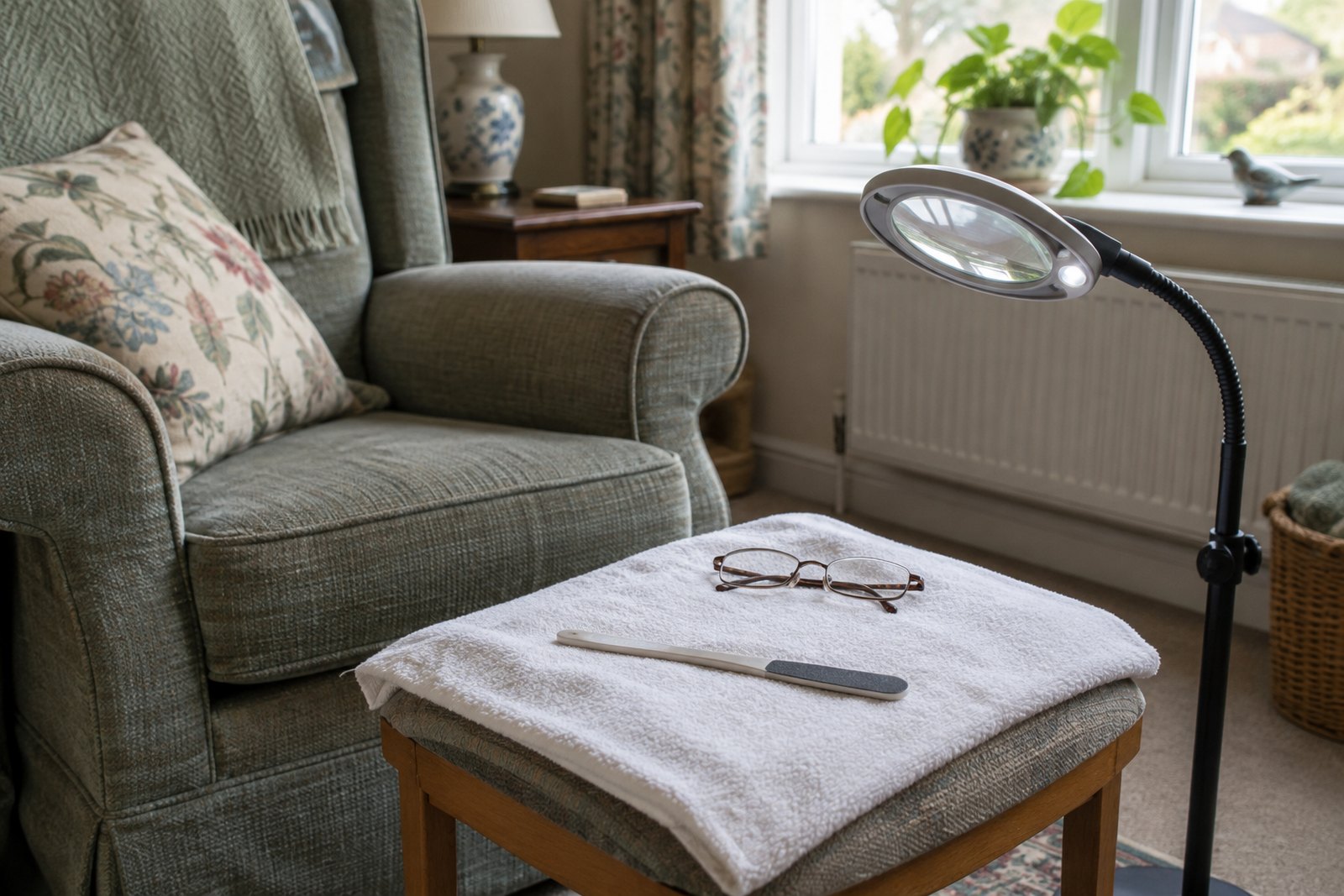
If you are struggling with cutting toenails for an elderly parent, or you have simply reached the point where you can't reach your own toenails any more, you are in very large company. Feet seem to get further away as we age. Hips and backs stiffen, eyesight blurs, nails thicken and hands lose their grip. Somewhere in there, a two-minute job turns into something people quietly stop doing, until a nail starts catching on socks or hurting in shoes.
The short answer is this. Many people can keep cutting their own nails safely with a few changes: do it after a bath or shower when the nails are softer, sit somewhere stable, cut straight across, file rather than cut where you can, and use long-handled clippers or a long-handled file with good light. But some people should not cut their own toenails at all. That includes anyone with diabetes who has numbness or poor circulation in their feet, and anyone with very thick, curved or ingrown nails. They need a podiatrist. The rest of this page explains how to tell which group you are in, how to do it safely, and where to find help if you can't.
Why cutting your toenails gets so hard
It is rarely one thing. Usually it is several small problems stacking up until the job becomes awkward, then risky, then avoided.
- Reach. To cut your toenails you need to bring your foot up or your hands down, and hold that position steadily. Stiff hips, a sore back, a larger tummy or tight hamstrings all get in the way.
- Balance. Many people do it perched on the edge of the bed or the bath, leaning forward with one foot in the air. That is a very good way to topple.
- Eyesight. Cataracts, macular degeneration or just needing a new prescription make it hard to see where the nail ends and the skin begins. Reading glasses are set for a distance much closer than your feet.
- Thick nails. Toenails often thicken with age, and with fungal infection or old injuries. Ordinary clippers will not go through them, and forcing them is how skin gets cut.
- Hands. Arthritis in the fingers and thumbs, a tremor, or a weak grip makes squeezing clippers painful and less precise.
- After hip surgery. After a hip replacement your surgical team may ask you to avoid bending deeply or crossing your legs for a while. Reaching your toes is exactly the movement you are being asked not to do. Follow your own team's advice, and see our guide to life after a hip replacement for the rest of the daily routine.
If socks and shoes have already become a struggle, toenails are usually not far behind, because the same problem sits underneath both. Our guide to dressing aids and easier ways to get dressed covers sock aids, long shoehorns and other ways round it.
First: should you be cutting them at all?
Before technique, an honest check. Do not cut your own toenails, and do not ask a family member to, if any of these apply:
- You have diabetes and have been told you have reduced feeling (neuropathy) in your feet, poor circulation, or a foot that is at increased risk at your annual diabetes foot check.
- You have numbness, tingling or burning in your feet from any cause, so you might not feel it if you nick the skin.
- You have poor circulation in your legs: cold feet, pale or bluish toes, calf pain when walking, or small cuts that are slow to heal.
- You bruise or bleed easily, for example because of medicine you take. Do not change any medicine because of this, but do mention it to whoever cuts your nails.
- Your nails are very thick, hooked or curling over, crumbly, or digging into the skin.
- You have an ingrown toenail, or a toe that is red, swollen, hot or weeping.
The reason is simple. A small nick that would heal in a few days on a healthy foot can turn into an ulcer or an infection if you cannot feel it, or if the blood supply is poor. For these feet, nail care is a job for a podiatrist (still sometimes called a chiropodist).
How to cut toenails safely, step by step
If none of the above applies, here is the plain version.
- Pick your moment. Straight after a bath or shower is best, when nails are softer and easier to cut. If you do not bath often, a few minutes with your feet in warm (not hot) water does a similar job. Check the temperature with your hand or elbow, not your feet.
- Sit somewhere stable. A firm chair with arms, back supported, is far safer than the edge of a bed or bath. Rest the foot you are working on on a low stool or a firm cushion, so you bring the foot towards you rather than folding yourself forward.
- Get the light right. Daylight from a window or a bright lamp aimed at your foot. Wear the glasses that let you see clearly at about arm's length, which may not be your reading pair.
- Use the right tool. Toenail clippers with a straight cutting edge, not curved fingernail clippers or small scissors. Make sure they are clean and sharp. Blunt clippers crush rather than cut.
- Cut straight across. Take several small bites rather than one big cut. Leave the nail roughly level with the end of the toe, not shorter.
- Leave the corners alone. Do not cut down into the corners or dig underneath them with anything sharp. That is how ingrown toenails start.
- File the edges. Smooth any sharp points or snags with a nail file or emery board.
- Look at your feet. While you are down there, check the skin (more on this below).
Little and often is easier than a big job every few months. Toenails grow slowly and at different speeds in different people, so there is no fixed rule. Most people find that every few weeks keeps things manageable.
Filing instead of cutting
For a lot of people, filing is the safer answer. You cannot cut skin with a file, it needs much less hand strength, and you can do a little every few days while watching television. It will not shorten a very long nail quickly, but once a nail is a sensible length, regular filing can keep it there without clippers at all.
Long-handled clippers, files and other aids
There is a fair range of equipment aimed at exactly this problem. It helps some people a great deal. It does not help everyone, and it is worth knowing why before you buy.
Long-handled nail clippers
These have a small clipper head on the end of a long handle, so you can reach your toes while sitting more upright. You squeeze at the hand end and the jaws close at the far end. The trade-off is control. The further your hand is from the nail, the less precise each cut is, and the harder it is to see what you are cutting. They tend to suit people whose main problem is bending, who still have good eyesight and steady hands. They are not a good idea if you cannot see the nail clearly, if you have a tremor, or if you have reduced feeling in your feet.
Long-handled files
A nail file or emery board fixed to a long handle. Slower than clippers but much more forgiving, and a sensible first thing to try if you can't reach your toenails. Many people use one with their foot resting on a low stool.
Easier-grip and lever clippers
Clippers with longer, wider or padded handles, or a lever action, need less squeezing force and suit stiff or painful hands. Some are sold as being for thick nails. They will manage moderately thick nails, but if you find yourself forcing a nail, stop. That nail needs a podiatrist, who has tools designed to thin it safely.
Magnifiers and lighting
A free-standing magnifier on a flexible arm, ideally with a built-in light, leaves both hands free. Some clippers come with a small magnifier attached, which helps a little but is no substitute for good light. A hand mirror or a mirror laid on the floor lets you see the soles of your feet and between your toes. If sight loss is affecting more than your feet, our guide to low vision aids and living with sight loss covers lighting and magnification around the home.
Related aids for washing feet
Keeping feet clean and dry, especially between the toes, matters as much as the nails themselves. A long-handled sponge or a toe washer makes that possible without bending double. See our guide to washing aids, long-handled sponges and toe washers.
Check the skin while you are there
Nail time is a good chance for a proper look at your feet, or at the feet of the person you care for. You are looking for:
- cuts, blisters or broken skin, including ones you did not feel happen
- cracks, especially around the heels
- redness, swelling, warmth or a change in colour
- soggy, white or peeling skin between the toes
- hard skin, corns or calluses
- nails that are thick, yellow, crumbly or lifting
- any smell or discharge
Do not cut or shave corns or hard skin yourself. A pharmacist can advise on mild problems such as athlete's foot or a fungal nail. See your GP or a podiatrist for an ingrown toenail, painful thick nails, corns that hurt, or new numbness or tingling.
Get help the same day, from your GP practice or NHS 111, if you have diabetes or poor circulation and notice any cut, blister or sore, or if a foot or toe is red, hot, swollen or the redness is spreading. Call 999 if a foot or toe suddenly turns cold, pale or blue and painful, or if someone with a foot wound becomes confused, very unwell, breathless or has mottled skin, as these can be signs of a serious emergency such as sepsis.
Where to get help with toenail cutting
NHS podiatry
NHS podiatry services exist across the UK, but who qualifies varies a lot by area. Many services prioritise people whose feet are at medical risk, such as diabetes with foot complications, poor circulation or conditions that affect the feet, rather than routine nail cutting. In some areas you can refer yourself; in others you need a referral from your GP. Ask at your GP practice or search for your local NHS podiatry service to find out what applies where you live. If you have diabetes, you should be offered a foot check as part of your regular diabetes care, and that is a good moment to ask about nail cutting.
Charity and community nail-cutting services
Some local Age UK branches and other community organisations run toenail cutting services, either at home or in a local clinic. These usually charge a fee and are not available everywhere. Contact your local Age UK, ask at your GP practice, or check your council's website for local services for older people. These services are generally for straightforward nails; if you have diabetes complications or circulation problems, they may refer you on to a podiatrist.
Private podiatrists and foot health practitioners
In the UK, "podiatrist" and "chiropodist" are protected titles. Anyone using them must be registered with the Health and Care Professions Council (HCPC), and you can check the register online. Many private podiatrists will visit at home. Foot health practitioners are a different group and are not regulated by the HCPC. Some offer a perfectly good routine nail-cutting service, but ask about their training and insurance, and choose a registered podiatrist if any of the higher-risk points earlier on this page apply.
If you are cutting someone else's toenails
Plenty of family carers end up doing this, often without anyone showing them how. A few things make it easier for both of you.
- Ask first and talk it through. Feet are personal. Explain what you are about to do before each cut, and stop if they want you to.
- Sort out positions. Have them sit in a supportive chair. Sit facing them on a low stool, with their foot on a towel on your lap or on a footstool. Avoid kneeling on the floor for long; your back and knees matter too.
- Hold the toe steady. Use your other hand to hold the toe gently, and take small cuts straight across.
- Keep it short. If the person has dementia or gets anxious, pick a calm time of day, do one foot or even a couple of toes at a time, and switch to filing if clippers cause distress.
- If you nick the skin. Clean it, press gently with clean gauze until it stops bleeding, cover it, and keep an eye on it. If they have diabetes or poor circulation, get it checked the same day.
And if they fall into the higher-risk group, it is not a failure to hand this over. It is the right call.
Where an occupational therapist fits
To be clear: an occupational therapist does not cut toenails. That is a podiatrist's job, and for anyone with diabetes, neuropathy or circulation problems, the podiatrist leads on foot care.
What an occupational therapist can do is look at why reaching your feet has become hard, and what else that is affecting. Often toenails are the first visible sign of a wider problem with bending and reaching, which also shows up in washing and drying feet, putting on socks and shoes, and getting in and out of the bath. An occupational therapist visiting at home can look at how you sit, how far you can safely reach, your balance and your hands, and then suggest safer positions, different ways of doing things, and equipment such as long-handled aids, footstools, sock aids or a perching stool. After hip surgery they can help you work within the precautions your surgical team has given you. If eyesight, tremor or memory problems are part of the picture, they can adapt the approach to suit.
If nail cutting is genuinely the only problem, a podiatrist or a local nail-cutting service is probably all you need. If it is one of several daily tasks that are slipping, an occupational therapy assessment may be worth it. Your GP is the right person for new numbness, circulation problems or diabetes concerns, a physiotherapist can help improve hip and back movement and strength, and an optometrist should check your eyes if your sight has changed.
Frequently asked questions
Can I get my toenails cut on the NHS?
Sometimes. NHS podiatry eligibility varies by area, and many services focus on people whose feet are at medical risk rather than routine nail cutting. Ask your GP practice or look up your local NHS podiatry service to find out what is offered where you live.
Does Age UK cut toenails?
Some local Age UK branches run toenail cutting services, but not all of them, and there is usually a charge. Contact your local branch to ask what is available near you.
Are long-handled nail clippers safe?
They can be, for people who mainly struggle with bending but still see well and have steady hands. You lose some control with the longer handle, so they are not a good choice if your eyesight is poor, you have a tremor, or you have reduced feeling in your feet. A long-handled file is a gentler starting point.
Should toenails be cut straight across or curved?
Straight across, leaving the nail roughly level with the end of the toe. Then smooth any sharp edges with a file. Cutting down into the corners or too short can lead to ingrown toenails.
My nails are too thick to cut. What should I do?
Do not force them. Very thick nails need a podiatrist, who can thin them safely. A pharmacist or GP can advise if a fungal infection might be part of the cause.
How do I find a properly qualified podiatrist?
Check the HCPC register. Anyone calling themselves a podiatrist or chiropodist in the UK must be registered, and the register shows whether they are.
Next steps
If reaching your feet has become part of a wider struggle with washing, dressing or getting about, an occupational therapist can help you find safer ways and the right equipment. See our equipment and daily living aids page, or current guide prices, and choose your area below.
Talk to an occupational therapist near you
This guide is general information. For advice about your own situation - or someone you look after - a local occupational therapist can visit you at home and see it for themselves.
Choose your area: