

Cooking With Dementia: Keeping the Kitchen Safe and Useful
By Mobile Occupational Therapist • 6 October 2026 • 12 min read
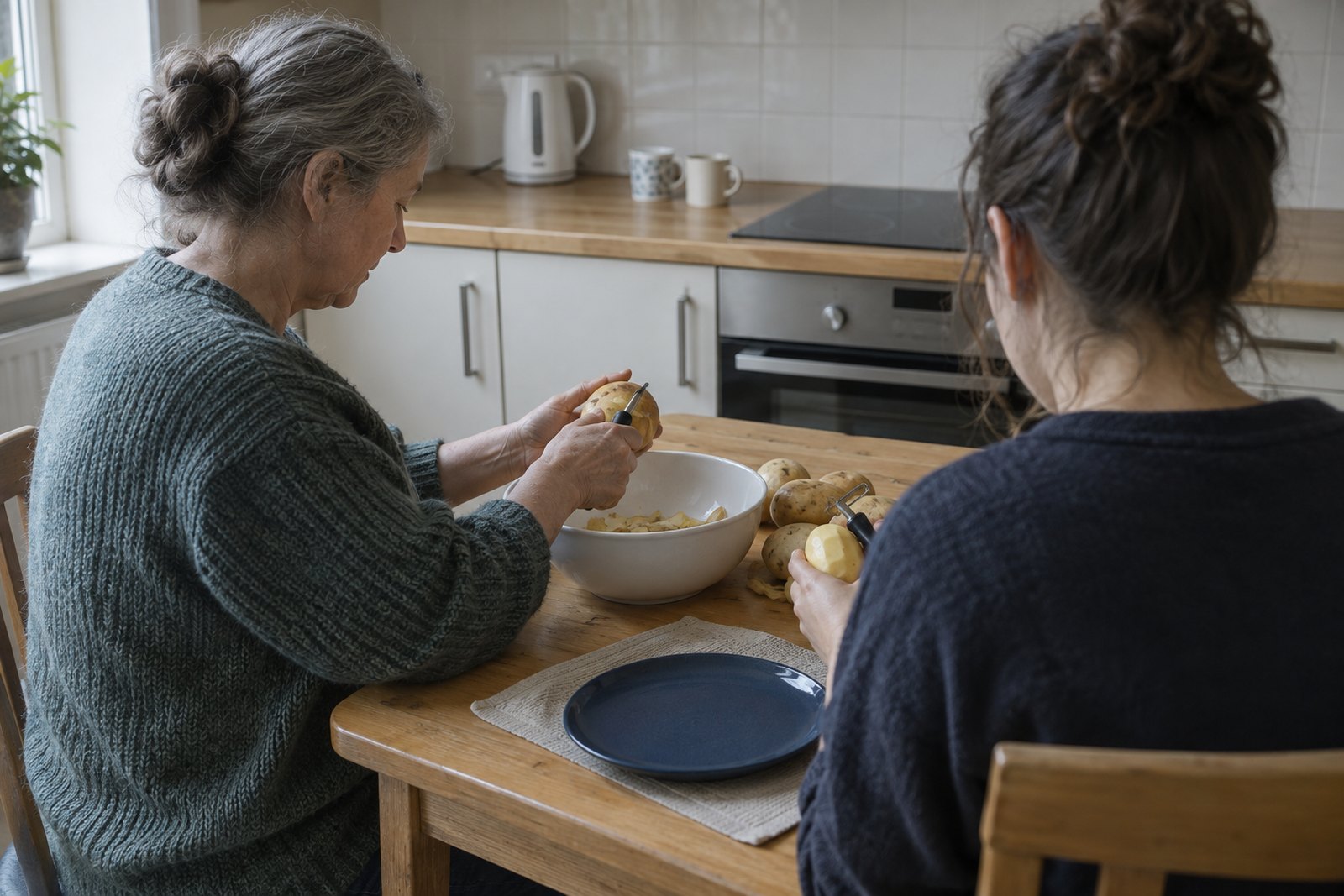
Cooking with dementia is usually possible for longer than families fear, but rarely in the same way as before. What goes first is not the skill itself. It is the things that hold a meal together: remembering which step comes next, remembering the hob is on, noticing that the chicken in the fridge is a week past its best. Keeping someone safe in the kitchen is mostly about propping up those things, not banning them from the room.
So the short answer is this. Simplify the kitchen. Make what matters visible. Add a few safety devices in the background. Cook together rather than for them where you can. Check the fridge quietly and often. And plan honestly for the point where cooking alone is no longer safe. That point usually arrives in stages. Using the hob alone may stop long before making a sandwich or a cup of tea does.
What changes in the kitchen as dementia progresses
Dementia affects people differently, but the same few problems turn up in kitchens again and again.
Sequencing
Cooking is a chain of steps in the right order. Fill the pan, put it on, turn the ring on, wait, add the pasta, drain it. Someone with dementia may manage every single step but lose track of where they are. You see pasta put into cold water, a pan on the wrong ring, or the same step done twice. Anything with lots of parts, or two things that need to be ready at once, usually goes first.
Forgetting the hob or oven
This is the risk that worries families most, and with reason. A pan left on while someone wanders off to answer the phone is how kitchen fires start. People with dementia can lose the nagging sense that something is unfinished, so nothing pulls them back to the cooker. Burnt pans, scorch marks on worktops and a smoke alarm that keeps going off are warning signs worth taking seriously.
Food hygiene and recognising food
Someone may no longer notice that milk smells off or that food has been in the fridge for days. Some people stop recognising food in its packaging, or put things in odd places: butter in the cupboard, biscuits in the fridge, cooked food left out overnight. Changes in smell and taste, which are common in dementia, make this harder still.
Judgement, eyesight and unfamiliar things
Other changes stack up. Difficulty telling hot from cold. Trouble seeing a white plate on a white worktop. Unsteadiness carrying a full pan. And new appliances can be baffling. A touch-control hob may be impossible to learn, even if the old cooker was second nature.
Small changes that keep cooking possible
None of these is expensive. Try one or two at a time and see what sticks.
- Simplify the menu. Fewer steps, fewer pans. Beans on toast, a sandwich, a bowl of cereal, a jacket potato in the microwave. Dishes someone has made for decades often last longest.
- Clear the worktops. Put away anything not used daily. Clutter makes things harder to find and easier to put down on a hot ring.
- Keep essentials visible. Tea, mugs, bread and the daily basics in one spot at a comfortable height. Open shelves, or taking the door off one cupboard, can help.
- Labels with pictures and words. A picture of a cup on the mug cupboard, with a large clear word underneath. Label what is useful rather than every surface.
- Use contrast. A coloured plate on a plain mat, a dark mug, a contrasting edge on the worktop. Contrast helps people see food and edges. There is more in our guide to eating and drinking problems in dementia.
- Step-by-step cards. For the one or two things they still make alone, a short numbered card stuck inside a cupboard door. A few words per step.
- Keep familiar appliances if they are safe. Replacing a familiar kettle or cooker with a better one can take away the skill overnight. If something must go, choose a replacement that works the same way, with simple controls.
- A big, simple timer. Set it as the pan goes on. Check while you are there that the person still connects the beep with the cooker, or it just becomes noise.
For ideas beyond the kitchen, see a dementia-friendly home, room by room.
Safety devices worth knowing about
These work quietly in the background. None of them replaces keeping an eye on things, but together they close the gaps.
Cooker and gas isolation
Several kinds of device can cut the power or gas to a cooker. Some are simple isolation switches or valves, so a carer can turn the cooker off at the supply when they leave. Others add a timer, turning the cooker off after a set period, or a sensor that notices heat or no movement in the kitchen. Some link to a telecare system so someone is alerted. Anything on a gas supply must be fitted by a Gas Safe registered engineer, and electrical work done by a qualified electrician. Ask the council's adult social care or telecare service what they provide before you buy.
Kettles and small appliances
Most modern kettles switch off when they boil, and many cut out if switched on empty, but older ones may not. Check yours. A kettle tipper steadies a heavy kettle for someone whose grip or balance is going. A microwave with a single simple dial can be safer than a hob for warming food, as long as metal and foil are kept out of reach.
Smoke, heat and carbon monoxide alarms
In the kitchen itself, a heat alarm is usually better than a smoke alarm, which goes off with every slice of toast until someone takes the battery out. Smoke alarms belong in the hallway and on landings. Linked alarms, which all sound when one does, help when someone might not hear or understand a single alarm. Any home with a gas or solid fuel appliance should have a carbon monoxide alarm. Most fire and rescue services offer free home fire safety visits, particularly for people at higher risk. Contact your local service and mention the dementia when you do.
Water and flood detectors
Taps left running are common. Flood detectors sit on the floor and raise an alarm when they sense water, and some can alert a family member or a monitoring centre through telecare. Plugs that release water once it reaches a certain level are another simple option.
Doing it together: supervision without taking over
The easiest way to keep someone cooking safely is to cook with them. It also keeps cooking something they do, rather than something done to them.
- Give one step at a time. "Can you peel these?" works better than "Can you make dinner?"
- Hand over the jobs that are safe and still satisfying: peeling, washing vegetables, buttering bread, stirring off the heat, laying the table, tasting.
- Keep the hob and sharp knives on your side if needed, without making a show of it.
- Show rather than tell. Doing the first potato alongside them often beats an explanation.
- Let small mistakes go. If the carrots are chopped oddly, the carrots are chopped.
- Choose their best time of day. For many people that is morning rather than late afternoon.
Making a pot of tea for visitors, baking, or a family recipe can matter enormously to someone whose sense of being useful is slipping. Cooking is often more than food. It can be who someone has been for fifty years.
Fridge checks without a row
Checking someone's fridge can feel like an inspection, and they may feel it as one.
- Make it routine. Look while you put shopping away or make a drink.
- Swap rather than throw out in front of them. New milk goes in, old milk goes quietly in your bag.
- Write the date opened on items in large marker.
- Keep less in. Smaller, more frequent shops or deliveries mean less to go off.
- Notice patterns. A fridge full of untouched meals, the same item bought over and over, or a fridge that is nearly empty all tell you something.
If food is going uneaten or weight is dropping, raise it with the GP. Weight loss in dementia has several possible causes, and some can be treated.
Capacity, risk and dignity
A dementia diagnosis does not on its own mean someone cannot decide whether to keep cooking. Under the Mental Capacity Act 2005, which covers England and Wales, a person is assumed to have capacity unless shown otherwise, capacity is judged decision by decision, and people are allowed to make choices others think are unwise. Scotland and Northern Ireland have their own laws.
In practice, talk with the person, not about them. Explain the worry plainly and offer changes rather than imposing them. "Shall we get one of those cookers that turns itself off?" lands very differently from disabling the hob while they are out. If someone clearly can no longer understand the risk, decisions may need to be made in their best interests, involving them as far as possible and anyone holding lasting power of attorney for health and welfare. The GP or a social worker can help when this gets difficult. There is no risk-free version of living at home. The aim is a balance everyone can live with.
When cooking should stop, and what replaces it
Signs that cooking alone is no longer safe include:
- Repeated burnt pans, scorch marks or smoke alarms
- Gas left on unlit, or rings left on after cooking
- Burns or scalds
- Eating food that is clearly spoiled
- Metal, plastic or packaging put in the oven or microwave
- Forgetting to eat, or eating the same thing at every meal
If you smell gas in England, Scotland or Wales, get out and call the National Gas Emergency number on 0800 111 999. If there is a fire, get out and call 999.
Stopping usually happens in stages. The hob goes first while the kettle and microwave stay, then later only cold food and drinks remain. What replaces cooking matters as much as stopping it:
- Ready meals that only need a microwave, chosen with the person so they still decide what they eat.
- Frozen meal delivery services that bring a stock of meals to the door.
- Hot meal services run by some councils or local charities. These vary a great deal by area, so ask adult social care or your local Age UK.
- Carers at mealtimes through a care package, to prepare a meal and make sure it gets eaten.
- Shared meals at a lunch club, day centre or with family.
A Care Act needs assessment from the council is the usual route to help with meals and telecare. And keep a role in the kitchen even after cooking stops: drying up, laying the table, choosing tonight's meal. Being shut out of the kitchen entirely can feel like a far bigger loss than the cooking.
Where an occupational therapist fits
Occupational therapists look at how people manage everyday activities, and the kitchen is one of the most revealing places to do it. A kitchen assessment usually means watching the person make something familiar, like a cup of tea or a snack, in their own kitchen. It shows what they can still do, exactly where the process breaks down, and what is genuinely risky rather than just untidy.
From that, an occupational therapist can suggest layout changes, equipment such as safer kettles or cooker safety devices, prompts that suit that person, and a plan for which tasks can safely carry on. Their written observations can support a council needs assessment, and help when family members disagree about how much risk is acceptable. Council occupational therapists do this through adult social care, though waits vary. A private occupational therapist visiting at home can usually come sooner. There is more on our dementia page.
An OT is not the right person for everything. New memory problems or weight loss need the GP. Sudden confusion that comes on over hours or days can be a sign of infection or another illness, so contact the GP the same day or call NHS 111. Coughing or choking when eating needs a speech and language therapist, usually through the GP. Gas and electrical work needs a qualified engineer or electrician.
Frequently asked questions
Should someone with dementia still cook?
Often yes, for a while, with changes and some company. While they have capacity it is their decision. The question is usually which parts of cooking are still safe, not whether they can be in the kitchen at all.
How do I stop someone with dementia using the cooker?
Talk about it first. Then consider an isolation switch, valve or timer device, fitted by a Gas Safe registered engineer or qualified electrician. Taking the knobs off is a common stopgap, but it does not work on every cooker and is no substitute for a proper isolation device.
Can the council help pay for kitchen safety equipment?
Often, after a needs assessment. In England, councils must provide assessed community equipment and minor adaptations costing up to 1,000 pounds free of charge, though ongoing telecare monitoring may be charged. Rules differ in Scotland, Wales and Northern Ireland, so check with your council.
What if they live alone and insist on cooking?
Focus on making it safer rather than winning the argument. Simplify the menu, fit a cooker safety device and heat alarm, and plan phone calls or visits around mealtimes. If the risk is serious and they cannot understand it, ask the GP or adult social care for help.
Does an occupational therapist need to see the kitchen in person?
Yes. The value is in watching the person cook in their own kitchen with their own things. A description over the phone rarely shows where the real problems are.
Next steps
If you want a clear, practical view of what is safe in the kitchen and what would help, see our home assessment page, or current guide prices, and choose your area below.

Talk to an occupational therapist near you
This guide is general information. For advice about your own situation - or someone you look after - a local occupational therapist can visit you at home and see it for themselves.
Choose your area: