

Cardiac Rehabilitation: Getting Back to Daily Life After a Heart Attack
By Mobile Occupational Therapist • 19 October 2026 • 12 min read
Cardiac rehabilitation is a free NHS programme for people who have had a heart attack, a stent or angioplasty, heart surgery, or who are living with heart failure. It usually combines supervised exercise, information about your heart, medicines and lifestyle, and support with the emotional side of recovery. You should be referred before you leave hospital. If nobody mentioned it, or you said no at the time and have changed your mind, ask your GP or the cardiac nurse. It is not too late to ask.
Recovery after a heart attack at home is usually a gradual climb, not a straight line. Most people get back to most of what they did before, including housework, gardening, sex, driving and work. The trick is doing it in stages, at a pace your heart is ready for, with the rehab team's advice as your guide. This article explains what cardiac rehab involves, how to ease back into ordinary life, which warning signs mean you should call 999, and where an occupational therapist can help with the practical side.
What cardiac rehabilitation actually is
Cardiac rehab is not just an exercise class, although exercise is a big part of it. A typical programme covers:
- Exercise - built up gradually and supervised, so you learn how much your heart can safely do.
- Education - what happened to your heart, what your medicines are for, eating, smoking, alcohol, blood pressure and cholesterol.
- Emotional support - help with the anxiety, low mood and loss of confidence that are very common after a heart event.
- Getting back to normal life - advice on work, driving, sex, holidays and daily activities.
Programmes are run by teams that often include cardiac nurses, physiotherapists, exercise specialists and dietitians, with psychology support in some areas. The format varies across the country. You might be offered a group class at a hospital, community centre or leisure centre, a home-based programme with a manual and phone support, or an online option. If one format does not suit you, ask what else is available.
Plenty of people skip rehab. Some feel fine, some feel too anxious, some cannot get there. It is worth going if you possibly can. Many people say the biggest benefit was not the exercise but finding out, safely, that they could do more than they feared.
How to get referred
National guidance says people should be offered cardiac rehab after a heart attack, and the referral is normally made by the hospital team before discharge. In practice, referrals sometimes get missed, especially if you were discharged quickly or moved between hospitals.
If you have not heard anything within a few weeks of coming home:
- Check your discharge letter. It may name the local cardiac rehab service or give a phone number.
- Ring the cardiology ward or cardiac nurse team at the hospital that treated you.
- Ask your GP surgery to refer you.
If something is stopping you going, such as transport, work hours, caring for someone else or not speaking English as a first language, tell the team. They would rather adapt the programme than lose you from it. Our guide to coming home from hospital also covers what to check before and after discharge.
The first weeks at home
Expect to be tired. Your heart has been injured, you may have had a procedure, you have probably slept badly in hospital, and new medicines can take some getting used to. Tiredness in the first few weeks does not mean something has gone wrong.
A few things help early on:
- Get up, wash and dress each day, even if you rest afterwards. It keeps a sense of normal.
- Take short, gentle walks on the flat and build up a little at a time, as your team advised.
- Rest between activities rather than doing everything in one burst.
- Take your medicines exactly as prescribed. If you think one is causing side effects, talk to your GP or pharmacist rather than stopping it yourself.
- Keep your GTN spray or tablets with you if you have been given them, and make sure you know how you were told to use them.
Getting back to everyday activities
The general rule is the same for almost everything: start light, build up gradually, and follow the specific advice of your rehab or surgical team. Their advice is based on what happened to your heart and how it was treated, which a general article cannot know.
Pacing and the talk test
Many rehab teams teach a simple check called the talk test. While you are active, you should be able to talk in full sentences. A little breathless is fine. Too breathless to talk means ease off. Rehab teams may also teach you to rate how hard an activity feels. Learn whichever method your team uses and apply it at home.
Pacing also means planning your day. Spread heavier jobs across the week, alternate harder tasks with lighter ones, and avoid doing a lot straight after a big meal or in very hot or cold weather, when your heart is working harder anyway. Our practical guide to pacing was written for other conditions, but the planning methods work just as well here.
Housework and the kitchen
Start with light jobs: making a drink, washing up, dusting, folding laundry. Leave vacuuming, changing beds, mopping and carrying full washing baskets until you are further on. Break bigger jobs into chunks, such as one room a day.
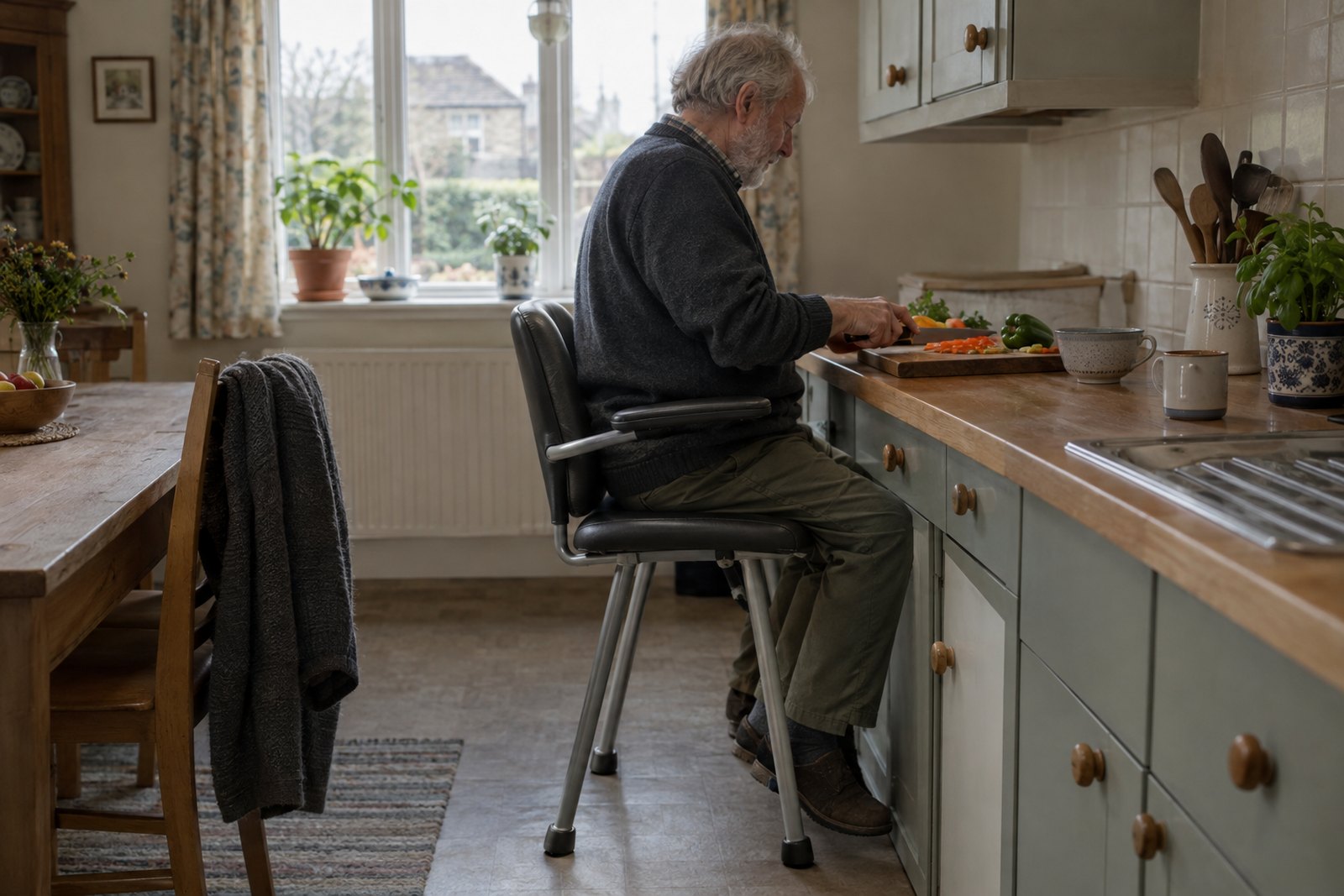
Sitting rather than standing for kitchen tasks saves a surprising amount of energy. A perching stool lets you prepare food or wash up at the worktop without standing the whole time. Keep the things you use most between waist and shoulder height so you are not bending low or stretching up repeatedly.
Stairs
You will usually be able to use stairs when you get home, but take them slowly. Go at an even pace, breathe normally rather than holding your breath, and stop halfway if you need to. Do not carry heavy things up and down. In the early weeks, it can help to plan the day so you are not going up and down repeatedly, for example keeping a drink and what you need for the afternoon downstairs.
Lifting, carrying and gardening
Avoid heavy lifting, pushing and pulling early on. That includes shopping bags, children, heavy pans, furniture, and mowing or digging. Lifting and straining puts a sudden load on your heart, and many people instinctively hold their breath while doing it.
If you have had heart surgery that involved opening the breastbone, the rules are stricter for longer because the bone needs time to heal. Follow your surgical team's instructions on lifting, reaching and pushing exactly, even if you feel ready sooner.
For gardening, start with light, short jobs such as watering with a small can, potting at a table or deadheading. Use kneeling pads and long-handled tools, and work in short spells with breaks. Save heavy digging, hedge cutting and moving pots for later, once your team says you are ready.
Sex
This is one of the most common worries and one of the least asked about. Most people can return to sex once they feel well and comfortable with moderate activity, but the right time depends on your recovery, so ask your rehab nurse or GP. They are asked all the time.
Loss of interest or erection problems are common after a heart attack, sometimes because of anxiety and sometimes because of medicines. Do not stop any medicine on your own. If you are thinking of taking anything for erection problems, speak to your GP or pharmacist first, because some of these medicines must not be combined with certain heart medicines, including GTN.
Driving
There is a period after a heart attack when you must not drive. How long depends on what treatment you had and how well your heart is working, and the rules are different for car and motorbike licences compared with bus, coach and lorry licences. For car drivers you often do not need to tell the DVLA, but bus and lorry drivers usually must. Check the current rules on GOV.UK under heart attacks and driving, and ask your cardiac team which applies to you. Heart surgery has its own restrictions. Tell your car insurer too.
Work
When you go back depends on your recovery and your job. Desk-based work often comes sooner than heavy manual work or shift work. Your GP can give you a fit note and suggest changes such as reduced hours or lighter duties. A phased return to work, building up hours over several weeks, suits many people. If your employer has an occupational health service, ask to be referred.
Breathlessness and tiredness
Some breathlessness with exertion is normal while you recover, especially if you were inactive in hospital. What matters is the pattern. Breathlessness that settles quickly when you stop is usually part of rebuilding fitness. Breathlessness that is new, worse than usual, comes on at rest or wakes you at night needs checking.
Tiredness often lasts longer than people expect, sometimes weeks or months. Keep a simple diary of what you did and how you felt afterwards. It shows you your real limits and progress, and gives the rehab team something concrete to work with.
The emotional side of recovery
A heart attack is frightening, and the fear does not always go when you get home. Many people feel anxious about every twinge, scared to be alone, low, irritable or tearful. Partners and family often feel the same, and can become overprotective without meaning to.
This is common and it is treatable. Cardiac rehab includes emotional support for exactly this reason. You can also talk to your GP, and in England you can refer yourself to NHS Talking Therapies for anxiety and depression. If low mood is severe, or you have thoughts of harming yourself, contact your GP urgently or call NHS 111 and choose the mental health option. If you feel you might act on these thoughts or are in immediate danger, call 999 or go to A&E. You can also call Samaritans free on 116 123 at any time.
Warning signs: when to get help
Call 999 if:
- You have chest pain that does not settle after using your GTN as you were instructed, or chest pain that lasts more than 15 minutes.
- You have chest pain or pressure that spreads to your arms, jaw, neck, back or stomach, especially with sweating, feeling sick, light-headedness or breathlessness.
- You are suddenly very short of breath, or you collapse or faint.
Do not drive yourself to hospital.
Contact your GP, heart failure nurse or NHS 111 the same day if you notice increasing breathlessness, swelling in your ankles or legs, sudden weight gain over a few days, a fast or irregular heartbeat that does not settle, dizziness, or chest pain that comes on more easily than before.
Where an occupational therapist fits
Be clear about who leads what. Your cardiologist, GP and cardiac nurses manage your heart, your medicines and your medical follow-up. The cardiac rehab team leads your exercise programme. A heart failure nurse, if you have one, monitors your symptoms. An occupational therapist does not replace any of them.
Where an occupational therapist helps is the practical gap between being told to build up gradually and actually doing it in your own home. Some NHS cardiac rehab teams include occupational therapists. A private occupational therapist visiting at home can:
- Look at how you manage washing, dressing, cooking, stairs and housework, and suggest ways to do them with less effort.
- Help you build a realistic weekly plan that paces activity alongside your rehab.
- Recommend equipment such as a perching stool, shower seat, kitchen trolley or stair rail where it would genuinely help, and advise where it should go.
- Help you plan a return to work, hobbies, gardening or caring for others.
- Support family members who are unsure how much to help and how much to step back.
This is most useful if you live alone, have other health conditions, had a long hospital stay, are recovering from heart surgery, or are living with heart failure that limits what you can do day to day.
Frequently asked questions
How soon after a heart attack does cardiac rehabilitation start?
It varies by area and by how you were treated. Some services make contact within days of discharge and the exercise part usually starts a few weeks later. If you have heard nothing after a few weeks, ring the hospital cardiac team or your GP.
Is cardiac rehabilitation free?
Yes. Cardiac rehab is an NHS service and there is no charge to take part.
Do I need to go if I feel fine?
It is not compulsory, but it is strongly recommended. Feeling fine does not tell you how much your heart can safely manage, and rehab covers medicines, risk factors and confidence as well as exercise.
Can I do cardiac rehab at home?
Many areas offer home-based programmes with a manual, phone calls or online sessions. Ask the rehab team what is available locally.
Can my partner or family come along?
Many programmes welcome a partner or family member to the education sessions, which can help everyone feel more confident. Ask your local team.
Will I get back to normal?
Most people get back to most of their usual activities. Some find they need to do certain things differently or more slowly, and many end up fitter than before because of the changes they made during rehab.
Next steps
If daily life at home feels harder than it should after a heart attack, an occupational therapist can help you plan a safe, realistic way back. See our hospital discharge page, or current guide prices, and choose your area below.
Talk to an occupational therapist near you
This guide is general information. For advice about your own situation - or someone you look after - a local occupational therapist can visit you at home and see it for themselves.
Choose your area: