
Occupational Therapy for Autism at Home: Staffordshire Moorlands
By Mobile Occupational Therapist • 19 October 2026 • 11 min read
Local Occupational Therapist -
Georgie Leeson, Staffordshire Moorlands
If your child is autistic, or you are waiting for an assessment, and you live in the Staffordshire Moorlands, an occupational therapist can help with the everyday things that make home hard. That means getting dressed, eating, sleep, using the toilet, coping with noise and busy places, and the moments when everything becomes too much. Occupational therapy does not diagnose autism. Good occupational therapy is not about making your child less autistic either. It is about making ordinary days work better for the child you actually have.
You can get occupational therapy through the NHS, sometimes through school, or privately. Our local occupational therapist visits families at home across the Moorlands, from Leek and Biddulph to Cheadle, Endon and the villages in between. This guide covers what the help looks like, some things you can try this week, and how the NHS, council and private routes fit together, so you can choose what suits your family.
What occupational therapy is for, and what it is not
An occupational therapist looks at the things a person needs and wants to do each day, and what gets in the way. For an autistic child that might be the scratchy school jumper, the cereal that is suddenly wrong, the bathroom fan that makes the toilet unbearable, or the five minutes between finishing tea and starting the bath that somehow turn into an hour of distress.
It is not a diagnostic service. An autism diagnosis comes from a specialist assessment, usually arranged through your GP, health visitor or your child's school, and often involving a paediatrician or a team of professionals. An occupational therapist may notice things worth passing on to that team, but cannot tell you whether your child is autistic. The useful news is that you do not have to wait for a diagnosis to get help with daily life. Plenty of families start working on mornings and mealtimes while they are still on a waiting list.
It is also not about training your child to look or act less autistic. Flapping, rocking, humming, lining things up and avoiding eye contact are not problems to fix. The goals should be ones that matter to your child and your family: getting out of the door without a fight, eating enough, sleeping enough, feeling safe. Our guide to what occupational therapy for autistic children actually involves goes into more detail.
The everyday things an OT looks at
Dressing
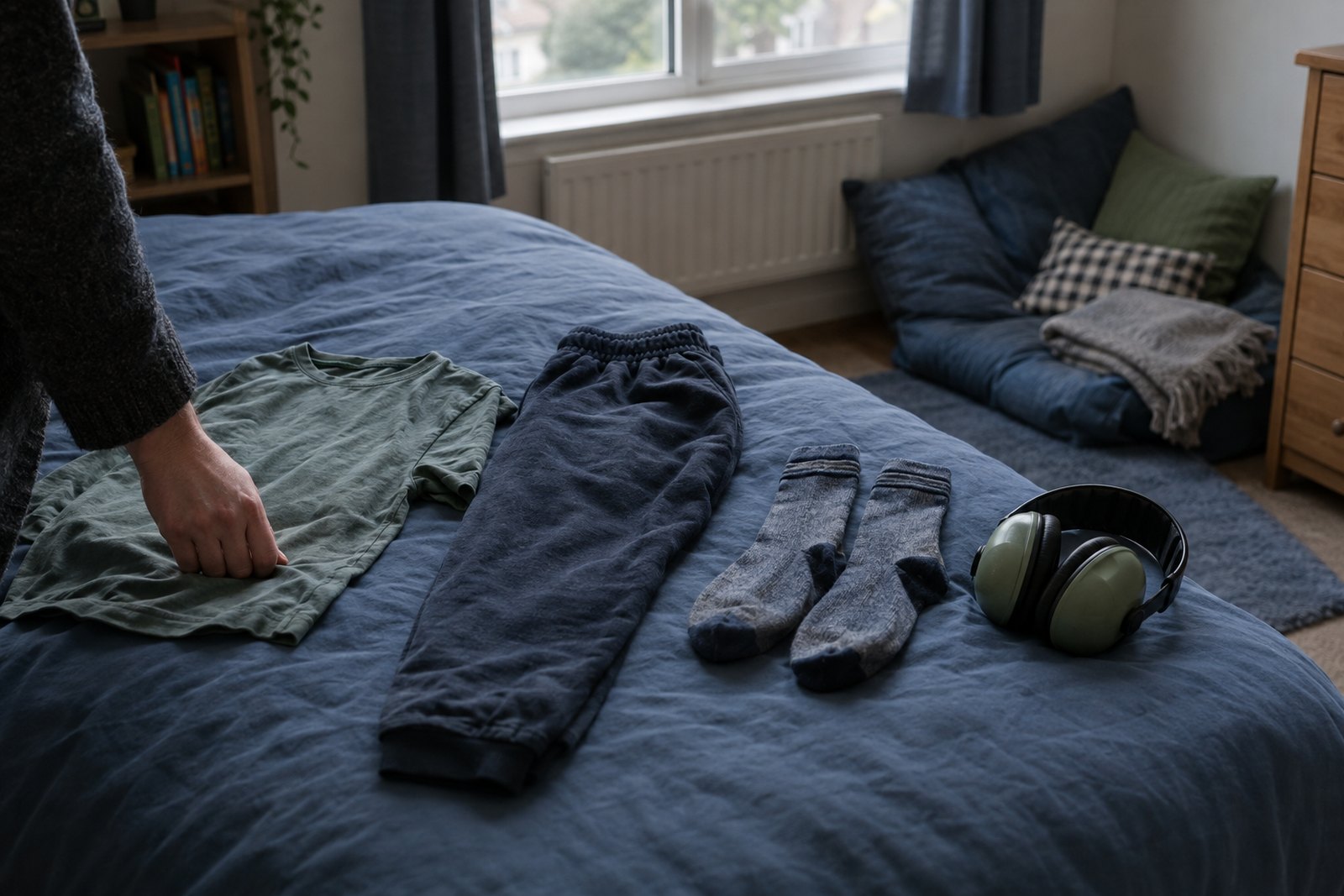
Dressing is harder than it looks. It needs body awareness, fine motor skills, planning the order of steps, and tolerance of how fabric feels on the skin. A child who refuses socks may not be being difficult. The seam may genuinely feel painful. An occupational therapist will work out which part is the problem. Sometimes it is the clothes (seamless socks, labels cut out, softer fabrics, elastic waists), sometimes the sequence (laying clothes out in order), and sometimes the timing (dressing after breakfast rather than straight out of bed).
Eating
Many autistic children eat a narrow range of foods, and many parents have been told it is just a phase. An OT can look at the sensory side of eating, your child's seating and position at the table, the noise and smells of the kitchen, and how new foods are offered without pressure. If your child's diet is very limited, they are losing weight, or you are worried about choking or swallowing, see your GP. Feeding and swallowing problems may need a paediatrician, a dietitian or a speech and language therapist to lead.
Sleep
Sleep problems are common in autistic children and exhausting for the whole house. An OT will usually look at the bedroom itself (light, noise, temperature, bedding), the hour before bed, and what helps your child's body settle. Our article on sleep problems in autistic children has more ideas. Be cautious with weighted blankets and similar products. They are not suitable for every child and should only be used after advice from someone who has assessed your child.
Toileting
Toilet training can come later for autistic children, and that is fine. The barriers are often sensory: the echo, the hand dryer, the cold seat, or simply not noticing the signal that you need to go. An OT can help with the routine, the bathroom set-up and practical things such as a footstool or a smaller seat insert. Constipation and withholding are common, so if your child is in pain, soiling, or has not opened their bowels for several days, speak to your GP.
Sensory overload
Many autistic children experience sound, light, touch, smell or movement more intensely, or sometimes less intensely, than other people. Supermarkets, school halls and family parties can be overwhelming. An occupational therapist can help you work out which senses are involved, which situations tip your child over, and what helps them recover. This is the heart of a sensory needs assessment, and it usually leads to small, practical changes rather than a room full of expensive kit.
Big feelings and meltdowns
A meltdown is not a tantrum. It is a response to being overwhelmed, and it is not a choice. Occupational therapy support focuses on spotting the build-up early, lowering the demands around it, and finding what helps your child calm down afterwards, which is different for every child. Our guide to autistic meltdowns explains more. If your child is hurting themselves or someone else and you cannot keep everyone safe, call 999. If you are worried but it is not an emergency, call NHS 111 or speak to your GP.
Transitions and routines
Moving from one thing to another is often where days unravel: leaving the house, turning off a game, a change of teacher. Predictability helps. Visual timetables, now and next pictures, warnings before a change, and a set order for the morning can make a real difference. An OT can help you build routines that are firm enough to feel safe but not so rigid that one change wrecks the whole day.
Things you can try this week
- Keep a short diary for a week. Note when things go wrong, what happened just before, and what helped. Patterns appear quickly, and the diary is useful for any professional you see.
- Pick one battle. Choose the part of the day that hurts most and work on that. Trying to fix mornings, meals and bedtime all at once rarely works.
- Cut the sensory load at the hardest time. Turn down the television, switch off the extractor fan, dim the main light, or let your child eat with ear defenders on if that helps.
- Show, do not just say. A photo of the next step, or a simple picture sequence on the bathroom wall, often works better than repeating instructions.
- Make a recovery space. A corner with cushions, a den or a quiet bedroom where your child can go without it being a punishment.
- Look after the grown-ups. You cannot calm a child when you are running on empty. Take the help that is offered, even when it is not quite the help you wanted.
NHS, school and council routes in the Moorlands
Start with your GP, health visitor or your child's school. They can refer you for an autism assessment if you have not had one, and they can tell you how to reach NHS children's occupational therapy locally. NHS children's therapy services often have waits and may focus on particular needs, so ask what is offered and whether your child meets the criteria.
At school, talk to the SENCO. If your child needs more support than the school can provide from its own resources, an Education, Health and Care plan may be the next step. Our guide to EHCPs and what an occupational therapy report adds explains how it works.
If your child's needs mean your home itself needs changing, the Disabled Facilities Grant may help. In the Moorlands, the first step for a disabled child is to contact Staffordshire County Council's Children and Families Services and ask for an assessment. If the county supports the application, it refers you to N-Able, the partnership that runs the grant for Staffordshire Moorlands District Council covering Leek, Biddulph, Cheadle, Cheddleton, Werrington, Blythe Bridge and the villages around them. N-Able then handles the forms, plans, quotes and builders. Under the standard rules the grant goes up to £30,000, and there is no means test for a disabled child.
The district council's published policy says an application will normally come with an occupational therapy report from the county council, another agency or a private occupational therapist. That is the council's policy, policies can change, and the version online is marked as a draft, so check with N-Able or the county how a private report would be used before you pay for one. Our Disabled Facilities Grant page for the Staffordshire Moorlands has the contact details.
Your local occupational therapist
Georgie Leeson is a Clinical Specialist Occupational Therapist who works with children and young people with complex needs and visits families at home across the Staffordshire Moorlands. Georgie's profile describes specialist work with children with autism, ADHD and cerebral palsy, among other conditions, with a focus on helping children take part in daily life and become more independent.
Georgie starts with a thorough assessment and then builds a plan around your child, aimed at everyday abilities and at supporting emotional regulation. Georgie works alongside families, schools and other health professionals, so what happens at home can link up with what happens in the classroom. One of the approaches Georgie uses is Cognitive Orientation to daily Occupational Performance, often called CO-OP, in which a child is helped to work out their own strategies for a task they want to get better at. Georgie is HCPC registered, and sensory needs are among the areas listed on Georgie's profile.
Seeing a child at home matters with autism. The things that cause trouble are often in the house itself: the echoing bathroom, the cluttered hallway, the busy kitchen at teatime. You can find more about local occupational therapy on our Staffordshire Moorlands page.
What a home visit is likely to involve
Expect a conversation first, about your child, what a typical day looks like and what you most want to change. The therapist will probably want to see the rooms where things tend to go wrong, and perhaps a routine in action if your child is comfortable with that. Your child does not have to perform. A good therapist will go at your child's pace and will not mind if much of the visit is spent talking to someone hiding under a table.
Afterwards you should come away with practical recommendations you can actually use. Before you book, ask what is included, such as whether there is a written report and whether the therapist can share findings with school. It helps to have your diary, any letters from school or health, and a short list of your top three worries ready on the day.
Frequently asked questions
Can an occupational therapist diagnose autism?
No. Diagnosis comes through a specialist assessment, usually arranged via your GP, health visitor or school. An occupational therapist can help with daily life before, during and after that process, and can share observations with the assessment team if you want them to.
Does my child need a diagnosis to get occupational therapy?
Generally not for private occupational therapy, which is based on what your child is finding hard rather than on a label. NHS and school services set their own criteria, so ask them directly.
Will an OT try to stop my child stimming?
It should not. Stimming often helps autistic children regulate themselves. An OT may help if a particular stim is causing injury, and may look at safer ways to meet the same need, but the aim is your child's comfort and safety, not making them look less autistic.
Can a private OT report help with an EHCP or a grant?
An occupational therapy report can be submitted as evidence when you apply for an EHCP. For the Disabled Facilities Grant in the Moorlands, the council's policy names a private OT report as one route, but the policy online is a draft, so check with N-Able or the county first.
Whatever it is for, ask any therapist exactly what their report covers before you book.
Do we have to pay for home adaptations for an autistic child?
Under the standard Disabled Facilities Grant rules there is no means test for a disabled child, and the grant goes up to £30,000. Whether a particular adaptation is approved depends on the assessment, so start with the county's Children and Families Services.
Next steps
If you would like help with the everyday parts of life with your autistic child, have a look at Georgie's profile and prices, then send Georgie an enquiry describing what is hardest at home right now. A few lines about your child and what you would most like to change is plenty to start with.