

Toileting Aids for Limited Reach: A Frank Guide
By Mobile Occupational Therapist • 17 September 2026 • 8 min read
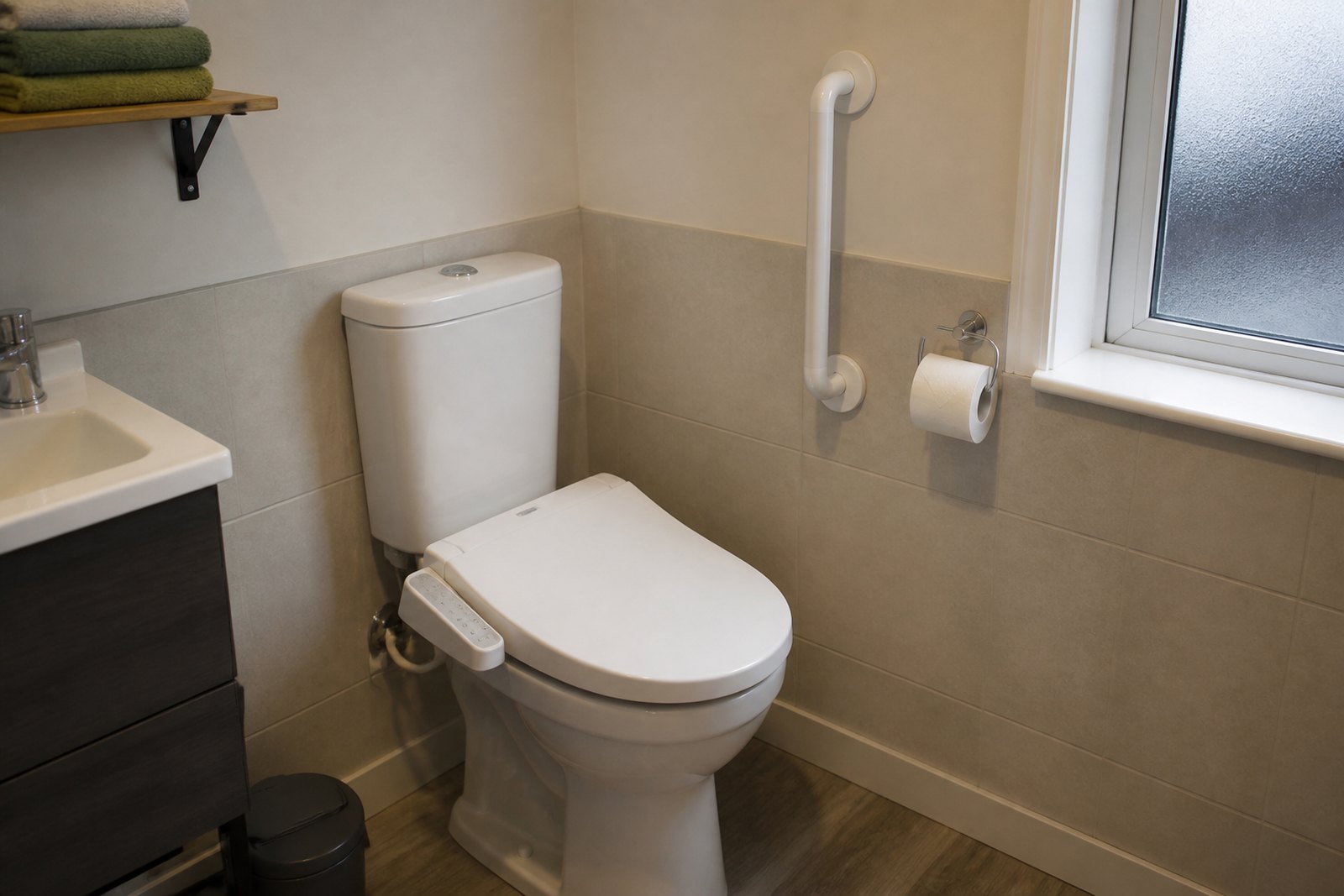
This is the question people put off asking, sometimes for years: what do you do when you cannot reach to clean yourself after using the toilet? It comes up after hip or shoulder surgery, with severe arthritis, with obesity, with a spinal injury, and with anything limiting how far the arm travels behind the body. There are good answers - a bottom wiper aid, a bidet seat that washes and dries, or a different toilet set-up altogether - and there is no reason at all to lose your independence over it. This guide covers the options frankly, without fuss, because the alternative is people managing badly in private and telling nobody.
Bottom wiper aids
A bottom wiper aid is a long handle, usually curved or angled, with a head that grips folded toilet paper or a wipe. You load the paper, reach behind or between your legs, clean, and release the paper directly into the toilet by pressing a button - so you never handle it. Handles come in different lengths, and some fold for a bag or pocket.
Two things decide whether one will suit you, and both are worth getting right before you buy:
- Which hand, and which side. Most people find one side far easier, particularly after a shoulder problem or a stroke affecting one arm. Some aids are shaped for a particular approach - between the legs, or round the side - and the shape that suits one person is awkward for the next.
- Hip precautions. After a hip replacement you may have been told not to bend the hip past a right angle or twist inwards, and reaching round to wipe can breach exactly those precautions. A longer handle with a straight approach is usually safer. Ask the therapist who gave you the precautions to check your technique - they expect to be asked.
Grip matters too: if arthritic hands cannot squeeze the release mechanism, the aid ends up in a drawer. Try the mechanism before committing. If reach is limited across many tasks and not just this one, an assessment for daily living equipment usually solves several problems at once.
Bidets and add-on bidet seats
For a great many people this is simply the best solution, and it is under-used in the UK because we are not used to the idea. An add-on bidet seat replaces your existing toilet seat and directs a controlled spray of warm water to wash, then warm air to dry, operated by a side panel or remote. There are simple non-electric versions that wash with cold water only, and fuller electric versions that wash, dry and adjust nozzle position and temperature.
The advantages are considerable. No reaching at all. No paper, so no skin abrasion. And complete independence for people who would otherwise need a carer for this one task - often the task that tips a household towards paid care.
The practical requirements are a water connection at the cistern, which most models take, and a nearby socket for electric versions - which sometimes means an electrician, since bathroom sockets are restricted. Where washing after the toilet cannot otherwise be managed independently, a bidet seat can sometimes be funded as an adaptation following an occupational therapy assessment. It is worth asking. Our guide to the Disabled Facilities Grant explains the assessment-led route.
Why we are unenthusiastic about moist wipes
Moist wipes feel like the obvious answer and cause two real problems. The first is plumbing: they do not break down like toilet paper, and "flushable" claims on packaging are not a reliable guide - blocked soil pipes are overwhelmingly wipes. The second is skin. Frequent wiping with a product containing fragrance, alcohol or preservatives, on skin already being rubbed several times a day, causes exactly the soreness people are trying to avoid.
If wipes suit you, use fragrance-free ones, pat rather than scrub, and bin them rather than flushing them. But if you are reaching for wipes because ordinary paper is not getting you clean, that is a sign the answer is a bidet seat rather than a different wipe.
Skin care, plainly
Skin in this area is thin, warm and often damp, and it breaks down quickly once it is sore. Three things prevent almost all of it. Dry thoroughly - properly, into the folds, patting not rubbing; damp skin is what breaks. Do not over-clean - repeated soaping strips the skin's own protection, and plain water or a soap substitute is usually kinder. Use a barrier product if there is any incontinence, applied thinly to clean, dry skin.
Report to a district nurse or GP any red area that does not fade, any broken skin, any persistent rash or itching, or any pain - and do it early. Soreness here goes from irritating to genuinely serious faster than almost anywhere else on the body.
Continence: assessable, often treatable, not inevitable
This is the most important part of this article. Incontinence is very common, particularly in later life - and it is not a normal or inevitable part of getting older. It is a symptom, it has causes, and a great many of those causes can be treated or substantially improved. Bladder and bowel problems can stem from infection, constipation, medication, prostate conditions, pelvic floor weakness, restricted mobility that simply means not reaching the toilet in time, or a condition such as Parkinson's, stroke or dementia. Each of those has a different answer.
Every area of the UK has an NHS continence service - specialist nurses who assess bladder and bowel problems properly, investigate the cause, and offer treatment such as bladder retraining, pelvic floor work, medication review or management of constipation. You get there through your GP, and this is the step most people do not know exists. Ask for it by name. Being handed a bag of pads without an assessment is not a plan.
Where products are needed they should be the right ones - the right absorbency and shape, changed often enough, with barrier cream and good skin care alongside. Products stored discreetly and disposed of properly are a practical matter and nothing more; the embarrassment people carry about them does far more harm than the products themselves.
When the answer is not a wiping aid at all
Sometimes the difficulty is not reach but the toilet itself. If you cannot get down onto the seat or up off it, you will struggle whatever you are holding, and a raised toilet seat, a surrounding frame or a well-placed rail solves the actual problem - see raised seats, frames and rails. If the stairs are the barrier, a commode downstairs at night is a sensible interim answer, not an admission of defeat. And if the underlying issue is arthritis limiting movement everywhere, the toilet is one of several things worth looking at in the same visit.
Frequently asked questions
What is the best bottom wiper aid?
There is no single best one: the right length, angle and grip depend on your build, your reach and which side you approach from. Try before buying if you can - many community equipment stores and occupational therapists have samples - and buy the mechanism your hands can actually operate.
Are incontinence aids for the elderly available on the NHS?
Continence products are provided by NHS continence services in most areas following an assessment, though what is supplied varies locally. The assessment comes first, and it is the part that matters - it is where a treatable cause gets found. Ask your GP for a referral.
Can a bidet toilet seat be fitted to any toilet?
Most standard UK toilets will take an add-on seat, but check the pan shape and fixing centres, and check whether an electric model can be safely supplied with power in your bathroom. An occupational therapist or a plumber can confirm before you buy.
Next steps
If reaching, transferring or continence is making the toilet difficult, it is worth having someone look at the whole picture rather than buying one gadget and hoping. An occupational therapist will look at how you get to the toilet, how you get on and off it, what you can reach, and what would restore the most independence for the least money - and will say when the answer is a GP referral rather than a purchase. See equipment and aids. To find an OT near you, see the areas we cover and our prices.
Talk to an occupational therapist near you
This guide is general information. For advice about your own situation - or someone you look after - a local occupational therapist can visit you at home and see it for themselves.
Choose your area: