

Micrographia: Why Parkinson's Makes Handwriting Small and What Helps
By Mobile Occupational Therapist • 20 October 2026 • 13 min read
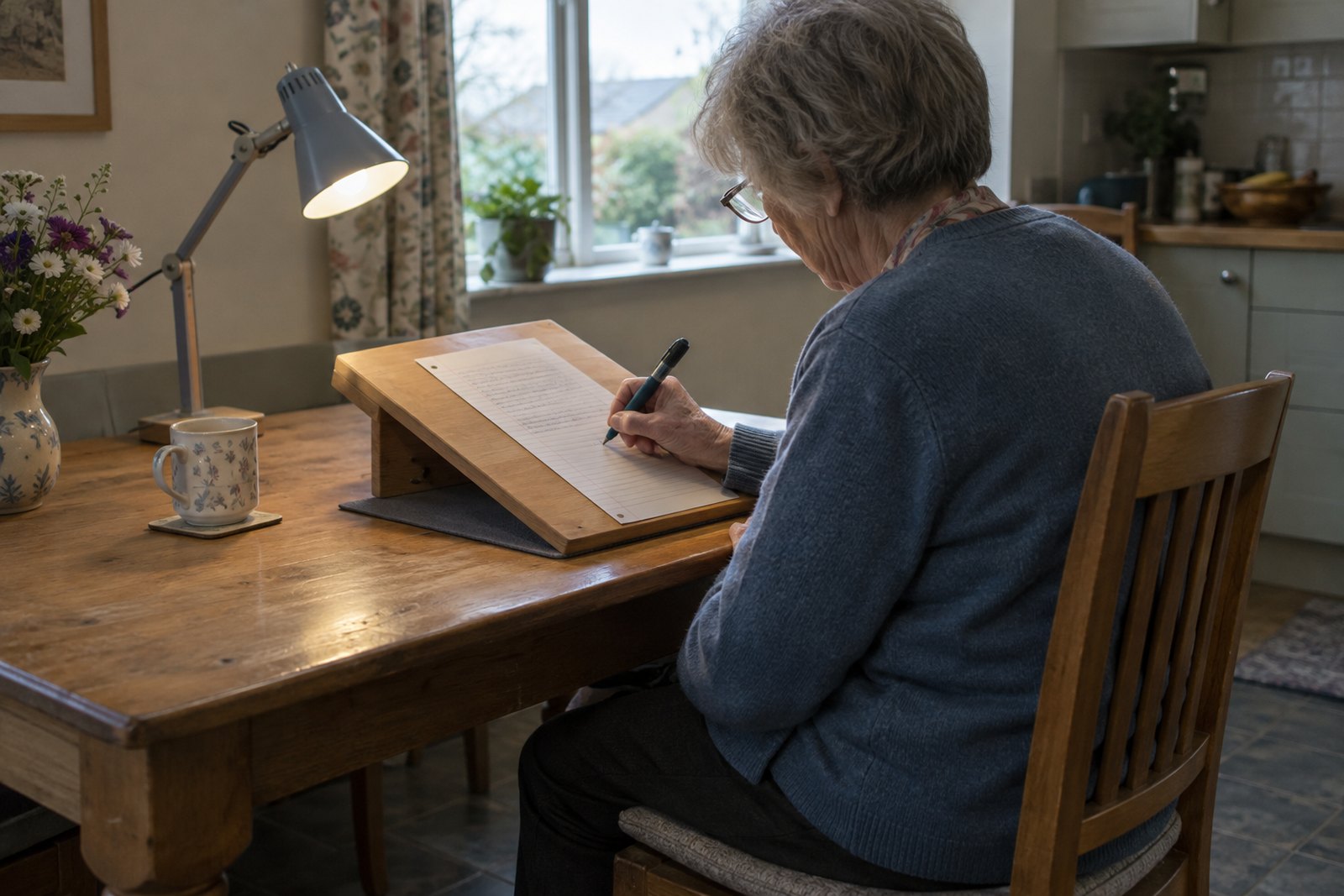
Micrographia is the medical name for handwriting that becomes unusually small and cramped. In Parkinson's it often has a particular pattern: you start a line at a normal size, and by the end of the sentence the letters have shrunk and squashed together, sometimes to the point where you cannot read them yourself. For some people it happens from the first word. For many it is one of the earliest things they or their family noticed, sometimes before diagnosis.
The short answer to "can anything be done?" is yes, quite a lot. Micrographia is not a sign that your hand muscles are weak, and it usually responds to simple changes: writing bigger on purpose, using lines as a guide, pausing to reset, choosing an easier pen and sorting out your posture and lighting. Where writing is no longer worth the effort, there are good alternatives for signatures, forms and notes. This guide covers all of it, and explains where an occupational therapist fits and where someone else, such as your Parkinson's nurse, is the right person to ask.
What micrographia actually looks like
People describe it in different ways. Some common versions:
- Shrinking as you go. The first word or two look normal, then the letters get progressively smaller along the line or down the page. This is often called progressive micrographia.
- Small from the start. Everything is smaller than it used to be, but the size stays fairly even. This is sometimes called consistent micrographia.
- Cramped and crowded. Letters run into each other, the spaces between words close up and loops on letters like l, e and g flatten out.
- Slower and more effortful. Writing takes longer and your hand or forearm feels stiff or tired.
- A signature that no longer looks like yours. This is the one that causes practical trouble, at the bank, on forms and on postal votes.
It can sit alongside tremor, but it is a different thing. Tremor makes writing shaky. Micrographia makes it small. Some people have both, some only one.
Why Parkinson's makes handwriting smaller
Parkinson's reduces the amount of dopamine available in a part of the brain called the basal ganglia. Among its many jobs, this area helps you do two things without thinking: keep a movement going smoothly, and make it the right size.
When that system is not working well, movements tend to get smaller and slower, especially repeated ones you used to do on autopilot. Handwriting is exactly that kind of movement. So are walking, swinging your arms and speaking. That is why the same person may notice their steps shortening, their voice getting quieter and their writing shrinking. It is one underlying problem showing up in different places. Stiffness in the hand and forearm adds to it, and so does tiredness: the longer you write, the more the size tends to drift down.
The useful part of this explanation is what it tells you about fixing it. The ability to make bigger movements is usually still there. What has gone is the automatic scaling. If you put the attention back in, consciously aiming for big letters and giving yourself visual targets, writing often improves noticeably. Most of the strategies below are built on that idea.
Practical ways to write bigger, starting today
Aim big, on purpose
This sounds too simple to work, but it is the single most useful change. Before you start, tell yourself "big" and aim for letters that feel slightly too large. What feels oversized to you will often come out looking normal to anyone else. Some people say "big" in their head at the start of each word, or each line.
Use lines as targets
Paper with wider line spacing gives your letters something to fill. Many people find it helps to aim for the tall letters (b, d, h, k, l) to touch the line above, and the bottom of letters like g and y to reach the line below. Options to try:
- Wide-ruled or extra-wide-ruled paper.
- Paper with a dashed middle line, like the kind used for teaching children, which helps keep small letters a decent height.
- Large-square grid paper, aiming for one letter per square.
- Drawing your own guide lines with a ruler and a thick pen on plain paper, or using a dark lined sheet slipped underneath thin paper.
A small mark at the right-hand edge of the page, or at the end of a space on a form, gives you a target to reach. It stops the line from bunching up at the start.
Pause and reset
If your writing shrinks as you go, stop at the end of each word or line, lift the pen, take a breath and restart with "big" in mind. Writing in short bursts rather than long stretches keeps the size up. For a longer piece, such as a card or a letter, break it into sentences with a short rest in between, and shake out your hand.
Warm up first
A minute of warm-up before writing loosens stiff fingers and reminds your brain what big movements feel like. Try:
- Opening your hand wide, stretching the fingers apart, then making a loose fist. Repeat slowly a few times.
- Drawing large loops, circles and zigzags across a whole sheet of paper, or on a whiteboard.
- Writing a few large letters or your name very big before the real thing.
If you have pain, a recent injury or other joint problems, keep movements gentle and ask your GP or physiotherapist what is suitable.
Choose an easier pen
A pen you have to press hard and grip tightly makes cramped writing worse. Things that often help:
- A thicker barrel, or a foam or rubber grip sleeve on your usual pen, so you do not have to pinch.
- A pen that glides, such as a gel or rollerball pen, or a felt tip. These need less pressure than many ballpoints.
- A slightly heavier pen, which some people with tremor find steadier. It does not suit everyone, so try before committing.
Thick felt tips also make letters look bolder, which helps you see what you are doing.
Get comfortable and well lit
Sit on a supportive chair at a table, feet flat, with the table at roughly elbow height. Slumping forward makes everything smaller and stiffer. A writing slope tilts the paper towards you, which can improve your wrist position, your view of the page and your posture. A sheet of non-slip matting or a clipboard stops the paper sliding, so your other hand does not have to hold it down.
Light matters more than people expect. A lamp positioned on the opposite side to your writing hand avoids your hand casting a shadow over the line. Black ink on white paper is easier to judge than pale ink.
Practise little and often
A few minutes of deliberate writing practice most days, such as copying a short sentence or writing a shopping list using big letters and wide lines, keeps the skill in use. Keep a sample now and again so you can see whether things are holding steady. Short, regular practice tends to be more useful than one long session that leaves your hand exhausted.
Timing writing around your medication
Many people with Parkinson's notice that their movements are better at certain times of day, often called "on" times, and harder as a dose wears off. If that applies to you, it makes sense to save important writing, such as signing a document, filling in a form or writing a card, for when you are usually at your best.
Some people find their handwriting improves when their medication is working well. Others notice little difference in writing specifically. Either way, do not change when or how you take your Parkinson's medication to fit around writing. If you think your doses are wearing off early, or your writing has changed noticeably, mention it to your Parkinson's nurse, GP or neurologist. They are the right people to review medication.
Signatures, forms and documents
This is where micrographia stops being an irritation and starts causing real problems. A signature that no longer matches the one on file can mean a declined cheque, a queried form or a rejected postal vote.
Practical options
- Update your signature. Banks and other organisations can usually take a new specimen signature. Do it during a good part of the day, and consider doing it again if your writing changes further.
- Avoid needing one. Card payments with a PIN or contactless, online and telephone banking, and direct debits all reduce how often you need to sign.
- Use electronic signatures. Many organisations accept documents signed electronically or by clicking to agree. Some legal documents still need a handwritten signature and a witness, so ask the organisation what they accept.
- Postal votes. If you cannot provide a signature, or a consistent one, because of a disability, you can usually apply for a signature waiver. Ask your council's electoral registration office or check GOV.UK for the current process.
- Tell people in advance. A short note to your bank, solicitor or pharmacy explaining that you have Parkinson's and your signature varies can save awkward moments.
It is also worth thinking ahead. Making a lasting power of attorney while you are well means someone you trust can handle financial or health decisions if you ever need them to. That is about planning, not about handwriting, but the two conversations often happen together.
When writing is no longer worth the struggle
There is no prize for forcing yourself to handwrite everything. Many people keep handwriting for the things that matter to them, such as birthday cards or a diary, and use other tools for the rest.
- Typing on a laptop, tablet or phone, with the text size made larger. A keyboard with bigger keys, or a keyguard, can help if tremor makes you hit the wrong key.
- Voice dictation, built into most phones, tablets and computers, turns speech into text. Note that Parkinson's can also make your voice quieter, which may affect how well dictation works. A speech and language therapist can help with voice volume.
- Voice notes and reminders on a phone or smart speaker instead of written lists.
- Printed address labels for cards and envelopes.
- A wipe-clean whiteboard with a thick marker for shopping lists and notes at home, where big writing comes naturally.
For more ideas on writing alongside a shake, see our guide to living with a tremor, and for the wider picture of daily life, Parkinson's and everyday tasks.
Where an occupational therapist fits
An occupational therapist looks at how you manage the everyday things you need and want to do, and handwriting is one of them. A private occupational therapist visiting at home can:
- Watch you write in your usual seat and spot what is making it harder, such as chair and table height, posture, lighting or grip.
- Try different pens, grips, paper, writing slopes and non-slip mats with you, so you buy what actually helps.
- Teach cueing strategies and set up a short, realistic practice routine.
- Help you work out which tasks to keep handwriting and which to switch to typing, voice or other tools, including setting up phone or computer accessibility features.
- Look at other fine hand tasks that tend to go with micrographia, such as buttons, cutlery, keys and opening packaging, and suggest equipment or easier methods.
- Consider fatigue, work tasks if you are still working, and how things are likely to change over time.
Others lead in some areas. A Parkinson's specialist, usually a neurologist or a geriatrician, makes the diagnosis, and your specialist team, including your Parkinson's nurse, manages medication alongside your GP. A physiotherapist leads on movement programmes focused on making movements bigger, along with walking and balance. A speech and language therapist helps with a quiet voice and with swallowing. NHS occupational therapy is available, often through a referral from your Parkinson's nurse, GP or neurologist, so ask about that too. Our neurological occupational therapy page explains what private support looks like.
One important point: if your handwriting has changed and you have not been diagnosed with anything, see your GP. Small handwriting has several possible causes and should be looked at properly. If writing changes suddenly, especially with weakness, a drooping face, slurred speech or confusion, call 999, as these can be signs of a stroke.
Frequently asked questions
Does small handwriting always mean Parkinson's?
No. Micrographia is strongly linked with Parkinson's, but other conditions can affect handwriting, and some people simply write small. If your writing has changed without explanation, or you have noticed other changes such as stiffness, slowness or tremor, book an appointment with your GP rather than drawing conclusions.
Can handwriting go back to normal?
For many people it improves noticeably with the strategies here, especially aiming big, using lines and pausing to reset. It may not return to exactly how it was, and Parkinson's changes over time, so the aim is writing that is readable and comfortable rather than perfect.
Will Parkinson's medication improve my writing?
Some people find writing is easier when their medication is working well, others notice little change in their handwriting specifically. Do not adjust your medication yourself. Raise any changes with your Parkinson's nurse, GP or neurologist.
Should I keep practising or just switch to typing?
Both are reasonable, and most people do a mix. Keeping some handwriting going helps for signatures and personal things like cards. Switching everyday notes and longer writing to a keyboard or voice saves energy for what matters to you.
Do weighted pens help with micrographia?
A heavier pen can help some people with tremor feel steadier, but it does not directly fix small writing. For micrographia, a comfortable thick grip, a smooth pen and wide lines usually make more difference. Try different options before buying several.
My bank keeps querying my signature. What can I do?
Ask the bank to update your specimen signature, ideally at a time of day when your writing is at its best. You can also reduce how often you need to sign by using PIN, contactless, online banking and direct debits. Banks have to consider reasonable adjustments for disabled customers, so it is worth explaining your situation.
Next steps
If handwriting and other hand tasks are getting harder, an occupational therapist can assess things in your own home and help you find what works. See our equipment and daily living aids page, or current guide prices, and choose your area below.
Talk to an occupational therapist near you
This guide is general information. For advice about your own situation - or someone you look after - a local occupational therapist can visit you at home and see it for themselves.
Choose your area: