Falls Prevention Home Assessments in Cheshire East
By Mobile Occupational Therapist • 5 October 2026 • 11 min read
Local Occupational Therapist -
Esther Yirrell, Cheshire East
If you are worried that you, or a parent, might fall at home in Cheshire East, the most useful thing is a proper look at how that person actually moves around their own home. A falls checklist is a start. A walk through a real day is better. That is what a home falls assessment is. An occupational therapist watches how someone gets out of their chair, manages the stairs, uses the bathroom and gets to the toilet at night. Then they suggest changes that fit that person and that house, not a generic list.
You have two main routes. Cheshire East Council runs its own occupational therapy service for adults, and it can arrange equipment and adaptations. Under its current policy, small adaptations such as grab rails are provided free. Or you can pay for a private home visit from an HCPC-registered occupational therapist, which some families choose while they wait or when they are paying for changes themselves. This guide covers both, what the visit looks at room by room, and the causes of falls that have nothing to do with the house at all.
Why falls are rarely just about the rug
Families usually start with rugs and trailing cables. Fair enough. They matter. But a fall is often several small things stacking up at once: a medicine that makes you light-headed when you stand, slippers that have stretched, legs that have weakened over a winter spent mostly indoors, a dim landing, and a hurried trip to the toilet at three in the morning.
Moving the rug helps. So does sorting out the medicines, the eyes, the feet and the strength in the legs. The best results come from looking at the person and the house together, which is exactly what a good assessment does.
What a home falls assessment looks at, room by room
Every home is different, and so is every person in it. Here is roughly what an occupational therapist will look at, and what you can start checking yourself today.
Getting in and out
Front and back door steps, and whether there is anything solid to hold. How the door gets opened while carrying shopping. Outside lighting, the doormat that curls at the edge, wet leaves and moss on the path. Many falls happen on the way in, with hands full and attention elsewhere.
Hallway and stairs
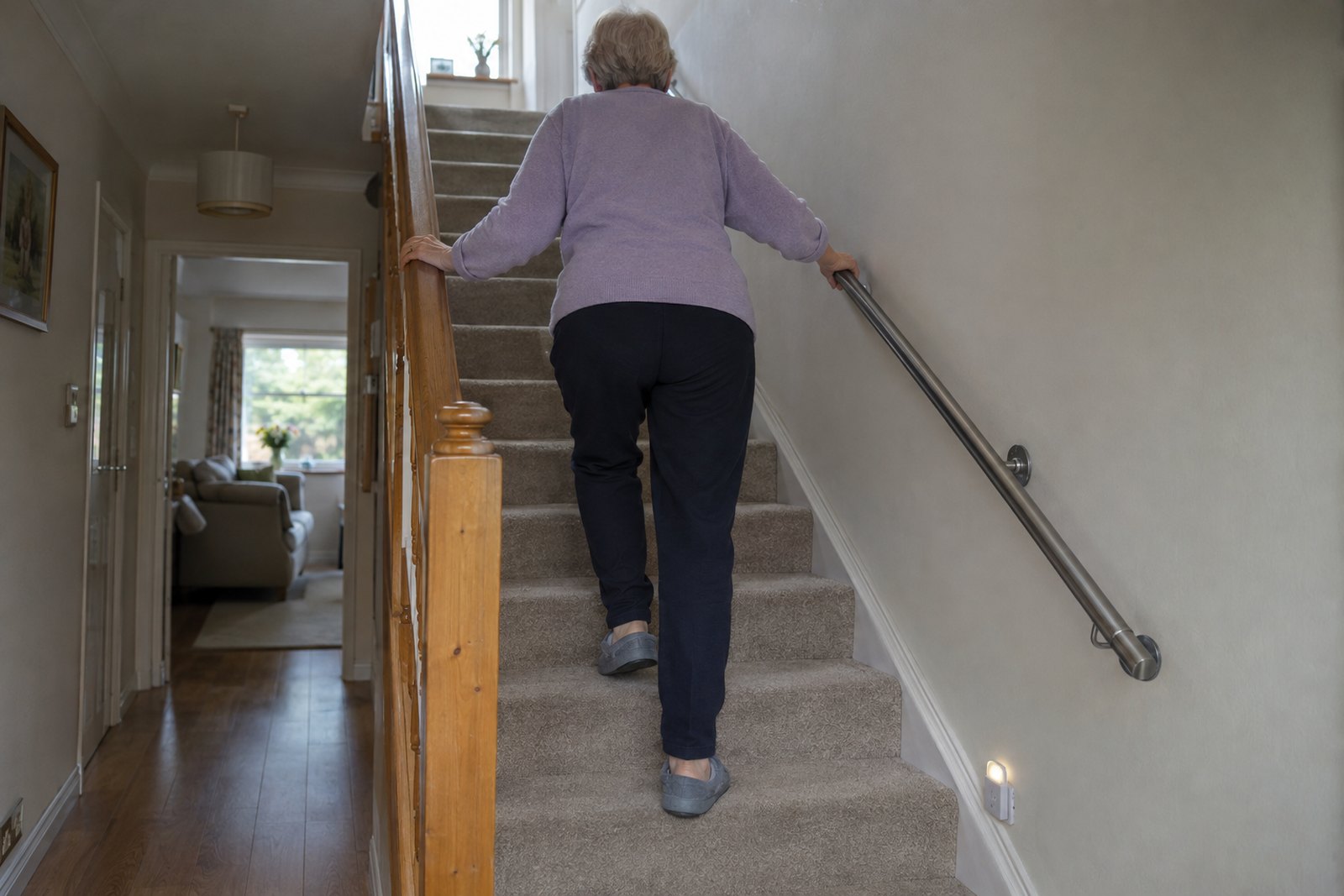
Is there a rail on both sides of the stairs, running the full length? Can the light be switched on at the top and the bottom? Are things left on the stairs to take up later? Can you see where each step ends? The bottom step is a common place to miss, because people think they have already reached the floor.
Living room
The chair matters more than people expect. Getting up from a low, soft chair is a classic moment for a wobble. The therapist will look at chair height and arms, footstools, cables, pets, and whether the things you use every day are within easy reach or on a shelf you stretch for.
Kitchen
Reaching into high cupboards, standing on a stool or chair to get something down, carrying hot drinks while also using a stick, and spills on a hard floor. Often the answer is rearranging the cupboards so everyday items live between waist and shoulder height.
Bathroom and toilet
Getting in and out of the bath, a wet floor, a low toilet with nothing to push up from. Towel rails, basins and radiators get grabbed in a hurry but are not built to take your weight. The therapist will look at where a properly fixed rail or a piece of equipment would actually help.
Bedroom and the night
Bed height, standing up too quickly, the route to the toilet in the dark, whether there is a light within reach, and whether glasses are by the bed. Night-time is when tiredness, low light and urgency all arrive together, so this part of the visit is often the most useful.
Just as important, the therapist watches how you move: how you stand, walk, turn and sit, whether you rush, and what you have quietly stopped doing. Often the best advice is a different way of doing something rather than a new piece of kit.
The causes that are not about the house
Medicines
Some medicines can cause dizziness, drowsiness or a drop in blood pressure when you stand up, particularly when several are taken together. If you take a number of medicines, or have had a fall or a near miss, ask your GP or community pharmacist for a medication review. Do not stop or change any medicine yourself.
Eyesight
Have your eyes tested regularly. In England, people aged 60 and over can usually get a free NHS sight test; check the NHS website for the current rules. If you wear varifocals, mention to the optician that you find steps or kerbs awkward.
Feet and footwear
Painful feet, numb feet, long toenails and loose backless slippers all make falls more likely. Well-fitting shoes or slippers with a back and a thin, grippy sole are worth more than most gadgets. If foot problems are getting in the way, ask your GP about seeing a podiatrist.
Strength and balance
The NHS recommends exercise that builds strength and balance to help prevent falls. Ask your GP whether a strength and balance programme or a falls service referral would suit you. Start gently, and if you have a heart or lung condition, check with your GP first.
Dizziness, blackouts and other warning signs
If a fall happened because you blacked out, felt your heart racing, had chest pain or became suddenly confused, see your GP. If those symptoms are sudden or severe, call 999. Falls are sometimes the first sign of an infection or another health problem, so do not write them off as clumsiness.
Equipment that can help
Equipment works best when it is chosen for the person and fitted in the right place. A rail at the wrong height or a toilet frame on an uneven floor can make things worse. Common suggestions include:
- Grab rails by the toilet, bath, shower and outside steps, fixed securely into the wall.
- A second stair rail, so both hands have something to hold.
- A raised toilet seat or toilet frame, to make standing up easier.
- Chair raisers or a higher, firmer chair with sturdy arms.
- A bath board, bath seat or shower seat, so you are not standing on a wet surface.
- A perching stool for the kitchen, and a trolley for carrying plates and drinks.
- A long-handled reacher, so nobody climbs on chairs.
- Night lights or motion-sensor lights on the route from bed to toilet.
- A personal alarm or falls detector, especially for someone living alone. Our guide to personal alarms and falls detectors explains what actually helps.
What to do after a fall
Have a plan before you need one. If you or someone you care for falls:
- Stay still for a moment. Get your breath and check for pain or injury before trying to move.
- Call 999 if there is a head injury, severe pain, a suspected broken bone, loss of consciousness, difficulty breathing, new confusion, or if the person cannot get up.
- If you are not hurt, get up slowly using a sturdy chair or bed for support. Our guide on how to get up from the floor after a fall walks through it step by step.
- If you cannot get up, call for help, keep warm with anything nearby, and shift your position now and then.
- Tell your GP even if you were not hurt. A fall is useful information. Call NHS 111 if you are unsure how urgent it is.
For a parent living alone, say in Knutsford or Alsager, lying on the floor for a long time is itself harmful. An alarm they will actually wear, and a way for help to get in, are worth sorting out early.
Council help in Cheshire East
Cheshire East Council is a single unitary council, so the same council handles assessments, equipment and adaptations whether you live in Crewe, Nantwich, Sandbach, Macclesfield, Congleton or Wilmslow. For adults, the first step is the council's Occupational Therapy service. An occupational therapist or social care assessor will look at your needs and, if an adaptation is needed, pass your case to the council's Housing team.
Under the council's current policy, which can change:
- Small adaptations under £1,000, such as grab rails, are provided free, outside the grant system.
- A Disabled Facilities Grant of up to £30,000 can pay for bigger work such as a level-access shower or a stairlift. It is means tested for adults, though people on an income-related benefit may not be.
- An Urgent Adaptations Grant of up to £10,000, with no means test, is available in certain situations, including when someone cannot leave hospital or a care placement until the work is done.
- Care and Repair, which in Cheshire East is part of the council, gives free advice and help with forms and funding.
Contact details and the full picture are on our Cheshire East grant page.
Paying privately: where it fits
Cheshire East's policy refers to a council-appointed occupational therapist, so a private report is unlikely to replace the council's own assessment for a grant. Ask the council before relying on one.
A private visit can still be worth it. It can tell you quickly what would help while you wait, guide you if you are paying for changes yourself or are over the means test, and help you avoid buying the wrong equipment. Our page on private home assessments explains what is involved.
Your local occupational therapist: Esther Yirrell
Esther Yirrell is the occupational therapist listed for Cheshire East on our directory. Esther is HCPC registered, based in Cheshire East, and travels to people's homes across the area. Home assessments and older people's independence are among the specialisms on Esther's profile, which describes helping older adults keep their independence and manage everyday life.
Esther's profile also describes over 20 years as an occupational therapist, with a particular focus on neurological conditions, especially recovery after a stroke. Home visits start with a thorough assessment of the person's needs, and Esther works with the person and their family to set goals they can realistically reach. Services Esther offers include home assessments, equipment and aids, home adaptations, hospital discharge and support for older people's independence. You can read more on Esther's profile, or see our occupational therapy in Cheshire East page for the towns covered, from Macclesfield and Poynton to Crewe and Middlewich.
Frequently asked questions
Is a home falls assessment free in Cheshire East?
An assessment through the council's adult Occupational Therapy service does not cost you anything to ask for, and under current council policy small adaptations such as grab rails are free. Larger work may be funded by a grant, which is means tested for adults. A private assessment is paid for.
Will a few grab rails be enough?
Sometimes, yes. Often the bigger gains come from the things that are not about the house: a medication review, an eye test, better footwear and strength and balance exercise. Rails help most when they are part of that wider picture.
My parent says they are fine and will not have anyone round. What can I do?
Start small and practical rather than with a big conversation about falling. A night light, a second stair rail or a higher chair is easier to accept than an assessment. It can help to frame a visit as keeping them independent at home, which is usually what they want too.
Should I get a private assessment before applying for a grant?
Not for the grant itself, as the council is likely to want its own assessment. A private visit may still help you understand what would make a difference while you wait, or if you plan to pay for some changes yourself.
Do I need to see a doctor after a fall if I feel fine?
Tell your GP, even if you were not hurt, because a fall can point to a health change worth checking. Call 999 for a head injury, severe pain, or if you cannot get up, and NHS 111 if you are not sure.
Next steps
If you would like a private home falls assessment in Cheshire East, have a look at Esther Yirrell's profile and Esther's prices, then send Esther an enquiry describing what is worrying you and the home you would like looked at.