

Dupuytren's Contracture: Surgery Recovery and Hand Therapy
By Mobile Occupational Therapist • 19 September 2026 • 13 min read
Dupuytren's contracture is a thickening of the tissue just under the skin of your palm. Over months or years it can form small lumps, then tight cords, which slowly pull one or more fingers down towards the palm so they will not straighten fully. The ring and little fingers are the usual culprits. It is not normally painful, and many people live with a mild bend for years without needing anything done.
Treatment is usually considered when the bend starts getting in the way: you cannot lay your hand flat on a table, you catch your finger putting a hand in your pocket, or washing your face, shaking hands or wearing gloves has become awkward. If that is you, the first step is your GP. If you have already had treatment, recovery is where much of the real work happens: looking after the wound, keeping swelling down, wearing a night splint and doing exercises taught by a hand therapist, who is often an occupational therapist. Whatever your surgical team tells you overrides anything general you read, including here.
What Dupuytren's contracture actually is
Under the skin of your palm is a layer of tough tissue called fascia. It helps protect the tendons and gives your grip some structure. In Dupuytren's, this tissue thickens. First you may notice a firm lump or pit in the palm, often near the base of the ring finger. Later, a cord can form, running from the palm into the finger like a tight string. As the cord shortens, the finger is drawn into a bend at the knuckle, the middle joint, or both.
It tends to run in families and is more common in men and in people over 50. It has also been linked with smoking, drinking a lot of alcohol and diabetes. It can affect both hands. It is not caused by something you did wrong, and it is not arthritis, though people sometimes have both.
It is also different from trigger finger, where a finger catches or clicks as you bend and straighten it. With Dupuytren's, the finger does not lock and release. It simply will not straighten.
When to see your GP, and when treatment is considered
A simple check you will hear about is the table-top test. Put your hand palm down on a flat table and see whether your palm and fingers can lie flat. If they cannot, it is worth booking a GP appointment. This is not a pass or fail test that decides treatment on its own, but it is a useful sign that the contracture has reached the point where a hand specialist may want to see you.
Your GP can usually recognise Dupuytren's by looking at and feeling your hand. If it is affecting what you can do, they can refer you to a hand surgeon. Generally, treatment is not offered for lumps alone, because the procedures carry risks and the condition can stay mild for a long time. The decision is about how much the bend is affecting your life, which joints are involved and how quickly it is changing.
Do see your GP sooner if your hand is painful, tingling or numb, or if a finger has changed quickly. Those are not typical of Dupuytren's and something else, such as a trapped nerve, may need checking. This is not usually an emergency, but a sudden injury to the hand, a finger that has gone white, blue or cold, or a hot, red, swollen hand with a fever needs urgent help: call NHS 111, or 999 if someone is very unwell.
While you wait
Being honest, there is no good evidence that stretching, massage or splinting in the early stages stops Dupuytren's from progressing, and forcing a bent finger straight can make it sore. What you can do is make daily life easier. Chunkier handles on tools, padded grips and gloves can help if a lump in your palm is tender when you grip. Notice which tasks catch you out, because that is useful information for the surgeon.
Treatment options, in plain terms
Your surgeon will talk you through what suits your hand. The main options are:
- Needle fasciotomy (sometimes called needle aponeurotomy). Under local anaesthetic, a fine needle is used through the skin to weaken and break the cord, then the finger is gently straightened. There is no large wound and recovery is usually quicker, but the contracture is more likely to come back than after open surgery.
- Fasciectomy. An operation to remove the thickened tissue through cuts in the palm and finger. Recovery takes longer and you will usually need hand therapy afterwards, but results tend to last longer.
- Dermofasciectomy. The thickened tissue and the skin over it are removed and replaced with a skin graft, often taken from the arm. It is sometimes used when Dupuytren's has come back or the skin is heavily involved.
- Other options. A surgeon may discuss radiotherapy for very early disease in some centres, or, in rare severe cases where a finger cannot be straightened, procedures on the joint itself. You may also read online about an injection treatment called collagenase. It was withdrawn from the UK market in 2020, so it is not generally available here, but your surgeon can tell you about current options.
It is reasonable to ask your surgeon how likely each option is to help your particular fingers, how long recovery tends to take for your type of work, and what happens if it comes back.
Recovery after Dupuytren's treatment
Recovery depends a great deal on which procedure you had. After needle fasciotomy, many people are using the hand lightly within days. After open surgery, expect several weeks of real limitation and some months before the hand feels fully normal. The steps below are typical, but your surgical team and hand therapist will give you specific instructions, and theirs come first.
Wound care
Keep the dressing clean and dry and leave it alone unless you have been told otherwise. A plastic bag or a waterproof cover over the hand helps in the shower, though many people find a strip wash at the sink easier for the first week or two. Stitches, if you have them, are usually removed at a follow-up appointment. Some wounds in the palm are deliberately left partly open to heal from underneath; this can look alarming but is a recognised technique, and your team will explain how to care for it.
Swelling
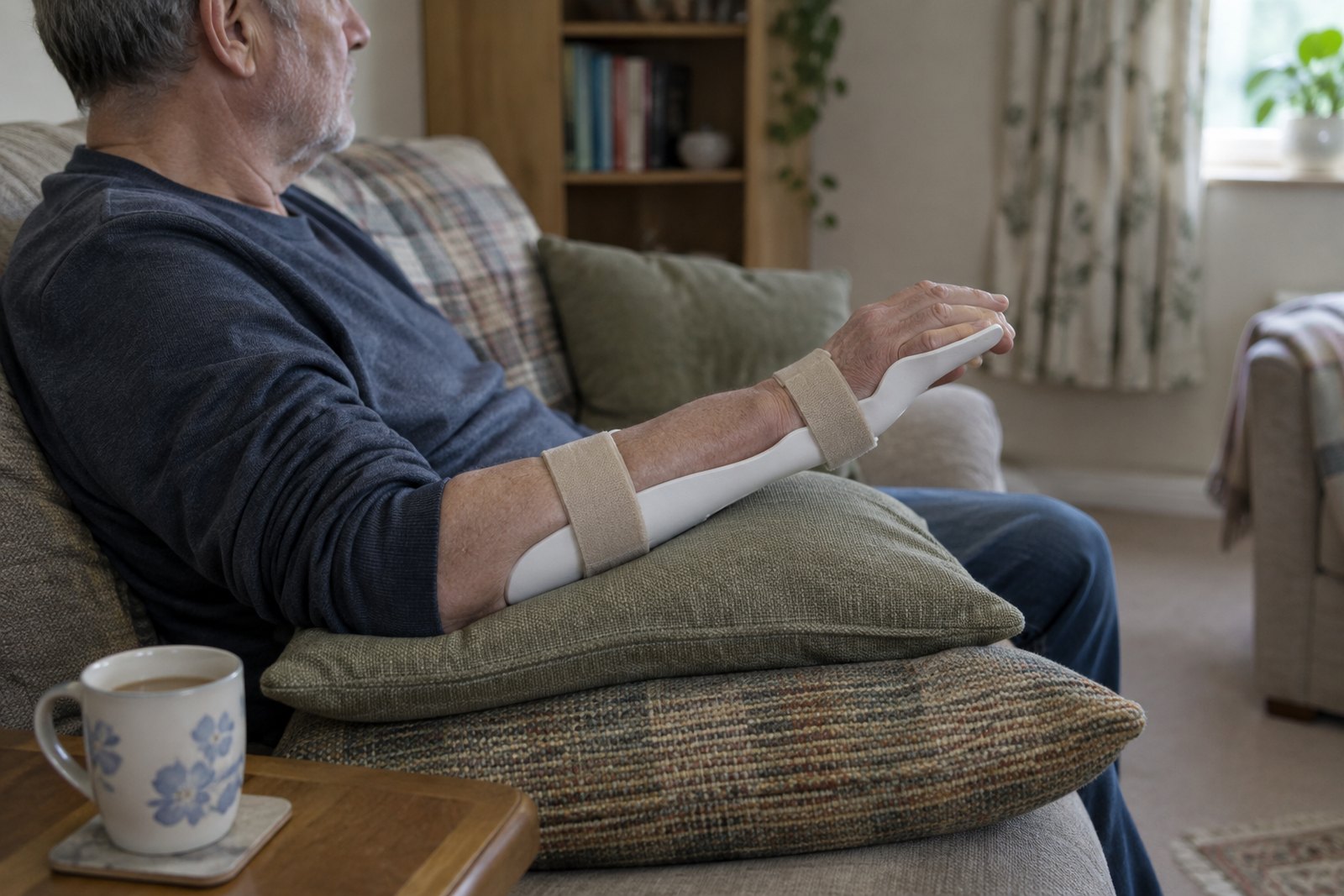
Swelling makes fingers stiff and sore, so controlling it early matters. Keep your hand raised above the level of your heart as much as you can for the first few days, propped on cushions when sitting and on a pillow in bed. Avoid letting it hang down by your side when walking. Gently moving the joints you have been told to move, including your elbow and shoulder, helps too. Take off rings on the affected hand before surgery, and do not put them back on until the swelling has settled.
The night splint
Many people are given a splint after treatment, usually made to measure by a hand therapist from a plastic that is shaped to your hand. It holds the treated fingers straight while you sleep. Practice varies: some units give everyone a splint, while others only use one if the finger starts to bend again, and the evidence for routine splinting is mixed. You may wear it day and night at first, then just at night for several months, depending on your therapist's advice.
A splint should feel firm but not painful. If it rubs, causes red marks that do not fade, makes your fingers tingle or go numb, or no longer fits because the swelling has changed, contact your hand therapy department. Do not trim it or reshape it yourself, and do not tighten the straps to push the finger straighter.
Exercises, as taught by your hand therapist
Exercises usually start within the first few days or week, but the exact programme depends on your surgery and your hand. It often includes gently bending the fingers into a fist, straightening them fully, and moving each joint on its own. You may be asked to do them little and often, several times a day, rather than one long session.
The rule is to follow what you were shown, not what you find online. Pushing too hard can increase swelling and pain, and doing too little can leave the finger stiff. If something hurts sharply or you are unsure whether you are doing an exercise correctly, ask your therapist at the next appointment, or ring the department.
Scar care
Once the wound has fully healed and your team says it is fine, you may be shown how to massage the scar with a plain unperfumed moisturiser. This can help soften it and reduce tenderness. Scars in the palm can stay firm and sensitive for some months, which is normal. Protect the scar from strong sun while it is still pink.
Warning signs to act on
- Increasing redness, heat, swelling, pus or a bad smell from the wound, or feeling feverish: contact your surgical team or GP the same day.
- A finger that turns white, blue or cold: contact your surgical team urgently, or go to A&E.
- New numbness in a finger that does not improve: tell your team, as nerves can be affected during surgery.
- Pain that is much worse than expected, with swelling, skin colour changes or extreme sensitivity to touch: tell your team promptly, as this can need early treatment.
Managing everyday tasks while your hand heals
For a few weeks after open surgery you are effectively one-handed, and if it is your dominant hand, that is harder than people expect. Some practical ideas:
- Dressing: wear loose clothes with elastic waists, slip-on shoes and front-opening tops. Put the operated arm into sleeves first and take it out last.
- Kitchen: plan simple meals, use a non-slip mat to hold bowls steady, and fill the kettle using a small jug rather than lifting a full kettle. Our guide to kitchen aids and mealtime independence covers equipment that makes one-handed cooking safer.
- Washing: a long-handled sponge and pump-action soap and shampoo help when you only have one hand free and the other must stay dry.
- Sleeping: rest the hand on a pillow, raised, with the splint on as advised.
- Heavy and dirty jobs: gardening, DIY and lifting shopping usually wait until your team says the hand is ready. Wounds and grafts need protecting from dirt and strain.
If someone lives with you, let them do the jar lids and the bin bags for a while. It is temporary.
Going back to work and driving
When you return to work depends on the procedure, which hand, and what your job involves. Someone with a desk job after needle fasciotomy may be back quickly, while a person who grips tools or lifts all day after open surgery may need considerably longer. Ask your surgeon and hand therapist for guidance based on your actual job, and get a fit note if you need one. A gradual return can help; our guide to a phased return to work explains how to plan it with your employer.
For driving, there is no single set waiting time. You must be able to control the car safely, including an emergency stop and turning the wheel quickly, and you should not drive while wearing a splint unless your team says it is safe. Ask your surgeon when you can drive, check with your insurer before you start again, and see GOV.UK for current guidance on health conditions and driving.
Will it come back?
It can. Treatment releases the bend, but it does not cure the tendency to form this tissue. Dupuytren's can return in the same finger or appear in a different part of the hand, sometimes years later. It is more likely to come back after needle fasciotomy than after open surgery, and in people who developed it young or have a strong family history.
This does not mean treatment was wasted. Many people get years of easier hand use. If the bend returns and begins to interfere again, go back to your GP and ask for a re-referral.
Where an occupational therapist fits
Hand therapists are usually occupational therapists or physiotherapists with additional training in hands. After Dupuytren's surgery, NHS hand therapy is normally arranged by your surgical team, and that is the right place to start: they make your splint, set your exercises and know what was done in theatre. A private therapist does not replace this and should not contradict your surgeon's instructions.
Where an occupational therapist adds something is in the everyday picture. They look at how your hand is coping with real tasks, such as cooking, dressing, work and hobbies, and suggest ways of doing them that protect healing tissue. A private occupational therapist visiting at home can help with one-handed routines, equipment, managing a dominant-hand operation, or planning a return to a hand-heavy job. If you are waiting for NHS hand therapy, or have been discharged but still struggling, some people choose a private hand therapist; check they are HCPC-registered and have hand experience. You can read more about hand therapy at home and our page on hand and upper limb problems.
Diagnosis, the choice of procedure and wound problems sit with your GP and surgical team, not with an occupational therapist.
Frequently asked questions
Is Dupuytren's contracture painful?
Usually not. Some people find the lumps in the palm tender, especially early on or when gripping. Significant pain, tingling or numbness is not typical and is worth getting checked by your GP.
How long does it take to recover from Dupuytren's surgery?
It varies with the procedure. After needle fasciotomy, many people use the hand for light tasks within days. After open surgery, expect several weeks before the hand is useful for most daily tasks and some months before it feels settled. Your surgeon and hand therapist can give you a better estimate for your own hand and job.
How long will I need to wear a night splint?
Often for several months, but it depends on your surgery and how your fingers respond. Your hand therapist will tell you when to wear it and when you can stop, and may adjust it as the swelling changes.
Can exercises or stretching stop Dupuytren's getting worse?
There is no good evidence that they do before treatment, and forcing the finger can make it sore. After treatment, exercises taught by your hand therapist matter a great deal for keeping the movement you have gained.
Can I get hand therapy privately?
Yes. Private hand therapists, many of them occupational therapists, can provide splints, exercise programmes and help with daily tasks. Tell your surgical team if you are seeing someone privately so everyone is working to the same plan.
Will Dupuytren's come back after surgery?
It can, in the same place or elsewhere in the hand. If it returns and starts affecting what you can do, see your GP about a re-referral. Further treatment is often possible.
Next steps
If daily tasks are a struggle while your hand recovers, see our equipment and daily living aids page, or current guide prices, and choose your area below.

Talk to an occupational therapist near you
This guide is general information. For advice about your own situation - or someone you look after - a local occupational therapist can visit you at home and see it for themselves.
Choose your area: