

Comfort Height Toilets: Who They Help and What to Check
By Mobile Occupational Therapist • 17 October 2026 • 14 min read
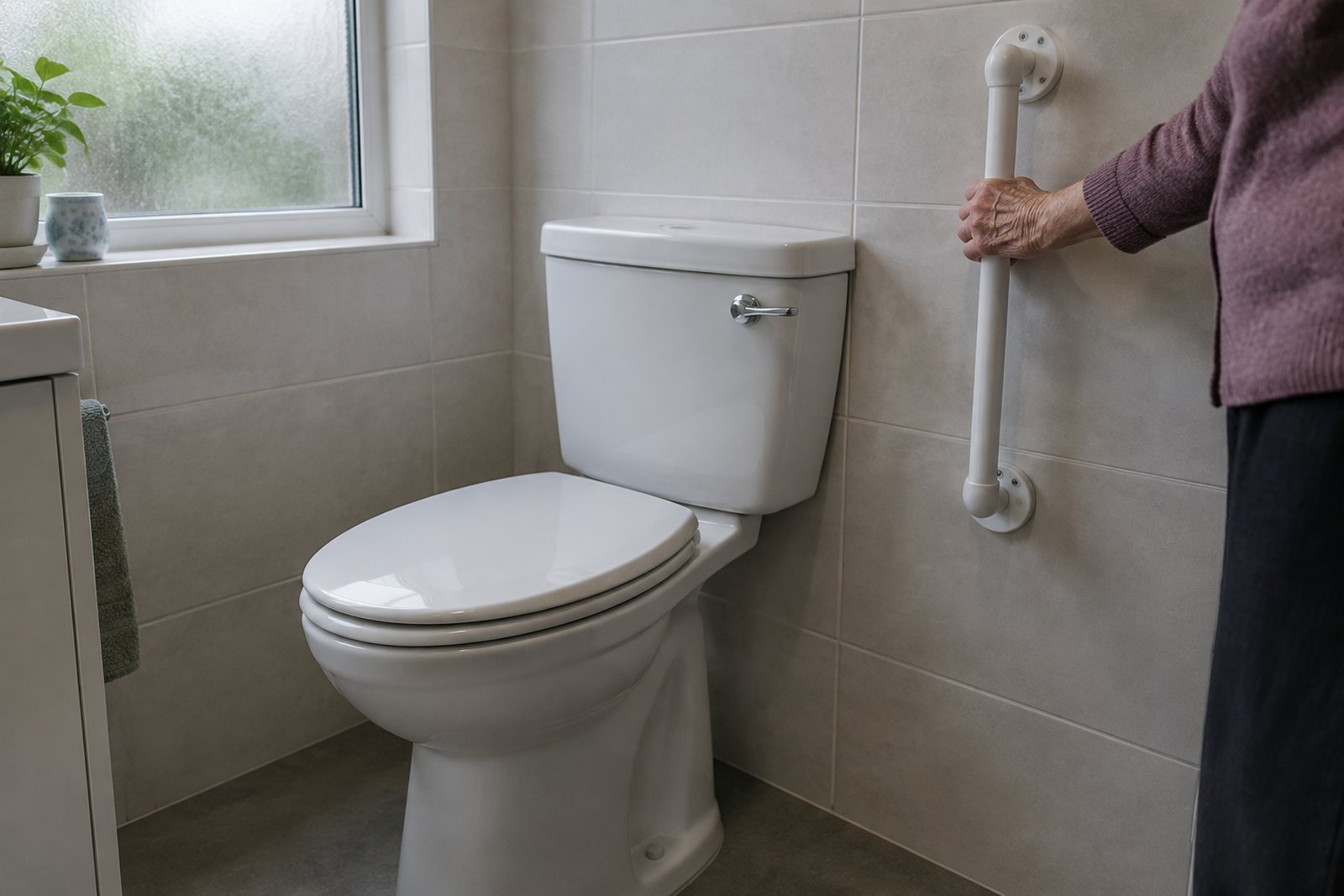
A comfort height toilet is simply a toilet with a taller pan. Once the seat is on, it sits at roughly the height of a dining chair, a few centimetres higher than a standard toilet. That small difference means less bending at the hips and knees when you sit down, and less work for your legs when you stand back up. You will also see them sold as raised height, chair height or tall toilets. They mean broadly the same thing, and there is no single official height that all of them share.
They help most the people who find low seats hard: stiff or painful hips and knees, weaker legs, recovery after a hip or knee replacement, or general frailty. They suit fewer people than the brochures suggest, though. If you are shorter, if children share the bathroom, or if you struggle with constipation, a taller pan can make things worse rather than better. And a raised toilet seat or a toilet frame may do the same job for a fraction of the cost, with no plumbing. This guide covers who benefits, who should think twice, the alternatives, and what to check before you buy.
What a comfort height toilet actually is
From the outside it looks like any other toilet. The pan is taller, so the rim and the seat sit higher off the floor. The cistern, flush and seat work in the same way. Most are close-coupled, with the cistern sitting directly on the back of the pan, or back-to-wall, with the cistern hidden in a unit or behind a panel.
Heights vary between models and makers, so do not assume that the label on one box means the same as the label on another. What matters is the height from the floor to the top of the seat once it is fitted, because that is what you actually sit on. Measure that, not the pan rim.
There is a third type worth knowing about. A wall-hung toilet is fixed to a frame inside the wall, with no pan touching the floor. The fitter can set it at whatever height suits you when it goes in. Changing that height later is a much bigger job, so it needs deciding carefully at the start.
Who a taller toilet helps
Sitting down and standing up from a low seat asks a lot of your hips, knees and thigh muscles. Raising the seat a few centimetres takes some of that load away. People who tend to find it helps include:
- People with stiff or painful hips and knees, for example from arthritis, who find the last part of sitting down is more of a drop than a controlled lowering.
- People recovering from hip or knee surgery, especially where the surgical team has advised against deep bending in the early weeks. Our guide to life after a hip replacement covers the toilet side of that in more detail.
- People with weaker legs, whether from age, a long illness, a stay in hospital or a neurological condition.
- Taller people, for whom a standard toilet has always been a long way down.
- People with back pain who find bending forward to lower themselves uncomfortable.
If the difficulty is long term and the bathroom is being refitted anyway, a comfort height pan is a tidy, permanent solution that looks like an ordinary toilet. Some people care about that a great deal. A toilet that does not announce itself as disability equipment can matter to someone who hates the idea of aids in their home, and that can be the difference between something being used and something being resented.
Who it may not suit
This is the part the product descriptions tend to skip.
Shorter people
If your feet do not rest flat on the floor when you sit, you lose your base. Standing up becomes harder, not easier, because you cannot push through your feet, and you are less steady while sitting. Dangling feet also leave the backs of the thighs pressing on the front edge of the seat. If a dining chair already leaves your feet hovering, a taller toilet is probably not for you.
Children and shorter members of the household
A toilet is shared. If grandchildren visit or you live with a much shorter partner, a taller pan may suit one person and make life harder for another. A child step can help children, but it is one more thing to trip over in a small bathroom. Sometimes a removable raised seat used by the one person who needs it is the fairer answer.
Constipation and some continence problems
Opening your bowels is generally easier with your knees raised above your hips, which is why NHS advice on constipation suggests resting your feet on a low stool while on the toilet. A taller toilet moves you the other way. Some people use a comfort height toilet and a footstool together, but the combination can be awkward and the stool becomes a trip hazard. If constipation, straining or emptying your bladder is already a problem, talk to your GP or a continence service before choosing a taller pan.
People who use a wheeled shower commode
Some shower commode chairs are designed to be wheeled over the toilet. A taller pan may not fit underneath. If that kind of chair is in use now, or might be later, measure the clearance under it first.
Wheelchair users
For sideways transfers, the toilet seat usually needs to be close to the height of the wheelchair seat. Too high and you are transferring uphill. This is worth having measured properly rather than guessed.
Cheaper alternatives to try first
A new toilet means a plumber, a disrupted bathroom and a bill. Before committing, it is worth knowing what else raises you up or helps you stand. Our guide to raised toilet seats, frames and rails goes into each in detail, but in short:
- Raised toilet seats sit on top of the existing pan and come in different heights. Some clip on, some bolt on. They are cheap and quick, and you can try one before deciding anything permanent. The downsides: they look clinical, some are harder to clean, and a loose or badly fitted one can shift as you sit. Check it is secure every time until you trust it.
- Toilet frames stand around the toilet and give you armrests to push up from. Many have adjustable legs. A lot of people find the arms help more than extra height does, because the hard part is often the push, not the distance.
- Combined raised seat and frame units do both jobs at once.
- Grab rails on the wall beside the toilet, covered below.
Councils often lend raised seats and frames free after an assessment, so check with adult social care before buying. A raised seat is also the obvious answer when the need is short term, such as the weeks after an operation. There is little point replacing a toilet for a problem that will be gone in two months.
How to work out the right height
You can get a good idea at home with a tape measure.
- Try sitting down and standing up from different chairs around the house, wearing the shoes or slippers you usually wear. Notice which one feels easiest to get up from with your feet still flat on the floor.
- Measure from the floor to the top of that chair's seat at the front edge. If it has a soft cushion, measure where you actually end up once it squashes down.
- Measure your current toilet from the floor to the top of the seat.
- Compare the two. The difference tells you roughly how much higher you need to be.
At the right height your feet rest flat on the floor and your knees are roughly level with your hips or a little lower. When you look at product dimensions, remember to add the thickness of the seat if the figure given is for the pan alone. If the numbers do not quite match, it is better to be a touch low with a rail to push from than too high with your feet off the floor.
While you are testing chairs, it is worth practising the easiest way to stand: shuffle forward to the front of the seat, bring your feet back slightly, lean forward so your nose is over your toes, then push up through your hands and legs together.
Fitting and plumbing: what to check
Swapping one floor-standing toilet for another is usually a routine job for a plumber, but a few things can turn it into a bigger one.
- The waste outlet. Toilets drain either out through the back or down through the floor. The new pan needs to line up with your existing soil pipe, or the connector needs changing. Ask the plumber to look before you order.
- The footprint. Taller pans are not always the same shape at the base. The old toilet may leave a gap in the flooring or an untiled patch that the new one will not cover.
- How far it sticks out. Some models project further into the room, which matters in a small bathroom, especially if you use a walking frame or need space for someone to help you.
- The flush. A lever on the side of the cistern is often easier for weak or painful hands than a small push button on top. If grip is a problem, try the action before you buy.
- The seat. A firm seat that does not shift sideways is safer than a soft or loose one, and the seat and lid should stay up on their own when lifted.
- Space for rails. Decide where grab rails will go before the toilet goes in, so the wall can be checked for a solid fixing.
If the bathroom is being changed because of age or disability, think about the whole room rather than just the toilet. Moving the toilet nearer the door, swapping the bath for a level-access shower, or changing which way the door opens can sometimes help more than toilet height on its own.
Grab rails beside the toilet
A taller seat reduces how far you have to go. A rail gives you something solid to push or pull on along the way. For many people the two together work better than either alone. A vertical rail near the front of the toilet tends to help with standing; a horizontal or angled rail on the side wall helps with lowering and steadying. Hinged drop-down rails suit toilets with no wall alongside. Our guide to where grab rails go and what not to grab explains positions and fixings.
What not to do is use whatever happens to be nearby. Towel rails, basins, toilet roll holders and radiators are not designed to take body weight. Basins in particular can crack or pull away from the wall, usually at the worst possible moment.
Getting it funded
If you are buying a toilet for yourself, you pay for it as you would any bathroom work. In some circumstances disabled people can get VAT relief on adapting a bathroom or toilet, but the rules are specific, so check GOV.UK before assuming it applies.
If the need comes from disability or ill health, there may be help:
- Council adult social care can carry out a needs assessment, often involving an occupational therapist. In England, minor adaptations below a set cost are usually provided free where you are assessed as needing them, but what counts as minor and how long you wait varies from council to council.
- A Disabled Facilities Grant from the council can pay for larger adaptations such as a bathroom refit, which can include a toilet at a suitable height where that is part of what is assessed as necessary. It is means-tested for adults but generally not for disabled children. Our guide to the Disabled Facilities Grant explains how the process works. Check current limits and rules on GOV.UK, and note that Scotland has its own scheme.
- Council and housing association tenants should ask their landlord, who may have its own adaptations process.
One rule matters more than the rest: do not start the work before a grant is approved. Work done beforehand usually cannot be paid for afterwards.
Where an occupational therapist fits
An occupational therapist looks at how you actually use the toilet, not just how tall it is. That means watching you sit and stand, checking your balance, how you turn and get on and off, how you manage clothing and cleaning yourself, whether you need to get there quickly at night, and how much room there is around you. They then recommend the simplest thing that works. Sometimes that is a comfort height toilet. Often it is a raised seat, a frame or a rail. Occasionally it is a bigger change to the bathroom.
An assessment is especially useful when:
- the condition is likely to change, such as Parkinson's, MS or motor neurone disease, so today's answer still needs to work next year;
- more than one person uses the toilet and their needs pull in different directions;
- you are applying for council funding, which normally needs an occupational therapy assessment;
- someone has already fallen in the bathroom, or a carer is helping with getting on and off.
Council occupational therapy is free, but waits vary. A private occupational therapist visiting at home can usually see you sooner and write a report you can share with the council, a builder or your family. It can cover the toilet alongside the rest of the house rather than in isolation.
An occupational therapist is not always the right first person, though. If getting up has become hard suddenly, see your GP, because new weakness, dizziness or pain needs checking. A physiotherapist can help build leg strength and balance, which may make the toilet easier whatever its height. Constipation, leaking or getting up repeatedly in the night are best raised with your GP or the NHS continence service. If someone develops sudden weakness on one side, a drooping face or slurred speech, call 999.
Frequently asked questions
Is a comfort height toilet the same as a disabled toilet?
No. A comfort height toilet is just a taller pan. Accessible toilets in public buildings are designed around wheelchair users, with space to transfer, rails and an alarm cord. At home, height is only one part of making a toilet easier to use, and rails, space and the right seat often matter just as much.
Can I put a raised toilet seat on a comfort height toilet?
You can, but you may end up too high, with your feet off the floor and less control when you stand. Measure the combined height from the floor to the top of the raised seat before you buy one, and compare it with a chair you find easy to get up from.
Will the council pay for a comfort height toilet?
Only if an assessment shows you need it and it is the right solution for you. Smaller changes may come under minor adaptations, and bigger bathroom work may come under a Disabled Facilities Grant. Contact adult social care first and do not buy or fit anything before funding is agreed.
Is a comfort height toilet good after a hip replacement?
It can help, but for the first weeks most people manage with a raised toilet seat, which the hospital often arranges before you go home. Follow the advice your surgical team gives you about bending, as precautions differ between people and hospitals. A permanent taller toilet makes more sense if you have ongoing stiffness or another joint that is also struggling.
Is a comfort height toilet bad for constipation?
It can make things harder, because a higher seat lowers your knees relative to your hips. NHS advice suggests resting your feet on a low stool to raise your knees. If constipation is already an issue, talk to your GP before choosing a taller pan, and consider whether a removable raised seat would be a better fit.
How much higher is a comfort height toilet than a standard one?
Usually a few centimetres, but it varies between models. Always check the height to the top of the seat, not the rim of the pan, and compare it with your own measurements rather than relying on the name.
Next steps
If getting on and off the toilet has become a daily struggle, an assessment can tell you whether a new toilet is worth it or whether a seat, frame or rail will do the job. See our home assessment page, or current guide prices, and choose your area below.
Talk to an occupational therapist near you
This guide is general information. For advice about your own situation - or someone you look after - a local occupational therapist can visit you at home and see it for themselves.
Choose your area: