

Carers Emergency Plan: What Happens If You Are Taken Ill
By Mobile Occupational Therapist • 24 September 2026 • 13 min read
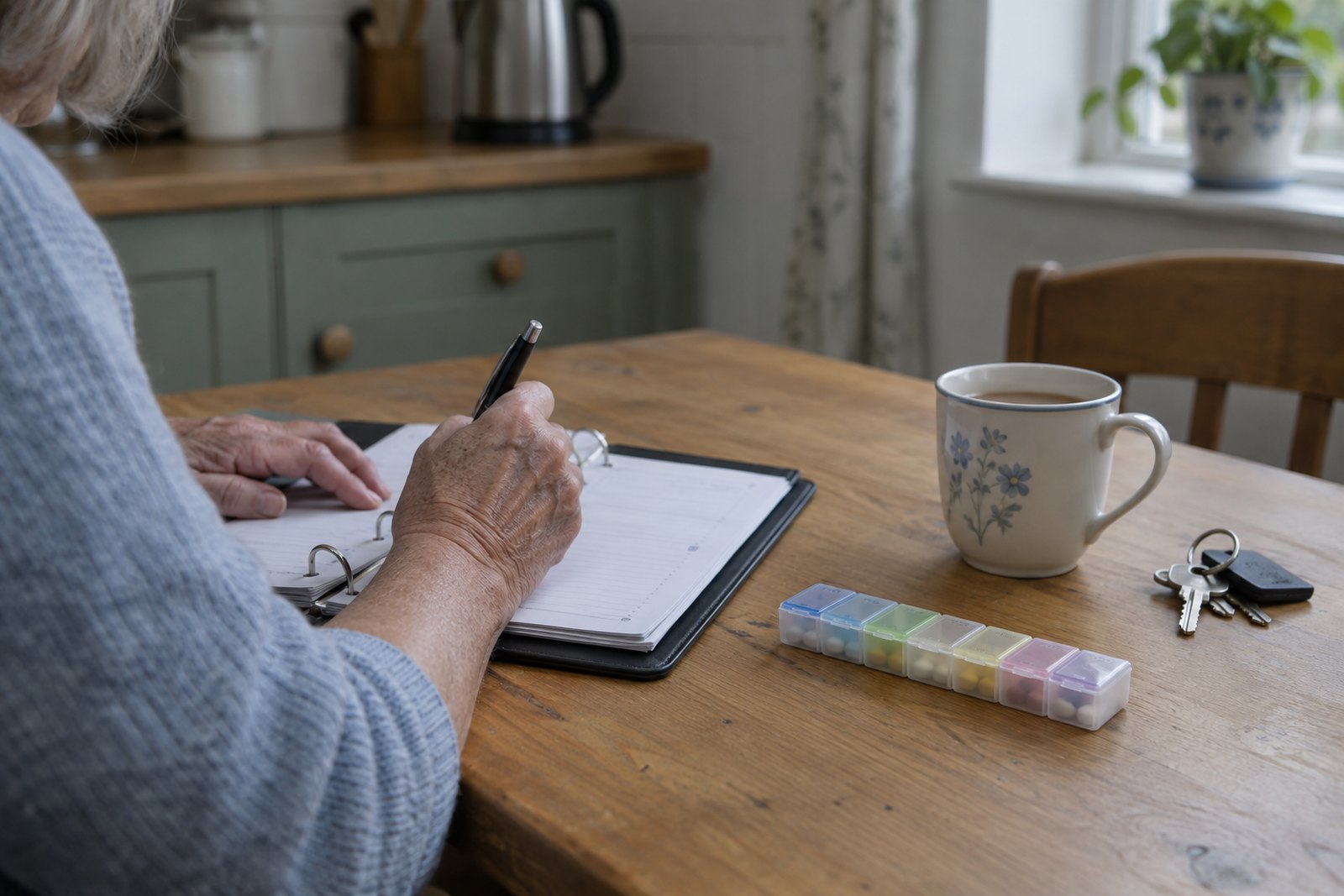
If you are a family carer and you are suddenly taken ill, the person you look after needs someone else to step in, quickly, and that person needs to know what to do. Without a plan, it usually falls to whoever finds out first: a paramedic, a neighbour, a hospital nurse. They will contact the council's adult social care team (or the out-of-hours emergency duty team), who will arrange something. That something may be a stranger who has never met your mum, or a short emergency stay in a care home, organised in a hurry with almost no information about her.
A carers emergency plan changes that. It is a short written document that says who the person is, what they need, what medicines they take, what their day looks like, and who to call. Paired with a carer's emergency card in your wallet and a few phone calls made now, it means the right people get contacted and whoever steps in can carry on without guessing. It takes an evening or two to write. This guide walks you through it.
Why it is worth doing now, not later
Most carers know they should have a plan. Most do not have one. It is not laziness. Writing it means imagining yourself in an ambulance, and nobody wants to sit down on a quiet Tuesday and do that.
But emergencies are not only heart attacks. A fall on the ice, a bad bout of flu, a car accident, a sudden operation, or your own child going into hospital can all take you out of action for days or weeks. And the people most likely to be first on the scene, a paramedic or a neighbour, are the people least likely to know that your husband cannot manage the stairs alone or that your dad will refuse food if it is not cut up a certain way.
There is a quieter benefit too. Writing the plan forces the conversation about who else could help, and often reveals that you are doing far more on your own than anyone realised. If that rings true, our piece on carer burnout may be worth reading next.
What goes in a carers emergency plan
Keep it short enough that a stranger could read it in five minutes. Two or three pages is plenty. Use plain headings, and write as if you were handing over to someone kind but completely new.
About the person you look after
- Full name, date of birth, address and NHS number if you have it.
- Their health conditions, in plain words.
- Allergies, including food and medicines.
- How they communicate. Do they wear hearing aids or glasses? Do they understand better if you speak slowly or show them things?
- How they move. Can they walk alone, with a frame, with one person helping? Do they use a hoist, stand aid or wheelchair? What is the safe way to help them out of bed or off the toilet?
- Anything that could put them at risk: wandering, falls, choking on certain foods, forgetting the cooker, getting very distressed in unfamiliar places.
- What calms them, what upsets them, and what they like to be called.
Medicines
List every medicine, the dose and the time it is taken. Say how they are kept (blister pack, pill organiser, original boxes), where they are, and which pharmacy supplies them. Note any medicines that must not be missed, and whether the person can take them alone or needs reminding or handing them. Keep a copy of the latest repeat prescription slip with the plan, as that is the most accurate list. Update it every time something changes.
The daily routine
Walk through a normal day. Getting up, washing, dressing, breakfast, toilet, lunch, afternoon, evening meal, bedtime. Include the small things that matter: tea with one sugar in the blue mug, radio on in the morning, checks during the night. Include any regular visitors, such as paid carers, district nurses or a day centre, with days and times.
Contacts
- Two or three family members, friends or neighbours who have agreed to be called, with phone numbers.
- The GP practice.
- Any paid care agency, district nurse or specialist team.
- The council's adult social care number and its out-of-hours emergency number.
- The pharmacy.
- Anyone with a key.
Who can step in, and for how long
This is the bit that needs real conversations, not just a list. Ask people directly. Could your brother come for a night? Could a neighbour pop in at lunchtime for a few days? Could your daughter take a week off work if it came to it? Write down what each person has actually agreed to, and what they are comfortable doing. Someone happy to sit with your dad may not be safe helping him shower.
Be honest about the gaps. If nobody can do personal care, or nobody can stay overnight, write that down. That gap is exactly what the council needs to know about, ideally before an emergency.
Carer's emergency cards
Many councils and local carers' centres run a carer's emergency card scheme, sometimes called a carer's card or carer's emergency alert. The details vary from area to area, but the idea is broadly the same. You register your emergency plan and contacts with the scheme. You get a wallet-sized card that says you are a carer and gives a phone number and a reference number. If you are taken ill or have an accident, whoever finds you calls the number, and the scheme contacts the people on your plan. Some schemes can also arrange short-term emergency care if no one else is available; others only pass on the message.
To find out what exists near you, search your council's website for carers' emergency schemes, ask your local carers' centre, or ask during a carer's assessment. If there is no formal scheme, make your own: a card in your wallet saying "I am the carer for [name] at [address]. In an emergency please call [number]" is far better than nothing. Put the same contact in your phone under a clear name such as "ICE" (in case of emergency), and set up the emergency information on your phone's lock screen so it can be seen without unlocking.
Tell people you are a carer
An emergency plan works best when the right services already know you exist.
Your GP
Tell your own GP practice that you are a carer and ask them to record it. Most practices keep a carers register. Being on it can mean more flexible appointments, being offered a free flu vaccination, and being pointed to local support. Crucially, it means your health records show that someone depends on you. If the person you look after has a different GP, tell their practice too, and ask whether they can note you as the main carer.
The council: a carer's assessment
If you provide care for an adult, you have the right to ask your council for a carer's assessment, whether or not the person you care for gets any help from the council. It looks at how caring affects you and what support could help. Emergency planning is a natural thing to raise there: ask what they would do if you were taken ill, whether they can record your plan, and whether there is a local emergency card scheme. Our guide to the carer's assessment explains how to ask for one and what to say.
The rules differ in Wales, Scotland and Northern Ireland. In Scotland you can ask for an Adult Carer Support Plan, and in Northern Ireland carer's assessments and emergency social care are arranged by your local Health and Social Care Trust rather than the council, so check with your council or Trust, or Carers UK, for the arrangements where you live.
Others worth telling
Let your employer know if you are comfortable doing so. Tell the pharmacy. Tell a trusted neighbour that there is a plan and where it is kept. If you ever go into hospital yourself, tell staff straight away that you are a carer and that someone at home relies on you.
Replacement care in an emergency
If you are suddenly unable to care and nobody in your plan can step in, the place to call is the council's adult social care team for the area where the person you look after lives. Out of hours, councils have an emergency duty team; the number is usually on the council website and is worth writing in your plan now.
Councils can arrange care urgently where someone would otherwise be at risk, without waiting for a full assessment to be finished. What that looks like depends on the person's needs and what is available locally. It might be home care visits, a short stay in a care home, or a mix. The council may later carry out a financial assessment, and some people will be asked to contribute to the cost, so it is worth asking about this when it is arranged.
If you know an emergency is likely, for example you have a planned operation coming up, do not wait. Contact adult social care well in advance and ask for planned replacement care. Our guide to respite care and short breaks covers how planned breaks are arranged, and having used a respite service once can make an emergency placement much smoother because the person and the staff already know each other.
Keep the plan where it can be found
A brilliant plan locked in a drawer nobody knows about is not much use. Think about who will need it and how they will get to it.
- Keep a printed copy in an obvious place at home, such as a clearly marked folder by the front door or stuck to the inside of a kitchen cupboard.
- Some areas run schemes where key medical details are kept in a container in the fridge, with a sticker on the front door or fridge so paramedics know to look. Ask your council or carers' centre.
- Give copies to the people named in the plan.
- Keep a copy on your phone, and photograph the repeat prescription list.
- If carers or a neighbour will need to get in when you are not there, a key safe can help. See our guide to key safes for where to fit one and who should have the code.
Keep important documents together too: the person's NHS number, benefit details, care plan, any Lasting Power of Attorney, and contact details for their bank. Review the whole lot every six months or whenever something changes, and put a date on the front so people can see how current it is.
The legal side: Lasting Power of Attorney
Being someone's carer does not give you legal authority to make decisions for them, and it does not give anyone authority to make decisions for you. A Lasting Power of Attorney, in England and Wales, lets a person choose someone they trust to make decisions about their money or their health and welfare if they later cannot, and it has to be set up while they still have the mental capacity to do so. Scotland has its own continuing and welfare powers of attorney, and Northern Ireland currently has an Enduring Power of Attorney, which covers money and property only. It is worth thinking about one for the person you look after and for yourself; GOV.UK explains how it works.
Where an occupational therapist fits
An occupational therapist is not the person who arranges emergency care. That is the council's adult social care team. Medical questions belong with the GP, and medicines with the GP or pharmacist. But an occupational therapist can make your emergency plan much stronger, especially where the person you look after has complex needs.
A private occupational therapist visiting at home can assess how the person actually manages each part of the day, and write down clear, step-by-step instructions for moving, transfers, washing and toileting for whoever steps in. Using a hoist and some assisted transfers needs hands-on training, so the plan should say which tasks must only be done by trained carers. They can look at equipment that might mean fewer people are needed to help, or that a neighbour could manage tasks without heavy lifting. They can also spot risks you have stopped noticing because you work around them every day. That same written assessment can be useful evidence when you ask the council for support. See our home assessment page for what a visit involves.
If the person's main difficulties are with swallowing or speech, a speech and language therapist leads. For walking and balance problems, a physiotherapist may be the right first call. If you are worried about your own health, see your GP, and if you have symptoms that could be serious such as chest pain, sudden weakness or severe breathlessness, call 999.
Frequently asked questions
What happens if a carer is taken ill and there is no plan?
Usually whoever finds out, often a paramedic or hospital staff, contacts the council's adult social care team or its emergency duty team, who arrange urgent care. It will happen, but it may be rushed and based on very little information about the person.
Is there an official carers emergency plan form?
There is no single national form. Many councils, carers' centres and Carers UK offer templates. Any clear written plan that covers needs, medicines, routines and contacts will do the job.
How do I get a carer's emergency card?
Ask your council's adult social care team or your local carers' centre whether they run a scheme. Not every area has one, and they work differently. If yours does not, a homemade wallet card with your details and an emergency contact is still very worthwhile.
Will the council charge for emergency replacement care?
It may. Councils usually carry out a financial assessment, and some people are asked to contribute towards the cost of care. Ask the council at the time, and check its charging policy on its website.
What if the person I care for refuses to let anyone else help?
This is common, and it is a reason to introduce help gradually now, rather than for the first time in a crisis. A short regular visit from a relative or paid carer can make an emergency much less frightening for them.
How often should I update the plan?
Whenever medicines, health or contacts change, and at least every six months. Date the front page so anyone reading it knows how recent it is.
Next steps
If you would like help working out exactly what care and equipment the person you look after needs, so a stand-in could step in safely, see our home assessment and older people's independence pages, or current guide prices, and choose your area below.

Talk to an occupational therapist near you
This guide is general information. For advice about your own situation - or someone you look after - a local occupational therapist can visit you at home and see it for themselves.
Choose your area: