

Apraxia After Stroke: Help When Everyday Tasks Get Muddled
By Mobile Occupational Therapist • 4 November 2026 • 15 min read
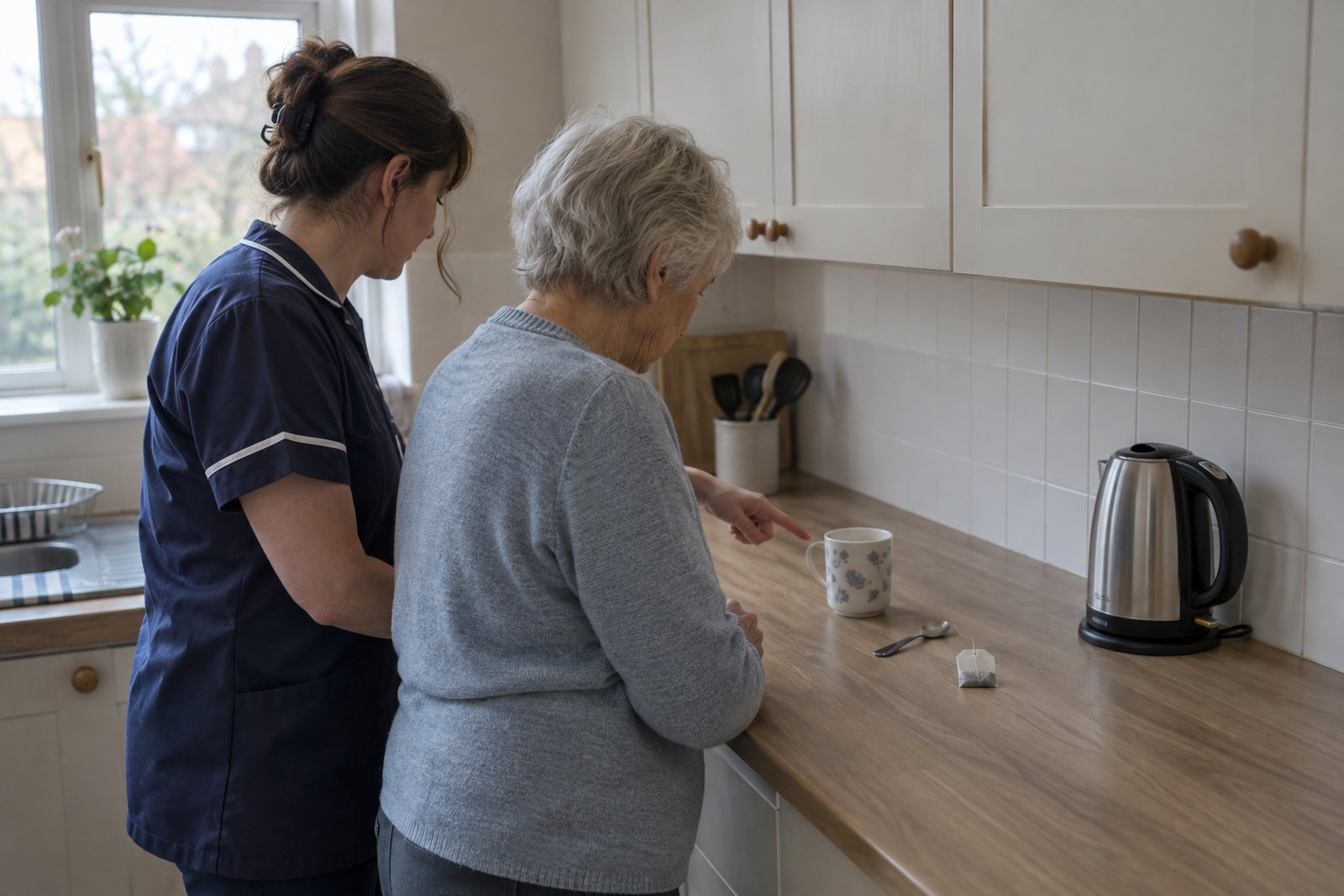
Apraxia after stroke is a difficulty planning and carrying out familiar movements and everyday tasks, even when the person has the strength to do them and understands what they are trying to do. It can look like doing steps in the wrong order, getting stuck halfway through, or using an object oddly (for example, holding a toothbrush like a comb).
What helps most is usually not more willpower or more explaining. It is calm, practical support: making the task simpler, reducing distractions, giving short prompts, laying items out in order, and practising the same task in the same place at the usual time of day. This article explains what apraxia is, how it shows itself at home, how to make things safer in the kitchen and bathroom, and the kind of strategies occupational therapists use.
What apraxia after stroke actually is
Apraxia is a problem with motor planning. After a stroke, the brain can struggle to organise the sequence of movements needed for a task. The person may know exactly what they want to do, but their body does not follow the plan smoothly.
You may also hear the word dyspraxia used after stroke. In everyday conversation people use apraxia and dyspraxia to mean similar things: difficulty with planning and organising movement. Clinicians sometimes use the terms differently, but for families the important point is this: the person is not being awkward, lazy, or "not trying". Their brain is having trouble running a well learned program.
Apraxia is not the same as:
- Weakness or paralysis. Weakness can be present as well, but apraxia is about planning and sequencing.
- Not understanding. Someone can follow a conversation and still be unable to get through the steps of dressing.
- Memory problems. Someone can remember what a toothbrush is for but still put toothpaste on the handle or stop halfway through.
Apraxia often comes alongside other stroke effects such as one sided weakness, sensory loss, visual problems, fatigue, or communication difficulties. Those can make the planning problem harder to spot at first.
How apraxia can look day to day
Families often describe it as "he knows what to do, but his hands do something else" or "she gets stuck and cannot get started again". It can change from day to day, and it can be worse when someone is tired, rushed, or in a new environment.
Common signs at home
- Using objects oddly, like bringing the toothbrush to the cheek, trying to drink from the wrong end of a cup, or holding a razor the wrong way round.
- Steps in the wrong order, like putting socks over shoes, or trying to button a shirt before it is on properly.
- Starting then stopping, like lifting an arm into a sleeve then freezing halfway through.
- Perseverating, meaning repeating a step even when it is done (for example, continuing to "wipe" an already clean surface, or brushing the same spot again and again).
- Difficulty copying an action when you show them, even though they can describe it.
- Needing things set up and still struggling to complete the task.
Examples you might recognise
- Dressing: underwear over trousers, putting both legs into one trouser leg, trying to pull clothing on back to front, or repeatedly taking a jumper on and off.
- Washing and grooming: washing hair with a flannel but forgetting the shampoo step, using deodorant like a spray cleaner, or holding a hairbrush but not making the brushing movement.
- Kitchen tasks: putting the kettle on a hob, turning on the wrong ring, leaving a tap running, or trying to cut food with the wrong side of a knife.
- Mobility and transfers: difficulty coordinating the "stand up, turn, sit down" sequence even when leg strength is improving.
If something suddenly gets much worse, or you notice new face drooping, arm weakness, speech changes, severe headache, collapse, or confusion, treat it as an emergency and call 999. A new stroke needs urgent help.
Why apraxia happens and what makes it worse
A stroke can damage networks in the brain that plan and organise movement. The same task can feel different depending on the context. A person might manage washing at the sink, then be unable to do the same movements when someone hands them a flannel in bed. That is not inconsistency. It is the brain relying on cues from the environment, and those cues have changed.
Things that commonly make apraxia worse include:
- Fatigue. Many people have significant tiredness after stroke, and planning gets harder as the day goes on.
- Too much talking. Long explanations overload the system.
- Distraction and clutter. Too many objects on the bed or at the sink can lead to the wrong item being picked up.
- Rushing. Time pressure increases errors and frustration.
- Pain or breathlessness, which reduce concentration.
- Low mood and anxiety. Worry can make people freeze or avoid tasks, which then reduces practice.
It can help to think of apraxia as a "traffic jam" between intention and action. Your job is to make the route simpler and more predictable.
Safety first: reducing risk at home
Apraxia can increase risk because familiar safety habits (like turning a pan handle in, or checking water temperature) may not happen automatically. If you are not sure what someone will do next, supervise closely for anything involving heat, water, heights, sharp tools, or leaving the house.
Kitchen safety
- Reduce "open ended" cooking. Choose simpler meals with fewer steps, especially when the person is alone or tired.
- Limit access when needed. If someone repeatedly turns on the wrong ring, cannot recognise danger, or forgets hot items, they should not use the cooker unsupervised and you should seek advice from an occupational therapist or adult social care about safer cooking options and managing risk in the least restrictive way. (How you do this depends on your home and the person. Safety first, dignity always.)
- One hot drink at a time. Set up a single clear space for making tea or coffee, away from clutter and the edge of the counter.
- Remove distractions. Turn off the TV or radio during hot tasks so attention stays on the sequence.
- Check for "hidden heat". People may re touch a hot mug, put a hand on a hob that looks off, or try to carry boiling water unnecessarily.
Bathroom safety
- Do not leave someone alone in the bath if apraxia means they cannot sequence steps safely (for example, turning taps on and off, standing up, or getting out).
- Keep it predictable. Same towels, same toiletries, same order. Too much choice makes mistakes more likely.
- Separate tasks. Washing body and washing hair might need to be two distinct routines, not one long "bath time" with lots of switching.
- Watch for scald risk. If someone struggles to judge what is happening while the taps are running, you may need to set the bathroom up and stay close.
If you need to physically help
Apraxia can lead to sudden, unexpected movements. If you are supporting someone to stand, turn or sit, protect your own back and do not wrestle through. If you are unsure about safe techniques, see our guide to safe moving and handling for family carers.
If you cannot manage safely at home, contact the GP, the stroke team (if still under them), or adult social care via your council. If there is immediate danger, call 999.
Practical strategies that often help (what to try today)
The golden rule is: make the next step obvious. You are trying to reduce decisions, reduce sequencing demands, and increase helpful cues.
1) Do the task in the real setting, at the usual time
Practise washing at the sink at "getting ready" time, not as an exercise in the afternoon. Practise making a drink in the kitchen where the mug lives. Apraxia is very sensitive to context. What is learned in one setting does not always carry over automatically.
2) Set up the environment so it guides the task
- Lay out only what is needed for this task, not the whole toiletry bag or the entire wardrobe.
- Put items in left to right order (or top to bottom) so the sequence is visible.
- Remove "nearby distractors" that get picked up by mistake.
- Use the same place each time. Consistency beats novelty.
3) Keep instructions short and consistent
Try one instruction at a time, with the same wording each time. For example:
- "Pick up the toothbrush." (Pause.)
- "Toothpaste on." (Pause.)
- "Brush top teeth." (Pause.)
Avoid stacked instructions like "Put your top on then go to the bathroom and wash your face". It is too much sequencing in one go.
4) Show, then cue, then help
A simple ladder to use:
- Show the movement (demonstration), without lots of talking.
- Cue with one short instruction.
- Gesture to the correct item or body part.
- Hand over hand guidance if needed, gently guiding the movement while the person stays involved, but avoid pulling on the affected arm or shoulder and stop if there is pain and ask an OT or physiotherapist to show you safer techniques.
Hand over hand support can be helpful, but only if it is calm and respectful. If the person pulls away or becomes distressed, stop and reset. For some people, being touched during a difficult task increases anxiety.
5) Build routines you can repeat
Routines reduce the planning load. Aim for "same place, same order, same words". That can feel boring, but boring is often what makes things doable.
It can also help to practise a task as a fixed script. For example, always dress in the same order, always start with the same arm, always sit in the same chair.
6) Reduce the number of choices
Choice is tiring. Instead of "What do you want to wear?", try: "Blue top or grey top?" Or better, put out one suitable outfit and ask: "Shall we put this on now?"
7) Give more time than feels reasonable
Apraxia slows tasks down. If you jump in too early, the person loses the chance to practise. If you wait too long, they may get stuck and distressed. The balance is difficult. A useful middle ground is: wait, cue, wait again, then help with the smallest possible amount of assistance.
Dressing, washing and toileting: small changes that make a big difference
These are the areas families often find most draining, because they happen every day and they are hard to rush.
Dressing
- Sit down to dress. Sitting reduces fall risk and frees up attention for planning.
- Lay clothes out in order, with underwear first, then trousers, then top, then socks, then shoes.
- Turn clothing the right way round before handing it over. If inside out clothing is a frequent problem, remove that problem.
- Start the movement if needed. For example, guide the hand to the sleeve opening, then let them pull through.
- Avoid tricky fastenings at first. Elastic waists and simple closures can reduce frustration while skills rebuild.
Washing and grooming
- One item at a time. Put the toothbrush in their hand, not the whole wash bag within reach.
- Keep the sink area clear. Too many objects lead to the wrong object being used.
- Use the mirror carefully. Some people find mirrors helpful cues. Others find them distracting. If the person keeps watching themselves and loses the sequence, try turning away from the mirror.
- Separate face, teeth, shaving into mini routines with a pause between.
Toileting
Apraxia can affect the sequencing of undressing, wiping, and dressing again, especially if there is time pressure.
- Give privacy with safety. Stay nearby and available rather than hovering, if it is safe to do so.
- Prepare clothing. Loosen waistbands, use clothing that pulls up and down easily, and avoid lots of layers.
- Use consistent prompts like "Trousers down" then "Sit" then "Stand" then "Trousers up".
If continence has changed since the stroke, tell the GP. There may be treatable causes and there is support available.
Meals and drinks: keeping independence without taking big risks
Many people want to "make a cuppa" long before they can safely manage a full meal. That is a good goal, but it needs a safety plan.
Set up a "one job" drink routine
- Keep mug, spoon, tea or coffee, and sugar in one place.
- Clear the worktop so there is one obvious space to work in.
- Use the same order every time and the same words.
- Stay present for the boiling water stage until you are confident it is safe.
Keep food tasks concrete
- Choose tasks with few steps, like making toast with supervision, rather than cooking multiple pans.
- Use pre portioned ingredients to reduce decision making.
- Do prep seated if standing balance or fatigue is an issue.
If swallowing is affected (coughing on food or drink, wet voice after drinking, repeated chest infections), ask for a speech and language therapy assessment. Do not try to "push through" swallowing problems.
Apraxia or memory problems: how to tell the difference
Apraxia and memory problems can look similar from the outside, but the support is slightly different.
With apraxia, you often see: the person recognises the object and the goal, but the action is muddled, out of order, or stuck. With memory problems, you may see: the person forgets what they were doing, why they are in a room, or what an object is for, especially after a short distraction.
Many stroke survivors have some of both. If you think memory and thinking are also affected, our guide on memory and thinking problems after a stroke explains what can help and when to ask for more assessment.
Ask for medical advice if confusion is fluctuating rapidly, much worse than usual, or comes with drowsiness, fever, pain on passing urine, or a significant change in behaviour. Delirium and infections need prompt assessment.
Where an occupational therapist fits
Occupational therapists (OTs) focus on helping people do everyday activities as safely and independently as possible. With apraxia after stroke, that usually means task based rehabilitation in the real world, not just exercises.
An OT can help by:
- Watching what is happening in the actual place it goes wrong (bathroom, kitchen, by the bed), then working out which part of the sequence is breaking down.
- Creating a plan of prompts that the whole family uses consistently, so the person is not trying to respond to five different styles of help.
- Teaching graded support (when to stand back, when to cue, when to guide, when to step in) so you are not doing everything, but you are also not waiting until there is a crisis.
- Adapting the task and environment to reduce errors, including layout, routines, and sometimes equipment if it genuinely makes the task safer.
- Assessing risk, including whether someone can be left alone for parts of the day, and what needs to be in place first.
- Working with the wider team. Physiotherapists may lead on strength, balance and walking. Speech and language therapists may lead on understanding language, communication, and swallowing. A GP or stroke consultant is the right person for medication review, mood concerns, seizures, or new neurological symptoms.
If you are looking for a private occupational therapist visiting at home, start with our neurological occupational therapy page. It explains the kinds of problems OTs help with after stroke and what to expect.
It also helps to understand the overall pattern of recovery after stroke and what support exists. See our overview of stroke occupational therapy support for related issues like fatigue, one sided weakness, and safety at home.
Frequently asked questions
Does apraxia after stroke get better?
It can improve, especially with repetition of real tasks, consistent prompting, and the right level of challenge. Progress is often uneven. People may do better in the morning than late afternoon, or manage at home but not in unfamiliar places.
Is dyspraxia after stroke the same thing?
Families and even some professionals use the terms interchangeably. In practice, both point to difficulties with motor planning that make everyday actions feel muddled. What matters most is identifying the situations where things break down and putting the right cues and routines in place.
How is apraxia diagnosed?
There is no single home test. It is usually identified by a clinician observing someone doing everyday tasks and noticing a mismatch between understanding, strength, and performance. An OT can assess this in the home context, where the difficulties are often clearest.
Should I keep correcting them when they do it wrong?
Correcting every mistake usually increases anxiety and can make performance worse. A better approach is short, consistent prompts and setting the task up so the "right next step" is easiest to do. If safety is at risk, step in calmly and reset the task without a long explanation.
What if apraxia makes the person unsafe when alone?
If there is risk with heat, water, falls, or leaving the home, supervision and environmental changes may be needed while skills rebuild. Speak to the GP, the stroke team, or adult social care. If new symptoms appear suddenly, call 999.
Can apraxia affect speech?
There is a separate condition called apraxia of speech, where planning the movements for talking is difficult. Many people after stroke also have aphasia (language difficulties). If speech, understanding, or swallowing are affected, ask for a speech and language therapy assessment alongside OT input for daily activities.
Next steps
See our neurological occupational therapy and home assessments pages, or current guide prices, and choose your area below.

Talk to an occupational therapist near you
This guide is general information. For advice about your own situation - or someone you look after - a local occupational therapist can visit you at home and see it for themselves.
Choose your area: