

Aphasia Communication Tips After a Stroke
By Mobile Occupational Therapist • 25 September 2026 • 13 min read
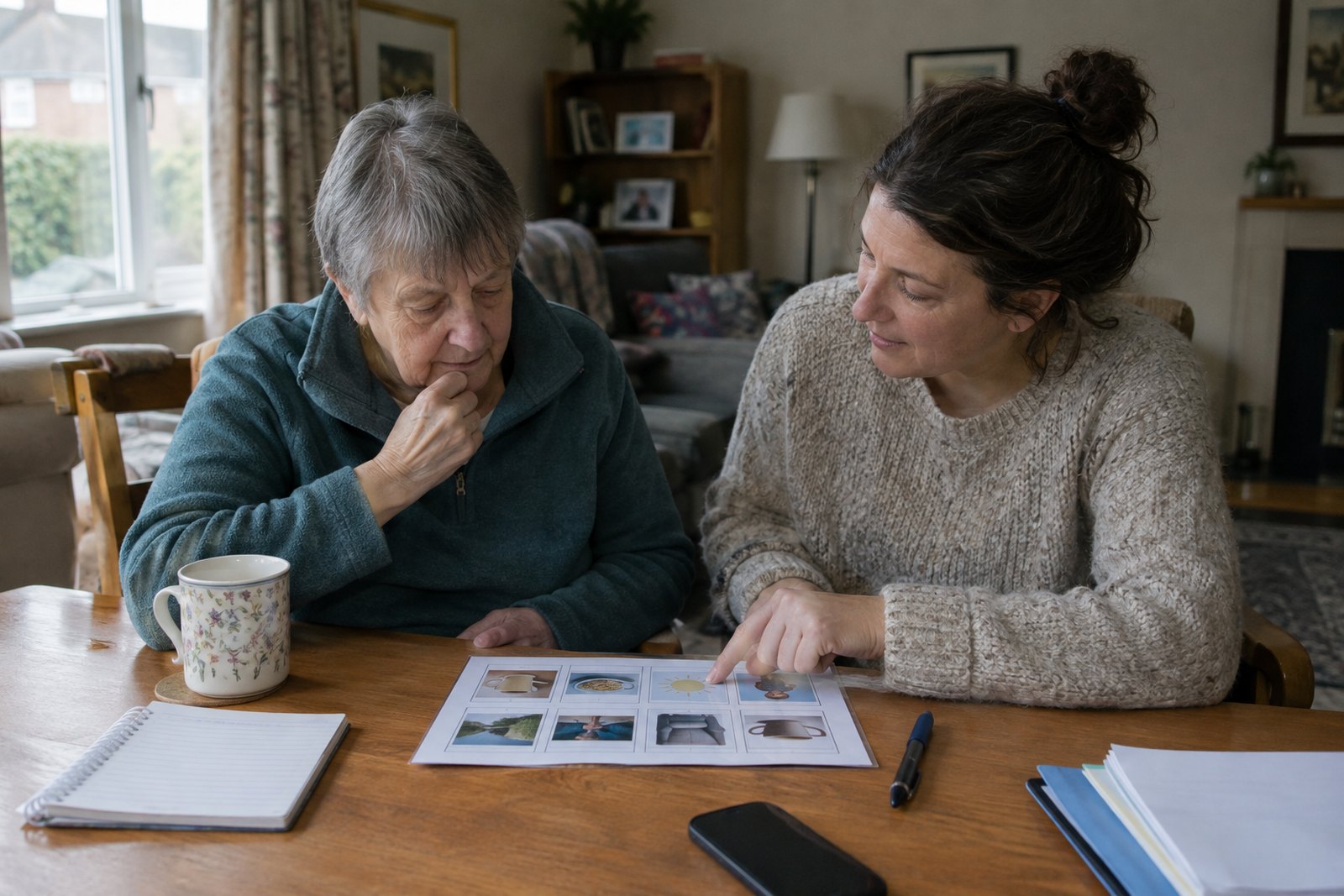
Aphasia is a common effect of stroke. It means the brain is having difficulty with language. That can affect speaking, understanding what is said, reading, writing, or all of these. The most important thing to know is that aphasia is not a sign of low intelligence. Your relative may understand far more than they can get out.
If you are looking for aphasia communication tips, start with this: make things calmer and slower. Reduce background noise, keep sentences short, give extra time, and check understanding without quizzing. Use gestures, writing, and pictures as much as speech. It can feel unnatural at first, but it often helps.
What aphasia is, in plain English
Aphasia is a language difficulty caused by damage to the language areas of the brain. After a stroke, it can show up in different ways:
- Finding words is hard (they know what they want to say but cannot get the word out).
- Speech is difficult to produce (short phrases, wrong words, muddled grammar).
- Understanding speech is difficult, especially if there is a lot being said quickly.
- Reading and writing are affected (anything from mild to very hard).
- Numbers, days, times, and names can become much harder, even if they were fine before.
People often describe aphasia as having the words "stuck", or as if everyone else is speaking too fast. Some people can talk quite fluently but what they say does not match what they mean. Others understand well but speech is very limited. Many people have a mix.
It can also sit alongside other stroke effects. For example:
- Slurred speech (dysarthria) where the words are right but the muscles are weak or uncoordinated.
- Thinking and attention problems where it is hard to follow a conversation even without aphasia.
- Hearing or sight loss which makes communication harder for anyone.
If you are unsure what is driving the difficulty, a speech and language therapist (SLT) is the right professional to assess and advise.
One more reassuring point: aphasia is often worst early on. Some recovery can happen naturally in the first weeks and months, and targeted therapy and practice can help longer term too.
Communication tips you can use today
The goal is not to make communication perfect. It is to make it possible, with less stress, so your relative can take part in ordinary life again.
Set up the room for success
- Turn off background noise where you can: TV, radio, running water, multiple conversations.
- Face each other. Good light helps. So does sitting at the same level.
- One person at a time. Group conversations are hard even for mild aphasia. Pick who is speaking and keep it simple.
- Make time. If you are rushing out the door, save the tricky conversation for later.
How to speak so it is easier to understand
- Use short sentences. One idea at a time.
- Slow down. Not patronising, just slower.
- Use ordinary adult language. Aphasia is not childhood.
- Emphasise key words and repeat them if needed.
- Be specific. "Do you want tea?" is easier than "What do you fancy?"
- Pause between sentences. Give the brain time to process.
If your relative also has visual problems after stroke, keep your gestures within their field of vision and reduce visual clutter around you.
How to help someone speak, without taking over
When someone is stuck on a word, your instinct is to jump in. Sometimes that helps. Sometimes it makes things worse, because it takes away control and can feel humiliating.
Try this sequence instead:
- Wait. Count slowly in your head to 10. It can feel like forever. It often is not.
- Acknowledge the effort. "I can see it is stuck. Take your time."
- Offer a choice. "Is it the kettle or the toaster?"
- Offer the first sound if they want it. "Is it a 'k' sound?"
- Only guess whole sentences if they ask you to, or if you have agreed this is helpful.
A good rule is to ask: "Do you want help or do you want time?" Some people want you to step in. Others really do not.
Ask better questions
Open questions can be exhausting. Yes or no questions are easier, but they can still go wrong if your relative is overwhelmed, or if they tend to say "yes" automatically to keep things moving.
What usually works best is either-or questions:
- "Tea or coffee?"
- "Shower now or after breakfast?"
- "Do you want to sit in the living room or the kitchen?"
Keep the options visible. Point to the mug. Show the towel. Hold up two items. The more channels you use, the less pressure there is on speech alone.
Check understanding without testing them
It is easy to fall into "Do you understand?" followed by a tense silence. Many people will say yes even if they do not, because they are embarrassed or tired.
Try these instead:
- Ask them to show you: "Can you point to the one you want?"
- Summarise and confirm: "So we are going to ring the GP tomorrow morning, yes?"
- Use a simple recap: "Tell me the plan in your words" (only if this does not feel like an exam).
If it is a safety issue (medicines, stairs, cooking), checking understanding matters. If it is a minor preference (which jumper), let it be easy.
Use writing, drawings, gestures and pictures
Many families are surprised by how much easier life gets when they stop relying on talking alone.
- Write key words, not whole sentences. Big letters. One or two words at a time.
- Draw simple sketches. They can be terrible. It does not matter.
- Gesture naturally. Point, mime actions, show sizes with your hands.
- Use photos (family, common items, places). Printed or in an album.
- Create a simple communication book with pictures for meals, toileting, pain, tiredness, people's names, places, and common questions.
If reading is difficult, symbols or photos can still work. If vision is affected, bigger pictures and strong contrast help.
Give extra time, but watch for fatigue
Aphasia often comes with mental fatigue. Your relative may start well and then fall apart later in the day. That is not stubbornness. It is overload.
Build in breaks. Keep conversations short. If they are getting irritable or shutting down, stop and try later. It can be kinder to say: "Let's pause. We will come back to it after lunch."
Keeping dignity and including them in decisions
Aphasia can make adults feel invisible. People start talking over them, "about" them, or to whoever is nearest. It happens in shops, in hospitals, and sometimes at home without anyone meaning harm.
A few practical ways to protect dignity:
- Talk to them first, even if you expect to interpret. Look at them, not just the helper.
- Use normal tone and volume. Aphasia is not deafness, and shouting rarely helps.
- Explain what is happening before you do it. "I am going to help you stand up now."
- Offer choices whenever possible. Even small choices restore control.
- Do not pretend you understand if you do not. It can feel kind in the moment, but it often leads to bigger upset later.
If you are making big decisions (care, housing, finances), involve your relative in a way that works for them. That might mean using pictures, visiting options in person, or discussing one part at a time over several short conversations.
Frustration, anger and low mood
It is hard to describe how frightening aphasia can feel. Imagine being able to think, but not being able to get out what you mean, or to understand what people are saying around you. Frustration is normal. So is grief for the life that used to be easy.
Things that can help at home:
- Name the feeling. "This is really frustrating." Many people calm slightly when they feel understood.
- Lower the demands when someone is struggling. Basic comfort first: drink, pain relief as prescribed, toilet, rest.
- Keep one communication method for "emergencies", like a pain scale or a simple card that says "I need the toilet", "I am tired", "Stop".
- Keep routines predictable. Less talking is needed when the pattern is familiar.
Low mood and depression are also common after stroke. If you are worried, read our guide to low mood and depression after a stroke and speak to the GP. If your relative talks about wanting to die, self-harm, or you feel they are not safe, seek urgent help via NHS 111 or 999.
If communication suddenly gets worse, or you notice new stroke symptoms (face drooping, arm weakness, speech changes), call 999. Do not assume it is just tiredness.
Phones, appointments, money and paperwork
Aphasia does not just affect "chat". It hits all the life admin that depends on language.
Phone calls and appointments
- Ask services what they can offer. Many GP practices, hospitals and councils can offer longer appointments or extra time, face to face communication, or involve a trusted family member with consent.
- Use speakerphone so you can support without grabbing the call.
- Prepare a script in large writing: name, date of birth, key message, questions.
- Take a notebook to appointments and write down key words as you go.
If your relative finds appointments overwhelming, ask for letters written in simpler language and for extra time where possible. Many organisations have "easy read" formats, but you may still need to advocate.
Money, bills and official forms
Filling in forms can be very hard if reading and writing are affected. Break tasks into small steps. Do one form section at a time, then stop. Use highlighters to mark key boxes. Keep a single folder for important paperwork so it does not vanish.
If your relative cannot manage their money safely, you may need longer-term solutions. This can involve talking to the bank, setting up support with bills, or exploring formal arrangements like power of attorney. Rules differ depending on capacity and circumstances, so check GOV.UK or get proper advice if you are unsure.
Even when you are doing the admin, keep your relative involved. Explain what you are doing. Offer choices where they exist. It is their life.
Getting the right professional help for aphasia
Speech and language therapists lead aphasia assessment and therapy. They can work on understanding, expression, reading and writing, and help you set up strategies at home that match your relative's type of aphasia. If your relative is still under a stroke service, ask for an SLT review. If they have been discharged, ask the GP what local NHS provision exists and how to access it. Some people also choose private speech and language therapy.
Charities can be a lifeline. National stroke charities and aphasia charities often provide information in aphasia-friendly formats, local groups, conversation practice, and support for families. If your relative is up for it, peer support can reduce isolation in a way professionals cannot.
It also helps to understand the wider picture of stroke recovery. See our overview of stroke for related issues like fatigue, mobility, cognition and daily living skills.
Where occupational therapy fits
Occupational therapy does not replace speech and language therapy for aphasia. But an occupational therapist can help with the knock-on effects of aphasia in everyday life: getting washed and dressed, making meals safely, managing routines, using the phone, getting out and about, and taking part in hobbies and relationships again.
A private occupational therapist visiting at home can:
- Assess how aphasia affects daily tasks, including safety and fatigue, in the real environment where life happens.
- Adapt routines so less language is needed at the hardest times of day.
- Set up visual cues like step-by-step picture prompts for a task (for example, making a drink or using the washing machine).
- Reduce cognitive and communication load by simplifying layouts, organising cupboards, and creating consistent "homes" for items.
- Support return to meaningful activities with practical workarounds, not just exercises.
- Work alongside SLT so that communication strategies are built into daily life, not only used in therapy sessions.
If you have never had an OT home visit before, our guide to what an occupational therapist does on a home visit explains what to expect and how to prepare.
Frequently asked questions
Does aphasia mean dementia or memory loss?
No, not on its own. Aphasia is a language problem. Someone can have aphasia and still think clearly. That said, a stroke can also affect memory, attention and problem-solving, and fatigue can make everything worse. If you are seeing wider changes that do not fit "language only", ask the stroke team or GP for a review.
Should we correct their words when they get them wrong?
Usually, no. Constant correction can shut communication down. Focus on meaning: "I think you mean the bathroom, is that right?" If your relative wants help practising speech, follow the plan set by the speech and language therapist and keep practice separate from everyday conversations.
Is it OK to finish their sentences?
Sometimes. The key is consent and timing. If you always jump in quickly, your relative may stop trying. Agree a simple rule together, such as: wait 10 seconds, then ask "Do you want me to help?" If they say yes, offer a choice or the first sound rather than taking over the whole sentence.
Why is communication worse in the evening?
Fatigue, noise, visitors, and the sheer effort of getting through the day can all make aphasia worse later on. Many people have a limited "language battery". Plan important conversations for the time of day when your relative is freshest, and keep evenings for easy topics and comfort.
Can someone with aphasia learn to use technology to communicate?
Often, yes, but it depends on the person's aphasia, vision, attention and one-handed use after stroke. Simple tends to work best: a small set of key photos, one clear way to call family, and a predictable routine. An SLT can advise on communication methods, and an occupational therapist can help set up devices and routines so they are actually usable day to day.
When should we seek urgent medical help?
Call 999 if there are signs of a new stroke or a sudden change in speech or understanding, especially if it comes with face drooping, arm weakness, or severe headache. For slower changes, worsening mood, or concerns about safety at home, contact the GP or NHS 111 for advice.
Next steps
If aphasia is making day to day life unsafe or miserable, support at home can make a real difference. See our neurological occupational therapy and home assessments pages, or current guide prices, and choose your area below.

Talk to an occupational therapist near you
This guide is general information. For advice about your own situation - or someone you look after - a local occupational therapist can visit you at home and see it for themselves.
Choose your area: