

Adults With Cerebral Palsy: Ageing Well and Staying Independent
By Mobile Occupational Therapist • 2 November 2026 • 13 min read
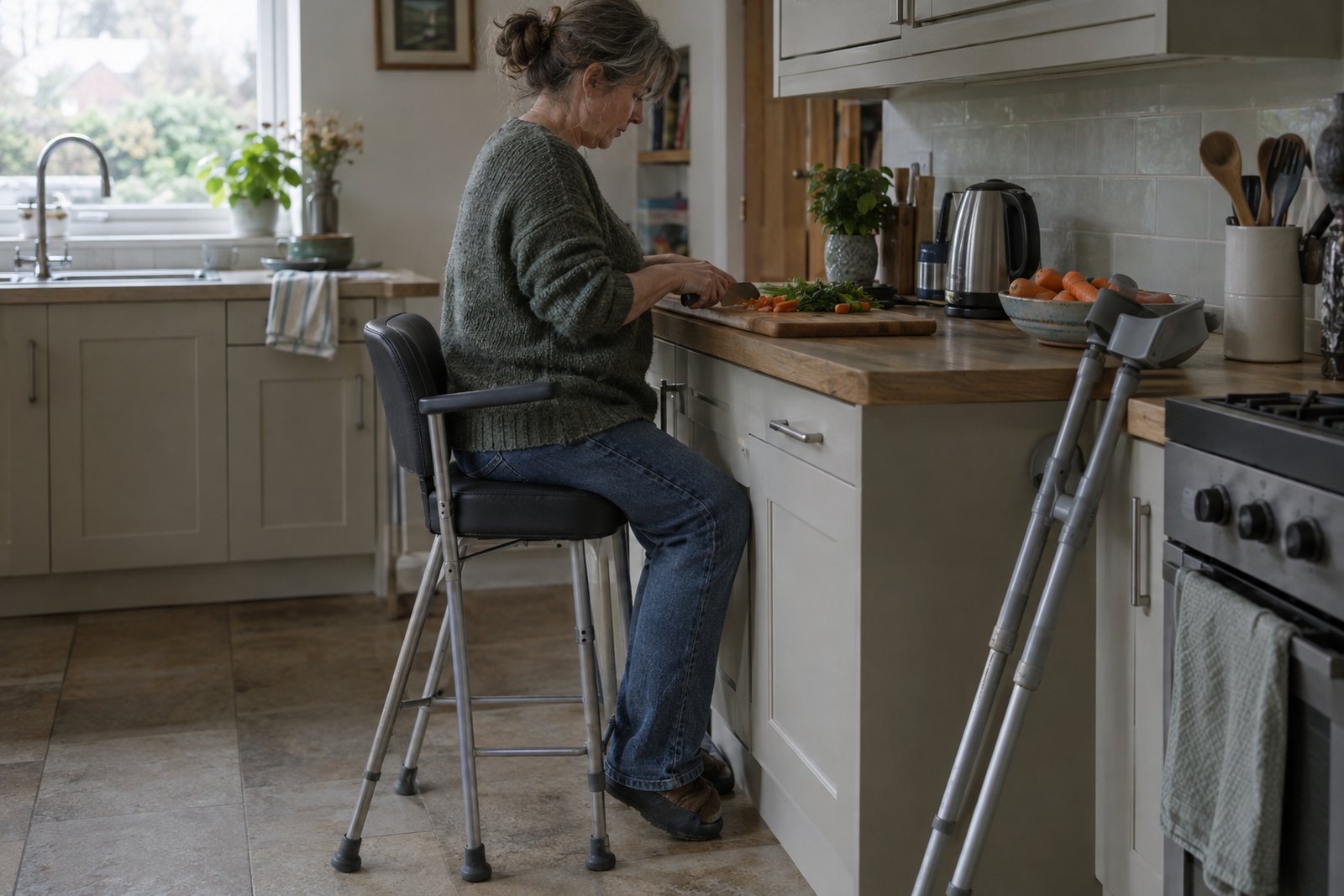
Cerebral palsy does not get worse. The original difference in the brain stays the same for life. The body living with it does change, though. Many adults with cerebral palsy find that in their thirties, forties and beyond, things that used to be manageable start to cost more: more pain, more tiredness, stiffer joints, walking that takes more effort, or falls that were not happening before. That is not your imagination, and it is not a sign that you have failed to keep up your exercises.
The frustrating part is that these changes tend to arrive just as the support disappears. Children with cerebral palsy usually have a team around them. Adults often have a GP and not much else. Adults can still be referred for physiotherapy, occupational therapy, orthotics and specialist reviews, and there is NICE guidance saying adults with cerebral palsy should have access to this kind of care. This article explains what changes with age, what you can do about it at home, and how to get the right people involved.
Why cerebral palsy can feel different as you get older
Living with cerebral palsy usually means your muscles and joints have been working in unusual ways for decades. Tight muscles pull on joints. Walking with a different pattern puts extra load on hips, knees, ankles and the back. Many people use more energy for ordinary movement than someone without cerebral palsy, simply because each step or transfer takes more effort. Over years, that adds up.
Changes adults commonly describe include:
- Pain, often in the back, hips, knees or neck, and sometimes from muscle spasms or stiffness.
- Fatigue that feels out of proportion to what you have done, and is slow to recover from.
- Joint problems, including wear and tear arthritis earlier than you might expect, and hip or spine changes.
- Changes in mobility, such as walking shorter distances, needing a stick or wheelchair more often, or finding stairs and getting up from the floor harder.
- Bone health worries, particularly if you have done less weight-bearing activity over the years.
- Swallowing or continence changes for some people.
- Low mood or anxiety, which is hardly surprising when the body you know starts behaving differently.
None of this happens to everyone, and the timing varies a great deal. Someone with mild cerebral palsy affecting one side may notice very little until later life. Someone with more widespread involvement may notice changes in their twenties.
When a change needs a doctor promptly
Do not assume every new symptom is 'just my CP'. See your GP promptly if you notice new numbness, tingling or weakness in your arms or hands, a change in how well you can use your hands, new problems controlling your bladder or bowels, or neck pain alongside any of these. These can have other causes, including problems in the neck or spine, that need checking. Repeated chest infections, coughing or choking when eating or drinking, or losing weight without trying also need a GP appointment. If weakness, numbness or loss of bladder or bowel control comes on suddenly or severely, or you have back pain with numbness around your bottom or genitals, call 999 or go to A&E. For other urgent worries, call NHS 111.
The gap when children's services end
Many adults remember the move from children's to adult services as the point where everything stopped. As a child you may have had a paediatrician, a physiotherapist, an occupational therapist, an orthotist and perhaps a speech and language therapist, often linked to school. Adult health services are organised differently. There is often no single team, and you may be expected to ask for each thing separately, usually through your GP.
If you are a young person approaching this point, or the parent of one, ask well before the last appointment: who will I see after this, how do I get referred back, and can I have copies of my recent reports? Keep those reports somewhere safe. If you are already an adult and have not seen a therapist for years, you have not missed your chance. Referral is still possible.
How to get physio, OT and orthotics as an adult
Start with your GP. Ask for a longer appointment if your practice offers them, and go in with a short written list. Useful things to say:
- 'I have cerebral palsy and my walking (or pain, hands, fatigue) has changed over the last year.'
- 'I would like a referral to physiotherapy and to orthotics.' Orthotics is the service that makes splints, insoles and braces.
- 'Is there a community neurology or neuro rehabilitation team I can be referred to?'
- 'I would like my spasticity and pain reviewed.' Medication, injections and surgery for spasticity are decisions for doctors, not therapists, so ask about this directly.
- 'Can I be referred to community occupational therapy for help at home?' In many areas you can also contact your council's adult social care team yourself.
What is available varies by area. Some places have specialist adult cerebral palsy or neurodisability clinics; many do not. NICE has published guidance on cerebral palsy in adults (NG119), which sets out the kind of care adults should be able to access, including support with pain, mobility, fatigue and mental health. You do not need to quote it at your GP, but it is useful to know it exists if you are told there is nothing for adults.
Staying active without running yourself into the ground
Movement matters. Keeping muscles stretched and strong, and keeping your heart and lungs working, helps protect what you can do as you age. But the old advice to push through often backfires for adults with cerebral palsy, because the energy cost of everyday life is already high.
A few principles that tend to help:
- Choose activity you will keep doing. Swimming, adapted cycling, seated exercise, a gym programme designed around you, or walking in short bouts. A physiotherapist can help you pick and adapt.
- Little and often beats occasional big efforts. Ten minutes most days is more useful than a heroic session that leaves you flat for three days.
- Stretch regularly, especially muscles that tend to tighten. Ask a physio to show you which ones and how, rather than guessing.
- Notice the boom and bust pattern. If good days end in overdoing it and bad days follow, that is a pacing problem, not a fitness problem.
Pacing and saving energy day to day
Pacing means planning your energy so you have some left for the things you care about. It is less about doing less and more about spending wisely. Try:
- Keeping a simple diary for a week of what you did and how tired or sore you were afterwards. Patterns appear quickly.
- Spreading heavy tasks across the week rather than doing all the washing, shopping and cleaning on one day.
- Sitting for tasks you usually stand for: preparing food, washing up, ironing, getting dressed.
- Planning rests before you need them, not after you have hit empty.
- Asking whether a task needs doing at all, or whether someone else, or a delivery, could do it.
Our guide to fatigue management and pacing was written with other conditions in mind, but the methods carry across well.
Equipment and adaptations: time for a review
Many adults with cerebral palsy have been using the same set-up for years, sometimes since they left home. Equipment that suited you at 25 may not suit you at 45. Signs it is time for a review:
- Getting on and off the toilet, bed or sofa has become a struggle, or you are pulling on furniture to get up.
- You avoid the bath or shower, or only wash when someone else is in the house.
- Stairs feel risky, or you have had falls or near misses.
- Your wheelchair or seating leaves you sore, slumped or uncomfortable by the end of the day.
- Splints or footwear no longer fit, or you have stopped wearing them because they hurt.
- Your hands tire more quickly with cooking, writing, phones or fastenings.
Things that often help include toilet frames or raised seats, grab rails, a shower seat or level access shower, a perching stool in the kitchen, a second stair rail, furniture raisers, lightweight kitchen tools, and voice control or smart plugs to cut down trips around the house. Bigger changes, such as a wet room, ramp or stairlift, may be funded through a Disabled Facilities Grant in England, Wales and Northern Ireland, or through your council's scheme of assistance in Scotland, after an assessment. Wheelchairs are usually provided through NHS wheelchair services, which you can be referred to through your GP or a therapist. If your chair no longer suits you, ask for a reassessment rather than putting up with it.
Work and study
Under the Equality Act 2010 in England, Scotland and Wales, and the Disability Discrimination Act 1995 in Northern Ireland, employers, colleges and universities must make reasonable adjustments for disabled people, and cerebral palsy will usually count as a disability. Adjustments do not have to be grand. Typical ones include:
- Flexible hours or a later start, to avoid rush hour and morning stiffness.
- Working from home some days, to save the energy of commuting.
- A parking space near the entrance, or a desk near the lift and toilets.
- An adjustable chair and desk, a different keyboard or mouse, or voice recognition software.
- Planned breaks, and extra time for tasks involving handwriting or fine hand control.
The government's Access to Work scheme can help pay for equipment, support workers and travel costs that go beyond reasonable adjustments. See our guide to Access to Work for how to apply. Students in higher education may be able to get Disabled Students' Allowance; check the current rules on GOV.UK or with your university's disability service. If your needs have changed since you started a job or course, it is reasonable to ask for adjustments to be looked at again.
Care and support at home
If daily tasks are taking much longer, or you are relying heavily on family, you can ask your council for a needs assessment. In England this comes under the Care Act 2014; Scotland, Wales and Northern Ireland have their own systems, but all offer an assessment. It looks at what you need help with and whether you meet the eligibility criteria, and is separate from the question of whether you pay anything towards care. Our guide to preparing for a needs assessment explains how to describe a typical day, including the bad days, so your needs are not undersold.
If a partner, parent or friend helps you, they can ask for a carer's assessment of their own. Many adults with cerebral palsy have been supported by parents for decades, and those parents are getting older too. It is kinder to everyone to plan for what happens when they can no longer do as much, rather than waiting for a crisis.
Benefits such as Personal Independence Payment are worth checking, especially if your needs have increased since your last award.
Where an occupational therapist fits
An occupational therapist looks at the things you need and want to do every day, such as washing, dressing, cooking, getting in and out of bed, working and getting out of the house, and works out what is making them hard and what would make them easier. For an adult with cerebral palsy that might mean:
- Assessing your home and recommending equipment or adaptations, including supporting a Disabled Facilities Grant application.
- Working out easier ways to do tasks that are causing pain or fatigue.
- Helping you build a realistic pacing plan around your week.
- Looking at seating, posture and positioning for sitting and sleeping.
- Advising on hand function and tools for writing, cooking and personal care.
- Writing reports for work, study, a needs assessment or a housing move.
Some things are led by other people. A physiotherapist leads on stretching, strength, walking and exercise programmes. An orthotist makes and fits splints, braces and insoles. A speech and language therapist assesses swallowing and communication. Your GP, or a consultant in neurology or rehabilitation medicine, makes decisions about medication, spasticity treatments, pain management and surgery. Often you need several of these working together, and it is fine to ask each one who else should be involved.
NHS and council occupational therapy is free, but waits vary. Some people choose a private occupational therapist visiting at home for a quicker or more detailed assessment, particularly when they need a report or are planning an adaptation. You can read more on our neurological occupational therapy page.
Useful organisations
Scope is a national disability charity with information and support for disabled adults, including on work, benefits and equipment. Cerebral Palsy Scotland offers information and services specifically for people with cerebral palsy in Scotland, adults included. The NHS website has a general overview of cerebral palsy, and the NICE guidance on cerebral palsy in adults can be read free online if you want to see what care is recommended.
Frequently asked questions
Does cerebral palsy get worse with age?
The brain difference that causes cerebral palsy does not progress. What can change is its effect on your body, because years of tight muscles and extra effort take a toll on joints, energy levels and mobility. That is why many adults feel their cerebral palsy is getting worse even though, strictly speaking, it is not.
Is it too late to have therapy as an adult?
No. Adults can benefit from physiotherapy, occupational therapy and orthotics at any age, whether that is a new exercise programme, better equipment or a different way of doing a tiring task. Ask your GP for a referral, or contact your council's adult social care team about help at home.
Is pain normal for adults with cerebral palsy?
Pain is common, but common is not the same as something you should just put up with. Tell your GP about it, including where it is, when it is worse and what it stops you doing. Pain can come from muscles, joints, posture, seating or spasms, and each has different things that help.
Can I refer myself to physiotherapy?
Some areas let adults refer themselves to NHS physiotherapy, usually for muscle and joint problems. Ask at your GP practice or check your local NHS services. For more specialist neurological physiotherapy, a GP or consultant referral is usually needed.
Will I need a wheelchair as I get older?
Some adults do start using a wheelchair more, often just for longer distances. Many find it saves energy and pain for the things they enjoy, rather than being a step backwards. An NHS wheelchair service assessment can help you find out what would suit you.
Do I have to tell my employer I have cerebral palsy?
You do not have to, but an employer can only make reasonable adjustments if they know you need them. Many people share just enough to explain what would help, such as flexible hours or different equipment.
Next steps
If daily life at home is getting harder, see our home assessment page, or current guide prices, and choose your area below.
Talk to an occupational therapist near you
This guide is general information. For advice about your own situation - or someone you look after - a local occupational therapist can visit you at home and see it for themselves.
Choose your area: