

Activities for Elderly in Care Homes: What Good Looks Like
By Mobile Occupational Therapist • 13 October 2026 • 13 min read
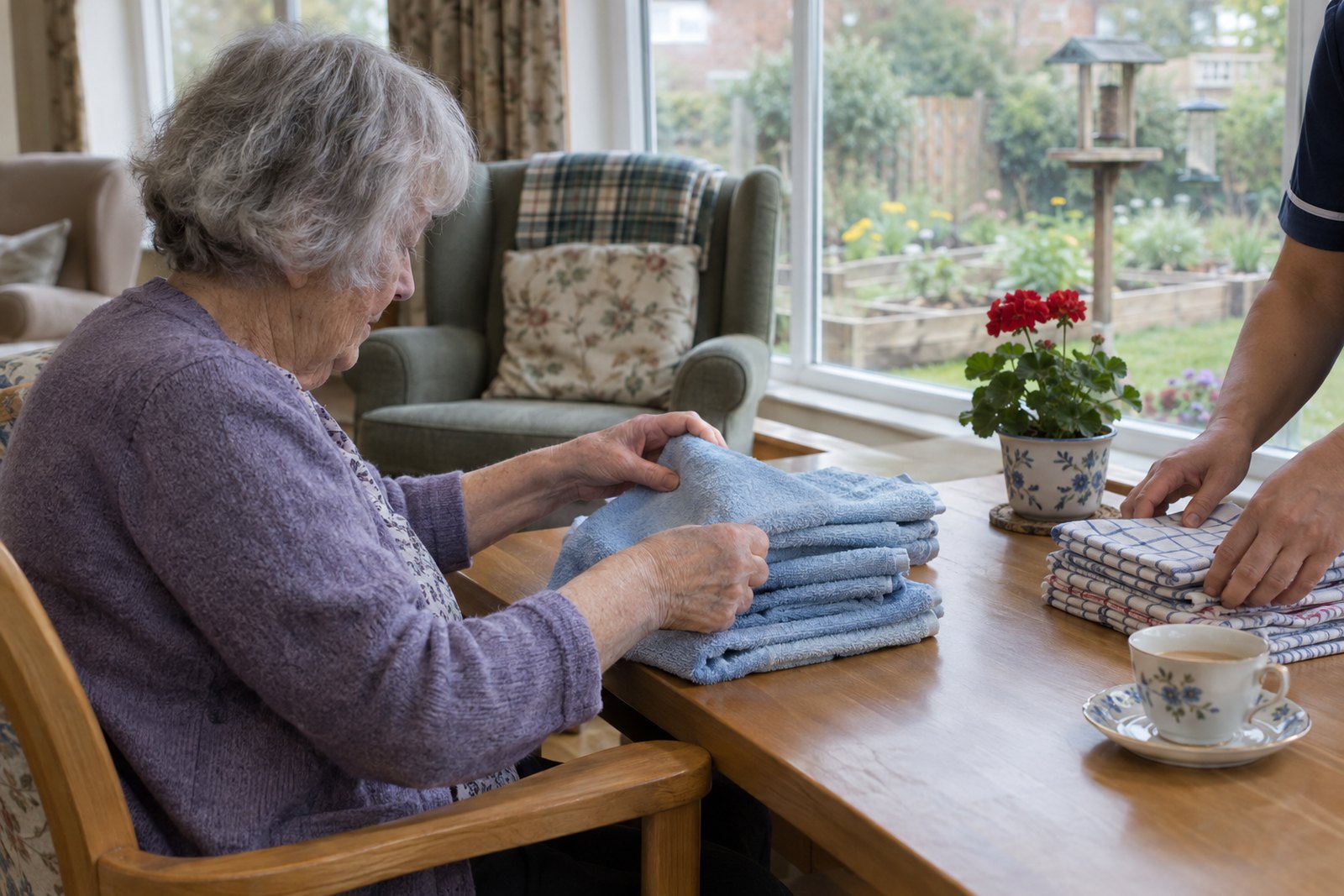
Good activities for elderly people in care homes are not a timetable of bingo, a quiz and a visiting singer on Thursdays. Those can be lovely, but they are entertainment. What matters more is whether each person spends their day doing things that mean something to them. Folding the laundry. Watering the tomatoes. Laying the tables for lunch. Listening to the music they danced to at twenty. Sitting with someone who knows their story.
So when you are choosing a care home, or worrying about the one your mum or dad is already in, the useful question is not "how many activities are on the board?" It is "what did Dad actually do today, and did any of it feel like his life?" This guide explains what good looks like, what helps people with advanced dementia, how families can help, and the questions worth asking before you choose.
Meaningful activity is not the same as entertainment
In a good care home, activity is not a slot in the afternoon. It is everything a person does from waking to sleeping: choosing what to wear, deciding on toast or porridge, chatting to the person next to them, helping clear the plates, going outside. Entertainment is something you watch. Meaningful activity is something you take part in, in a way that suits you.
The difference matters because long stretches of sitting with nothing to do are hard on anyone. People who are bored and under-occupied often become restless, walk about looking for something, call out, or simply sleep through the day. Staff can end up describing this as "behaviour" when a good part of it is boredom, or a person trying to find a purpose.
That does not mean everyone should be busy all the time. Plenty of older people value quiet, rest and watching the world go by. The point is choice. Sitting by the window because you like watching the birds is an activity. Sitting in the same chair facing a television nobody is watching, because nobody offered anything else, is not.
Start with the person, not the programme
Why life history matters
The best care homes build activity around who someone is, not around what the activity coordinator happens to be running that week. That starts with life history: where someone grew up, what work they did, who they loved, what they did at weekends, what they are proud of, what annoys them and what calms them down.
This is practical information, not a nice extra. A retired farmer who has been up at five every morning of his life may be miserable if he is expected to stay in bed until breakfast is served. A woman who ran a busy household may get unsettled around four o'clock because, for decades, that was when the children came home and tea needed making. Knowing this, staff can offer her a job at that time of day, rather than trying to sit her down.
Life history also gives staff things to talk about. Conversation is an activity too, and it is much easier when you know someone was a nurse, kept pigeons or followed a particular football team. Our guide to reminiscence therapy for dementia explains how to use memories, photos and familiar objects well, and the same ideas work in a care home.
Choice and control
Person-centred activity also means people get a say. Some love a group sing-along. Others would rather have a cup of tea in peace with the newspaper. Some would rather help with the activity than be part of it, handing out song sheets or setting up chairs. A good home asks, notices and adjusts, and does not take one refusal as a permanent "no".
Small daily roles: the activities that are easy to miss
Some of the most valuable activity in a care home does not look like activity at all. It looks like ordinary life. Many older people spent decades being useful to others, and losing that can be one of the hardest parts of moving into care. Small daily roles give some of it back.
- Laundry jobs: folding towels, pairing socks, sorting tea towels.
- Mealtimes: laying tables, folding napkins, putting out the sugar bowls, drying up, wiping trays.
- Food preparation: peeling vegetables, buttering bread, mixing cake batter, shelling peas.
- Gardening: watering pots, deadheading, potting up seedlings, sweeping a path, filling the bird feeders.
- Household tasks: dusting, polishing, sorting the post or newspapers, tidying a bookshelf.
- Social roles: welcoming visitors, showing a new resident around, reading the menu out to a table.
- Caring roles: looking after a house pet, watering the plants in the lounge, checking on a friend.
None of this is about getting free help. If the towels need refolding afterwards, that is fine. The value is in the doing, the sense of contributing and the familiar movements of a task done thousands of times before.
Some homes are cautious about letting residents near kitchens or garden tools. Sensible risk assessment is right, but blanket bans often are not. A good home works out how someone can do a task safely, with the right setup and supervision, rather than ruling it out entirely.
One-to-one time for people who cannot join groups
Group activities suit some people and leave others out. Residents who stay in bed, who are very frail, who have significant hearing or sight loss, who find groups noisy and frightening, or who are near the end of life can go days with very little meaningful contact beyond personal care. This is one of the clearest signs of a home that is doing activities well or badly.
One-to-one time does not need to be long. Ten focused minutes can make a real difference. Ideas include:
- a gentle hand massage with cream, if the person welcomes touch
- reading aloud from a newspaper, a favourite book or a letter
- looking through photos together and talking about them
- playing a favourite song and singing along
- painting nails, brushing hair or a shave, done slowly and as a pleasure rather than a task
- opening the window and talking about the weather, the garden or what is going on outside
- simply sitting together, holding a hand
A good home plans this, records it and makes sure it happens for people in their rooms, not just for those who make their way to the lounge.
Activities for people with advanced dementia
As dementia progresses, people may lose speech, struggle to follow instructions and stop recognising familiar faces. They do not stop experiencing the world. Activity at this stage leans more on the senses, on rhythm and on comfort.
Sensory activities
Things to see, touch, smell, hear and taste can bring real moments of connection. Soft or interesting fabrics, a warm towel from the dryer, the smell of lavender, fresh coffee or cut grass, a bowl of warm water to rest hands in, a pebble or a smooth piece of wood to hold. Always check towels and water feel comfortably warm, not hot, on your own wrist first, because people with advanced dementia or reduced sensation may not be able to tell you something is too hot. Objects linked to someone's past often work best: a handbag with familiar contents, a tool from their trade, a baby's blanket.
Music
Music is one of the most reliable ways to reach someone with advanced dementia. Songs from the teenage and young adult years tend to land best. A personalised playlist, played through headphones or a speaker at quiet times of day, can settle someone who is distressed or bring a flicker of recognition. Singing together, tapping a rhythm or swaying to the music all count.
The key skill is watching the response. Eyes opening, a hand moving, a hum, a change in breathing, a smile. If someone becomes distressed, stop and try something else later. Our guide to activities for people with dementia that actually work has more ideas, and our dementia page explains how occupational therapy can help at each stage.
What the standards say
Meaningful activity is not just a nice idea. NICE, which sets health and care standards in England, has a quality standard on the mental wellbeing of older people in care homes. One of its statements is that older people in care homes should be offered opportunities during their day to take part in meaningful activity that promotes their health and mental wellbeing. It is worth reading if you want to know what good is supposed to look like.
Care homes in England are inspected by the Care Quality Commission (CQC), which looks at whether care is person-centred and responsive to each resident. Inspection reports are published and often comment on activities and how residents spend their time. In Scotland the regulator is the Care Inspectorate, in Wales it is Care Inspectorate Wales, and in Northern Ireland it is the RQIA. Check the relevant regulator's website for the latest report on any home you are considering.
The National Activity Providers Association (NAPA), a charity that supports people who lead activities in care settings, has long argued that activity is part of care rather than an extra. Some homes use its training and guidance for their staff, and it is a reasonable question to ask.
How families can help
You know things about your relative that no assessment form will capture. Sharing them is one of the most useful things you can do.
- Write it down. A one-page profile with their life story, favourite music, food, routines, what upsets them and what calms them. Staff change shifts and leave; paper stays.
- Bring things in. Photos, a playlist, hobby materials, a familiar cushion or ornament, magazines about their interests.
- Do things together when you visit. Fold a pile of washing, walk round the garden, look at photos, do a crossword, paint their nails. Visits with something to do are often easier than visits spent searching for conversation.
- Tell staff what worked. If Mum lit up at a particular song, say so. If a visit went badly at teatime, mention that too.
- Offer your skills. Some homes welcome relatives who will run a gardening session, bring in a pet or play an instrument.
And if some visits are quiet, that is all right. Sitting together is still time well spent.
Questions to ask a care home about activities
- Who plans and leads activities, and is it only the activity coordinator's job or do care staff get involved too?
- How do you find out about each resident's life history and interests, and how is that used day to day?
- What would my relative actually do on an ordinary weekday morning?
- How do you support people who stay in their rooms or cannot join groups?
- What do you offer people with advanced dementia?
- Can residents help with everyday tasks like laying tables, laundry or gardening?
- How often do residents get outside, and can they go out into the community?
- What happens at weekends and in the evenings, when there may be fewer staff?
- Do staff have training in activity or dementia care?
- How do you record activity, and can families see it?
Then look around. A television on with nobody watching, residents asleep in a ring of chairs and an impressive timetable on the wall tells one story. Residents doing things, chatting and moving about tells another.
Where an occupational therapist fits
Occupational therapists are trained to help people do the things that matter to them, so meaningful activity is close to the heart of the job. A private occupational therapist visiting a care home can:
- assess what someone can still do, including thinking, movement, vision and concentration, and what gets in the way
- adapt activities so they are achievable, for example breaking a task into steps or changing how it is set up
- look at seating and positioning, because nobody can join in if they are slumped in the wrong chair or uncomfortable
- suggest equipment such as adapted cutlery, non-slip matting or a book holder
- write a practical activity plan for staff and family to follow
- advise staff on approaches for residents who are distressed, withdrawn or hard to engage
You can read more about this on our care home occupational therapy page.
Other professionals lead in some areas. A sudden change, such as new confusion, unusual drowsiness or a sharp drop in what someone can do, can be a sign of infection or another illness, and staff should contact the GP or NHS 111 promptly; call 999 in an emergency. Swallowing difficulties are assessed by a speech and language therapist. Building strength and walking is usually led by a physiotherapist. Persistent low mood should be raised with the GP. Music therapy, as distinct from enjoying music, is delivered by HCPC-registered music therapists.
Frequently asked questions
How many activities should a good care home offer each week?
There is no set number. A long weekly timetable can still leave many residents doing very little. Focus on what an individual resident does each day, whether it suits them, and whether people in their rooms are included.
My mum refuses to join in. Should staff keep encouraging her?
Gently, yes, but not by pushing her into a group. Try different times, smaller numbers, one-to-one time, or a role such as helping rather than taking part. Some people simply prefer quiet, and that choice deserves respect too.
What activities work for someone who is in bed most of the time?
Music, reading aloud, hand massage if welcome, looking at photos, a view of the garden, sensory objects and simple conversation. Short, regular contact matters more than long sessions.
Is it a bad sign if a care home has no activity coordinator?
Not necessarily. Some smaller homes build activity into everyday care rather than employing a dedicated person. What matters is whether residents are occupied in ways that suit them, so ask what actually happens day to day.
Can an occupational therapist visit my relative in a care home?
Yes. Families can arrange a private occupational therapist, with the home's agreement and your relative's consent or, if they lack capacity, a best interests decision. Ask whether the home already has access to any NHS or community therapy first.
Next steps
If you want help working out what your relative can still enjoy and how the home can support it, see our care home occupational therapy page, or current guide prices, and choose your area below.

Talk to an occupational therapist near you
This guide is general information. For advice about your own situation - or someone you look after - a local occupational therapist can visit you at home and see it for themselves.
Choose your area: