Upper Limb Rehabilitation After Stroke and Brain Injury in Staffordshire
By Mobile Occupational Therapist • 8 September 2026 • 7 min read
Local Occupational Therapist -
Helen Harrison, Staffordshire
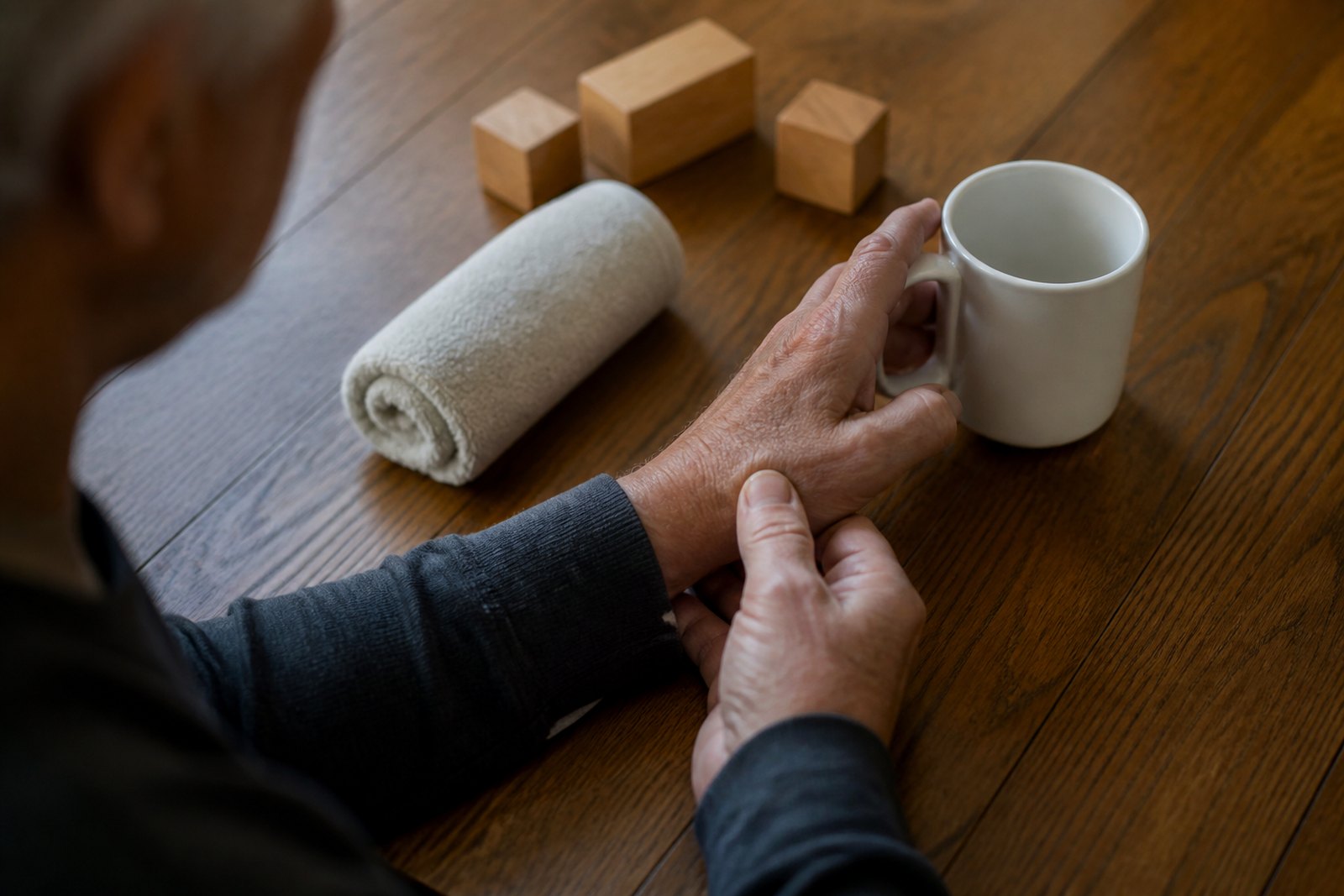
After a stroke or brain injury, the affected arm and hand often lag behind everything else. Walking gets attention because you cannot leave hospital without a plan for it; the arm, by contrast, can quietly slip down the list, and by the time someone is home in Burton upon Trent or Penkridge it may be doing very little - carried rather than used. Upper limb rehabilitation is one of Helen Harrison's core specialisms across Staffordshire, and this post explains what it involves: how the arm is assessed, what tools like SaeboFlex and FES actually are, where splints fit in, and why practising real tasks beats abstract exercise.
Why the arm gets left behind
There is a practical reason and a neurological one. Practically, you can get through a day one-handed - awkwardly, but you can - so the affected arm stops being needed, stops being used, and stops improving. Neurologically, this matters enormously: recovery depends on the brain rewiring itself, and rewiring is driven by use. An arm that does nothing sends the brain no reason to rebuild its connections. Therapists call the result "learned non-use", and it can set in even when real recovery potential remains. The encouraging flip side: structured, meaningful use can restart progress - which is why it can still be worth assessing an arm months or years after a stroke or brain injury.
What an upper limb assessment covers
Before anything is prescribed, Helen assesses what is actually going on in the arm and hand, because "it doesn't work" has many different causes and each points to a different programme. The assessment looks at:
- Strength. Which muscle groups fire, how strongly, and whether weakness or tightness is the bigger problem - including spasticity, the involuntary muscle tightness common after stroke and brain injury.
- Movement. What the shoulder, elbow, wrist and fingers can each do, alone and together, and what patterns the arm falls into when it tries.
- Co-ordination. Whether the arm can do the right thing at the right time - reaching, grasping, releasing, and the timing between them.
- Sensation. Whether you can feel touch, pressure and where the limb is in space. A hand you cannot feel is hard to use even with good movement, and sensory loss changes the rehabilitation approach.
- Use in real tasks. The most telling part: what the arm actually does during dressing, eating or making a drink, which is often quite different from what it can do on request.
Helen's training here runs deep - Bobath, a widely used approach to movement rehabilitation after neurological injury, along with certification in the specific technologies below - and it is all in service of one question: what combination of approaches gives this particular arm its best chance?
SaeboFlex and FES, in plain English
Two names come up often in upper limb neurorehabilitation, and both deserve a jargon-free explanation.
SaeboFlex is a mechanical device worn on the forearm and hand. After a stroke, a common pattern is being able to close the hand but not open it again - the grip works, the release does not, which makes the hand unusable for picking things up and putting them down. The SaeboFlex uses a spring system to open the fingers for you after you grip, so you can practise hundreds of real grasp-and-release repetitions in a session instead of none. That volume of practice is what drives the brain's rewiring. Helen is a certified SaeboFlex fitter, so assessment for suitability, fitting and the training programme can all happen at home.
FES - functional electrical stimulation - uses small electrical pulses, delivered through pads on the skin, to make weakened muscles contract. It is not painful; most people describe a tingling and then the odd experience of watching their own hand open. Used well, FES is not passive treatment - it is timed into practice, helping the arm complete real movements it cannot yet finish alone, so the brain relearns them. Helen trained in FES for the upper limb and uses it where assessment suggests it will help. Neither tool suits everyone, which is why assessment comes first - and anyone with implanted medical devices or other health concerns should loop in their GP or consultant before starting FES.
Splints that do a job
Splints in neurorehabilitation do two different jobs. Some protect and position - keeping a wrist supported, managing muscle tightness, preventing a hand from stiffening into an unusable posture. Others, less well known, are functional splints: bespoke pieces built to make a specific task possible right now, such as a splint that holds a pen so writing works again, or one that makes self-feeding manageable. That second kind can be quietly life-changing, because it separates two timelines - long-term recovery, which takes months, and doing the things you care about, which a well-made splint can restore this week. Helen trained in splinting and casting and later in functional splinting specifically, and makes bespoke splints as part of home programmes. For the broader world of hand recovery beyond neurological injury, see our national post on hand therapy at home and the hand and upper limb injuries page.
Why real tasks beat abstract exercises
A sheet of arm exercises has two problems: it is boring, so it stops happening; and it is abstract, so the brain gets less from it. Practice works best when it is intensive, repetitive and meaningful. So home programmes are built into the day rather than bolted onto it: the affected hand holds the mug, stirs the pan, does the buttons, with tasks graded to be hard enough to drive change but possible enough to succeed. This is where home genuinely beats a clinic, because your kitchen in Eccleshall or Codsall is where the practice must transfer to anyway. Fatigue management matters here too - quality of practice beats exhausted quantity - and both threads run through the wider programme on our neurological rehabilitation page.
Frequently asked questions
How long after a stroke can the arm still improve?
Longer than most people are told. Change is fastest early on, but with structured practice, functional gains are seen well beyond a year - and even where movement has plateaued, splinting and task adaptation can still increase what the arm does day to day.
Will I need to buy a SaeboFlex or FES machine?
Not as a starting point. The starting point is assessment: whether either tool suits your arm, and a trial of what helps. Equipment decisions come after that, with clear reasoning - never as a catalogue exercise.
What about pain in the shoulder?
Shoulder pain is common after stroke and worth taking seriously - it can come from the joint being poorly supported when muscles are weak. Positioning and support strategies are part of upper limb work, but new or worsening pain should also be raised with your GP.
Next steps
If an arm or hand has been written off - by a discharge summary, or quietly at home - it costs nothing to ask the question properly: get in touch for a free phone call about whether an upper limb assessment makes sense. Helen's certifications and neurological background are listed on her profile, and you will find session costs on the prices page.