

Mental Health Occupational Therapy Jobs: What the Work Involves
By Mobile Occupational Therapist • 20 October 2026 • 13 min read
Mental health occupational therapy jobs are about one thing: helping people whose mental illness has knocked everyday life sideways get back to doing what matters to them. That might be getting up at a reasonable hour, cooking a meal, managing money, keeping a tenancy, going back to work or simply leaving the flat. You assess how someone is functioning, not what their diagnosis is, and you use activity and routine as the main tool for recovery.
The work happens on inpatient wards, in community mental health teams, in forensic and secure services, in early intervention and children's services, and increasingly in primary care and private practice. Most posts are in the NHS on Agenda for Change pay bands, with newly qualified therapists usually starting at Band 5. If you like people, can sit comfortably with uncertainty and are more interested in what someone can do than what is wrong with them, it is some of the most rewarding work in the profession. It is also some of the most demanding. Both things are true.
What a mental health OT actually does
Job adverts tend to say things like "promote recovery through meaningful occupation". That is accurate but not very helpful if you are trying to picture a Tuesday. Here is what it looks like in practice.
Assessing function
Your core contribution to a team is a clear picture of how someone manages daily life. Can they plan and cook a simple meal? Do they wash and change their clothes? Can they get to an appointment on time, use public transport, budget for the week? What does their day look like hour by hour, and what has dropped out of it since they became unwell?
You gather this through interview, observation and standardised assessment. Many services use tools based on the Model of Human Occupation, along with outcome measures such as the Canadian Occupational Performance Measure. Kitchen assessments, community access assessments and home visits are bread and butter. The written report matters: your findings often shape discharge decisions, care packages and housing applications.
Meaningful activity and routine
Depression, psychosis, trauma and long hospital stays all erode routine. Days lose their shape, and people lose the roles that made them who they are - parent, worker, footballer, cook. A large part of the job is rebuilding that structure, starting small and building up. This overlaps with approaches like behavioural activation, though OTs tend to focus more on roles, environment and skills than on mood monitoring alone.
Groups
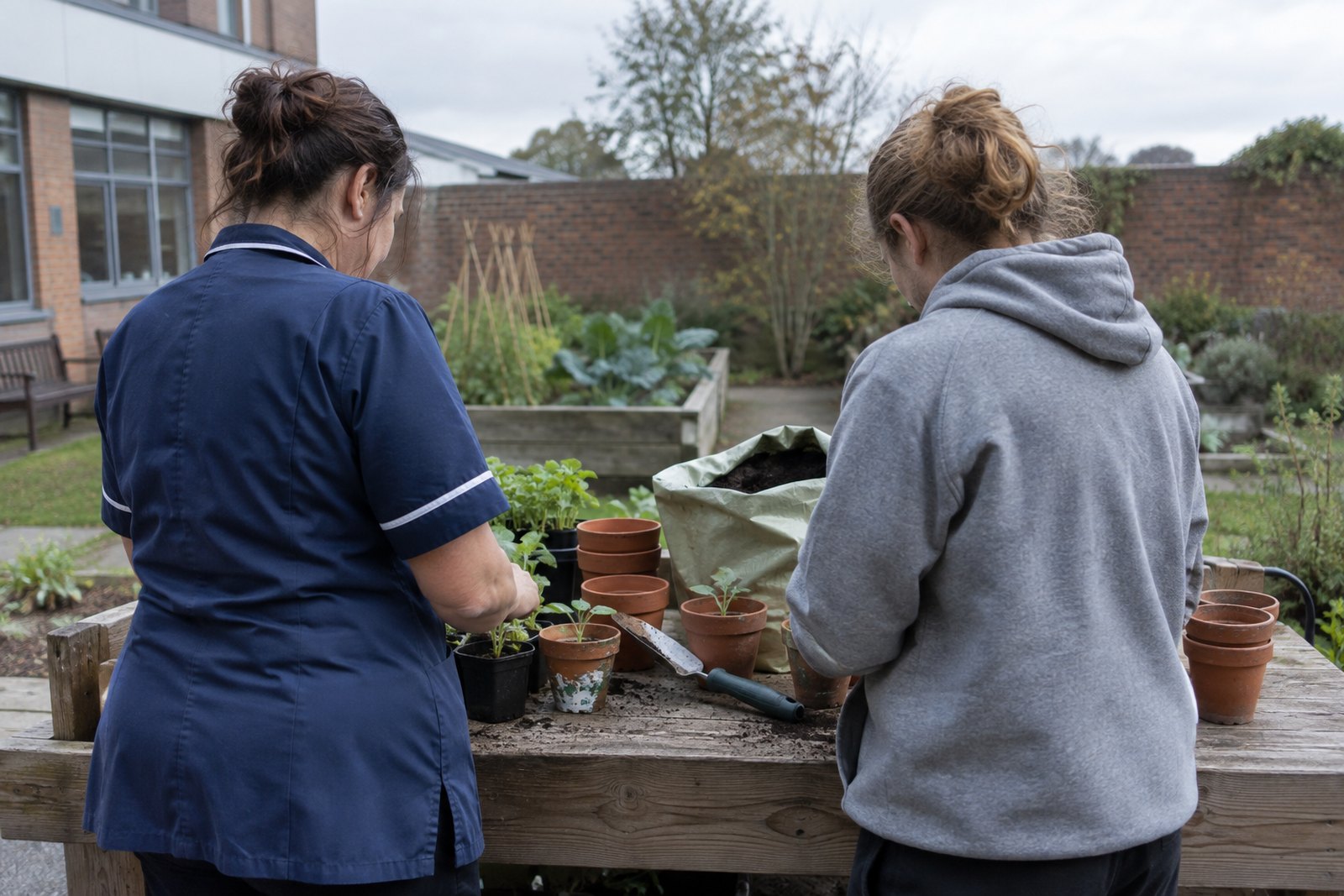
Expect to run groups, particularly in inpatient and day services. Cooking, gardening, creative activity, walking, community outings, life skills, anxiety management, relapse prevention. A good group is planned around a clear purpose, graded to the people in the room and reviewed afterwards. A bad one is a box ticked. Ward managers notice the difference, and so do patients.
Vocational rehabilitation
Work, study and volunteering are central to mental health OT. You might help someone keep a job they are struggling in, plan a phased return, explore volunteering as a stepping stone or think through whether a particular kind of work is realistic yet. Some trusts run employment services based on the Individual Placement and Support model, and OTs often work alongside or within them.
Recovery-focused practice
Recovery in mental health does not necessarily mean the illness disappears. It means building a satisfying life with or without ongoing symptoms. In practice that means goals set by the person, not the team, positive risk-taking where appropriate, and respecting choices you might not make yourself. Many trusts have recovery colleges where staff and people with lived experience co-produce and co-deliver courses, and OTs are often involved.
Where mental health OTs work
Inpatient wards
Acute admission wards, psychiatric intensive care units, rehabilitation wards and older adult wards all employ OTs. On an acute ward, people may only be there for a short time and are often very unwell, so you are assessing function, offering structure through the day and planning for discharge. Rehabilitation units are slower and more skills-focused, which suits people who like to see change over months.
Community mental health teams
In a community team you work alongside psychiatrists, nurses, social workers, psychologists and support workers. You may hold a caseload as a care coordinator or key worker, which brings generic duties such as care planning, risk reviews and medication liaison, as well as OT-specific work. The balance between generic and specialist work varies a lot between trusts, so ask about it at interview. Community services in England have been reorganising around primary care networks, and roles are changing. For context on how people reach these teams, see our guide to getting mental health support in the UK.
Early intervention in psychosis
Early intervention teams work with people, often young adults, experiencing a first episode of psychosis. The emphasis on education, employment and keeping life on track makes it a natural fit for OTs. The work is hopeful, energetic and often very practical.
Forensic services
Forensic OTs work in low, medium and high secure hospitals, in prisons and in community forensic teams. People may stay for years, so long-term rehabilitation, structured activity, work programmes and preparation for step-down are central. Security procedures shape everything, from which tools you can use in a kitchen to how outings are planned. It suits people who are calm, consistent and good with boundaries.
CAMHS
Child and adolescent mental health services employ OTs in community teams and inpatient units. You might work on sensory needs, school attendance, self-care, sleep routines or eating difficulties, often with parents and schools as much as the young person. Some CAMHS posts lean heavily on neurodevelopmental work, so check what the role really involves.
Talking therapies and other settings
Some OTs work in NHS talking therapy services for anxiety and depression, usually after additional training as a psychological wellbeing practitioner or high intensity therapist. In those posts you are employed for the therapy role rather than as an OT, though your background shapes how you work. Other settings include eating disorder services, perinatal mental health, liaison psychiatry in general hospitals, crisis and home treatment teams, memory services, learning disability services, substance misuse and homeless health.
Skills that matter
- Therapeutic use of self. Your relationship with the person is the intervention as much as any activity is. Warmth, honesty and consistency matter more than technique.
- Activity analysis and grading. Breaking a task into steps and adjusting it so it is achievable but not patronising. This is what distinguishes you from everyone else on the team.
- Clear risk thinking. Noticing changes, asking direct questions about self-harm and suicide, and documenting what you saw and did.
- Group facilitation. Managing a room with very different levels of energy, distress and attention.
- Report writing. Concise, functional, evidence-based reports that a tribunal, housing officer or benefits assessor can use.
- Holding your professional identity. In busy teams it is easy to drift into generic work. Knowing what OT adds, and saying so, is a skill in itself.
NHS bands and how careers progress
Most NHS mental health OT posts follow the Agenda for Change structure. As a general pattern, newly qualified OTs start at Band 5, often on a rotation or in a preceptorship programme. Band 6 posts are for therapists with experience who can work more independently and supervise others. Band 7 roles are usually senior, specialist or team lead posts, and Band 8 and above covers consultant OTs, service leads and managers. Exact expectations differ between trusts. For pay scales and how private earnings compare, see our guide to OT salaries in the UK, and check current figures on NHS Employers or NHS Health Careers.
There are also routes beyond the traditional ladder. In England, OTs are among the professions who can train as approved mental health professionals, and the Mental Health Act allows suitably trained OTs to become approved clinicians. These are significant extra roles with their own training and responsibilities, and only a minority take them on, but they show how far the career can go. Check current eligibility with your employer and the relevant professional bodies before planning around them.
Risk, safeguarding and keeping yourself safe
Risk runs through every part of the job. You will regularly work with people who self-harm, have thoughts of suicide, are vulnerable to exploitation or, less often, pose a risk to others. You need to be able to ask about these things plainly, record your findings and escalate promptly.
Safeguarding adults and children is everyone's responsibility. In practice that means knowing your trust's procedures, knowing who your safeguarding lead is and acting on concerns rather than sitting on them. Children in the household of an adult you are seeing are part of your safeguarding duty too.
Personal safety is real, especially in community and inpatient work. Expect training in de-escalation and breakaway techniques, lone working procedures and how to plan a home visit. Kitchen sessions and outings carry their own risks, so activity-specific risk assessments are part of routine planning, not an afterthought. Positive risk-taking - letting someone try something that carries some risk because the benefit to their recovery is greater - is a core recovery principle, but it has to be thought through, discussed and recorded.
Supervision
Good supervision is not optional in mental health work. You are carrying other people's distress, making judgements about risk and often working in emotionally heavy situations. Regular clinical supervision with an experienced OT helps you think clearly, stay within your competence and avoid burnout. HCPC standards expect you to reflect on your practice and keep your knowledge up to date, and supervision is a big part of how you evidence that.
Many mental health services also offer reflective practice groups and team debriefs after serious incidents. When you are job hunting, ask how often supervision happens, who provides it and whether it is protected when the service is busy. The answers tell you a lot about the culture.
Private and independent mental health OT work
Independent mental health OT is a smaller field than NHS work, but it is growing. Typical areas include case management and rehabilitation after personal injury where psychological trauma is part of the picture, medico-legal reports on functional impact, vocational rehabilitation and occupational health work, private hospitals and residential services, and direct work with adults whose anxiety, depression, burnout or trauma is limiting daily life.
Going independent changes your safety net. You no longer have a duty psychiatrist down the corridor or a crisis team in the same building. Before you take on mental health clients privately you need clear arrangements for:
- What you will do if someone discloses immediate risk, including liaison with their GP and local crisis services.
- Your own safeguarding procedures and how you will make referrals.
- Professional indemnity insurance that covers mental health work.
- Clinical supervision you arrange yourself, ideally with someone experienced in mental health.
- Record keeping and data protection that meet professional and legal standards.
- Being honest about scope. If someone needs psychiatric review, structured psychological therapy or a crisis response, your job is to help them get it, not to stretch your role to fill the gap.
Most people build a few years of NHS or statutory experience first. Our practical guide to going private as an occupational therapist covers the business side.
How to move into mental health OT
As a student, ask for at least one mental health placement and make the most of it. Volunteering in a mental health charity, peer support project or community group also helps, and shows you are comfortable with the work before you apply. In interviews, talk about how you used occupation, not just how you supported someone.
As a newly qualified OT, rotational Band 5 posts that include mental health are a good way in. Standalone Band 5 mental health posts exist too, often on acute or rehabilitation wards. Look for a solid preceptorship programme.
Moving from physical health, your activity analysis, functional assessment and discharge planning skills transfer well. What you may need to build is confidence with risk assessment, mental state, therapeutic relationships and group work. Short courses, shadowing a local mental health team and joining the RCOT's mental health specialist section can help. Be ready to explain in interview why you want the move and how your physical health experience will help - many mental health service users have physical health needs that teams overlook.
Where an occupational therapist fits in a mental health team
Being clear about roles makes you a better team member. Psychiatrists lead on diagnosis and medication. Psychologists lead on formal psychological assessment and structured therapies. Nurses typically lead on day-to-day clinical care, medication management and much of the risk monitoring. Social workers lead on statutory social care duties and often on safeguarding processes. Speech and language therapists, dietitians and physiotherapists contribute where communication, swallowing, nutrition or physical health need them.
The OT's distinct contribution is occupation: how someone spends their time, what they can and cannot do, what gets in the way and how to change it. When a team asks "is this person ready for discharge?" or "can they manage a tenancy?", the OT is often the one with the evidence. That is worth protecting, even when generic workloads are heavy.
Frequently asked questions
Do I need extra qualifications to work in mental health as an OT?
No. An HCPC-registered OT can apply for mental health posts straight after qualifying. Further training in areas like psychosocial interventions, trauma-informed care or specific assessments helps as you progress, and some specialist roles expect it.
Is mental health OT less clinical than physical health OT?
Not really. It is different rather than less. You still assess, set goals, intervene and measure outcomes. The tools tend to be activity, routine, environment and relationship rather than equipment and adaptations, though those come up too.
Will I end up as a care coordinator rather than an OT?
In some community teams, yes, at least part of the time. Care coordination can be valuable experience, but if you want to keep a strong OT identity, ask at interview how much of the role is generic and whether there is protected time for OT-specific work.
How emotionally hard is the work?
It can be very hard at times, particularly after a serious incident or a death. Good supervision, a supportive team and boundaries around your own time make a real difference. If a service cannot tell you how it supports staff, treat that as information.
Can I work in mental health privately straight after qualifying?
You legally can, if you are registered, but it is rarely wise. Private mental health work means managing risk without a team around you. A few years in statutory services gives you the judgement and confidence that independent work depends on.
What does an OT add that a support worker does not?
Support workers do vital practical work. The OT brings formal assessment, clinical reasoning about why someone is struggling, graded intervention planning and reports that carry professional weight in discharge, housing and legal decisions.
Next steps
If you already practise independently, including in mental health, you can list your practice with us so people can find you, and see how functional work is presented on our functional assessments and reports page. You can also choose an area below to see who is already practising near you.

Talk to an occupational therapist near you
This guide is general information. For advice about your own situation - or someone you look after - a local occupational therapist can visit you at home and see it for themselves.
Choose your area: