
Parkinson's and MS Occupational Therapy at Home in Staffordshire
By Mobile Occupational Therapist • 15 September 2026 • 12 min read
Local Occupational Therapist -
Helen Harrison, Staffordshire
If you or someone you love is living with Parkinson's or multiple sclerosis in Staffordshire, an occupational therapist can help with the parts of life that clinic appointments rarely reach. That means getting dressed without it taking an hour, eating without spills, getting through the afternoon without running out of energy, and keeping the house safe as things change. An occupational therapist can visit you at home, which is where most of this actually happens.
There are three ways to get that help. The NHS, usually through your GP, neurologist or specialist nurse. The council, which in Staffordshire means Staffordshire Cares for adults outside Stoke-on-Trent, and the city council's own service within it. Or privately, with an independent occupational therapist who comes to you. This guide covers what helps day to day, where each route fits, and how to plan ahead so you are not always reacting to the last crisis.
Who does what: the medical team and the occupational therapist
Parkinson's and MS bring a lot of professionals into your life, and it helps to know who leads on what. Your neurologist and your Parkinson's or MS specialist nurse lead on diagnosis, medication and treatment. A physiotherapist leads on movement, walking, balance and exercise. A speech and language therapist leads on speech and swallowing. Your GP holds it all together.
An occupational therapist works on daily life. Washing, dressing, cooking, getting in and out of bed, going out, working, and managing your energy across the day. The question is always the same: what do you need or want to do, and what is getting in the way? Sometimes the answer is a piece of equipment. More often it is a different way of doing the task, a different order to the day, or a change to the room. For background, see our pages on Parkinson's and multiple sclerosis.
An occupational therapist will not change your medication or replace your neurologist. If something new or worrying appears, that goes to your medical team first.
Fatigue: often where the real gains are
Fatigue in MS and Parkinson's is not ordinary tiredness. It can arrive without warning, it does not always lift with sleep, and the people around you can easily underestimate it. Plenty of people say it limits them more than anything else.
What tends to help:
- Spread the heavy jobs across the week. Shower one day, change the bed another, shop on a third, rather than doing everything on the day you feel good and paying for it for the next two.
- Sit down for anything that can be done sitting. Dressing, drying after a wash, preparing vegetables, ironing if you still iron.
- Plan around your best time of day. For many people with Parkinson's this is linked to how their medication is working. Talk to your specialist nurse about it rather than changing the timings yourself.
- Keep cool if you have MS. Heat often makes MS symptoms worse for a while. Lukewarm rather than hot showers and a fan in the bedroom are worth trying.
- Keep a simple diary for a week or two. What you did, and how you felt afterwards. Patterns show up that you would never spot otherwise.
The aim is not to do less of everything. It is to spend your energy on the things that matter to you, not just on the things that have to get done. Our guide to living with MS at home goes into fatigue and heat in more detail.
Freezing, falls and getting around the house
Freezing, where your feet feel glued to the floor, is common in Parkinson's. It often happens in doorways, in tight spaces, when turning, or when someone is hurrying you. A physiotherapist usually teaches cueing techniques, such as stepping to a count or aiming for a line on the floor. An occupational therapist looks at the home itself: where freezing happens, and what can be changed so it happens less.
Common changes include:
- Clearing the routes you use most, especially between bed, toilet and kitchen.
- Making turns wider, for example by moving a chair so you are not pivoting in a tight gap.
- Good lighting, including a light you can reach from bed and low lights on the way to the toilet at night.
- Rails beside steps, by the toilet and at the front door, fixed to the wall, so nobody is leaning on towel rails, sinks or radiators.
- Raising a chair, bed or toilet so standing up takes less effort.
In MS, falls often come from weakness, numb feet, poor balance, or fatigue late in the day. Foot drop, where the toes catch on the floor, is common. The same principles apply: clear routes, rails where you actually reach for support, and somewhere to sit when you need to rest.
If you fall and hit your head, cannot get up, or notice sudden new weakness, numbness or confusion, call 999. If you are falling more often than before, tell your GP or specialist nurse, because it can be a sign that something has changed. Getting up from the floor safely is a skill worth learning before you need it, and an occupational therapist or physiotherapist can go through it with you.
Dressing, eating and the small daily battles
Dressing
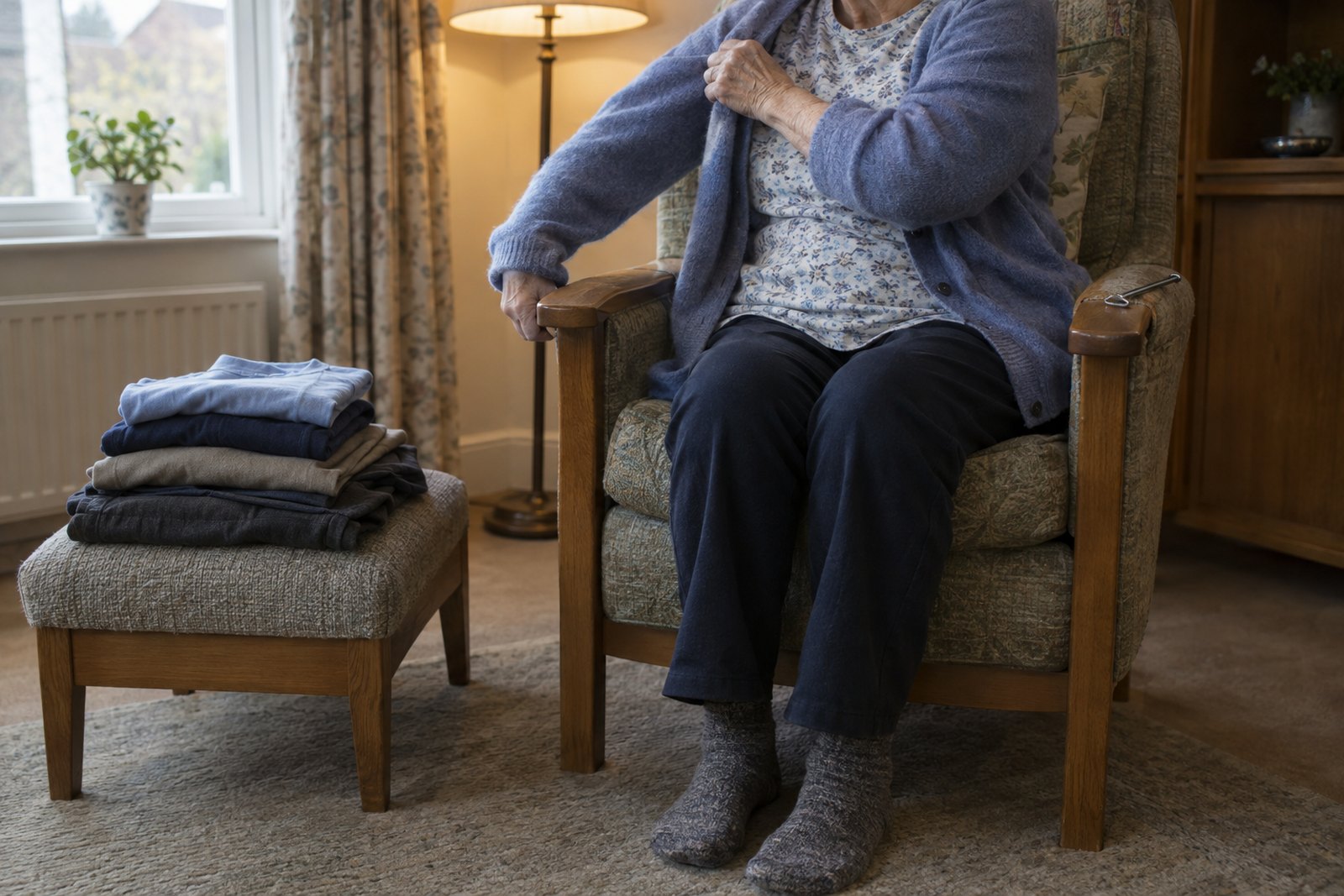
Stiffness, tremor, weakness and fatigue all make dressing harder. Things that often help: sitting on a stable chair or the edge of the bed with your feet flat, laying clothes out in the order you will put them on, dressing the stiffer or weaker side first and undressing it last, and choosing looser clothes with fewer fastenings. Button hooks, zip pullers, elastic laces and long-handled shoe horns are simple and inexpensive. If dressing leaves you worn out, try doing it in two stages with a rest in between.
Eating and drinking
Tremor and weakness make cutting food and lifting a cup hard work. A non-slip mat under the plate, a plate with a raised edge, cutlery with thicker or weighted handles, and a cup with two handles or a lid can make meals less of a battle. Resting your elbows on the table can steady your hands. Some people find a splint helps them hold a fork or pen, but that needs assessing properly rather than guessing.
If you are coughing or choking when you eat or drink, food feels as if it is sticking, or you keep getting chest infections, tell your GP. A speech and language therapist leads on swallowing, and it matters. If someone is choking and cannot breathe, call 999.
Setting up the home and planning ahead
Both conditions change over time, often slowly and unevenly, and MS can come and go in relapses. The awkward truth is that adaptations take time to arrange, and a crisis does not wait. It is far easier to plan a bathroom while you can talk it through calmly than after a fall in the bath.
Questions worth asking now:
- Could you manage on one floor if you had to? Is there room for a bed downstairs, and is there a downstairs toilet?
- Is the bath already a struggle? A level-access shower may serve you for longer than a bath lift.
- Are the stairs getting harder? A stairlift suits some people. For someone who may later use a wheelchair, it may not be the right long-term answer.
- Is the front door step manageable now, and would it be with a walking aid or wheelchair?
An occupational therapist can help you think about what will still work in five years, not just next month. With a progressive condition that matters, because the wrong adaptation can mean paying twice.
Huntington's disease and motor neurone disease
The same thinking applies to other progressive neurological conditions. With Huntington's disease, movement, thinking and behaviour may all change, and a calm, uncluttered, predictable home helps. With motor neurone disease, change can be faster, so planning equipment and adaptations early, alongside your specialist team, is especially important.
NHS and council routes in Staffordshire
The NHS. Ask your GP, neurologist or specialist nurse about a referral to occupational therapy. The people already treating you are best placed to know what is available near you.
The council. For an adult anywhere in Staffordshire outside Stoke-on-Trent, the starting point is Staffordshire Cares. They talk through what you need, arrange an occupational therapy visit if it is needed, and pass a recommendation for adaptations to your district council. In Stoke-on-Trent, which is a separate council, you start with the city council's occupational therapy service through its online adult social care portal. For a disabled child, contact the county council's Children and Families Services.
Larger adaptations, such as a level-access shower or a stairlift, are usually funded through a Disabled Facilities Grant, run by your district council. Since 2023 each Staffordshire district has done this its own way. Stafford Borough Council runs a shared service covering Stafford, Stone, Eccleshall and Penkridge along with the rest of South Staffordshire. Cannock Chase covers Cannock, Hednesford and Rugeley. East Staffordshire covers Burton upon Trent and Uttoxeter. Lichfield, Tamworth and Newcastle-under-Lyme each run their own. Several councils' policies include extra help beyond the standard grant, such as top-ups and hospital discharge grants. These are council policies and they can change. Our Staffordshire grant guide sets out what each council offers and how to get in touch.
Some councils also say how they treat a private occupational therapist's assessment. In South Staffordshire, for example, the grant can cover a private therapist's reasonable charges. If you are thinking of using a private assessment towards a grant, ask your council how it would use one before you book.
If you are the carer
Most of what is written for carers says look after yourself. Fair enough, but you probably need something more practical than that. A few things that make a real difference:
- Ask the council for a carer's assessment. Under the Care Act 2014, adult carers in England have a right to one, separate from the person they care for. Check the details on GOV.UK or with your council.
- Learn safer ways to help someone move. Hauling someone up by their arms hurts both of you. An occupational therapist can show you how to help with standing, turning in bed and getting off the toilet.
- Resist doing everything for them. It is often quicker, but it can take away independence they would rather keep.
- Talk early about what happens if you are ill. A simple written plan saves a lot of panic later.
If you are the one with Parkinson's or MS, remember that your carer's energy runs out too. Planning the week around both of you tends to work better than planning it around one.
A neurological occupational therapist covering Staffordshire
Our occupational therapist for Staffordshire is Helen Harrison. Helen is based in Stafford and covers the county through her practice, Helen Harrison Occupational Therapy Ltd, working alongside associate occupational therapists. If an enquiry would be better suited to a colleague, she will say so.
Helen has specialised in neurological rehabilitation since qualifying, with NHS years spent in neurological inpatient units and community neuro teams before she moved into independent practice. Alongside brain injury, stroke and spinal cord injury, her work includes progressive conditions: Parkinson's disease, multiple sclerosis, Huntington's disease and motor neurone disease.
A first visit is an assessment, and it starts as a conversation about what you are finding hard, what a normal day looks like at the moment, and what you most want to be able to do again. Treatment is then shaped around your goals rather than a set programme. Depending on what you need, that might mean fatigue management, which Helen sees as one of the places real progress is most often made. It might be practical strategies for memory, concentration and planning, work on arm and hand function, or washing, dressing, cooking and getting out locally. She also advises on seating, posture and equipment, and makes bespoke splints, including ones that help with writing or eating. Where returning to work is the aim, she can assess the workplace and talk to your employer about adjustments. She works regularly with case managers and solicitors on medico-legal cases too.
Her services include neurological occupational therapy, home assessments, equipment advice and home adaptations, and she visits homes across the county, from Stafford and Stone to Lichfield, Cannock, Burton and Tamworth. Our Staffordshire page has more about occupational therapy in the area.
Frequently asked questions
Can I get occupational therapy for Parkinson's or MS on the NHS in Staffordshire?
Yes, usually through a referral from your GP, neurologist or specialist nurse. For equipment and adaptations at home, adults outside Stoke-on-Trent can also contact Staffordshire Cares, and people in Stoke-on-Trent can go to the city council's occupational therapy service.
Do I need a GP referral to see a private occupational therapist?
No. You can contact a private occupational therapist directly. It is still worth telling your GP or specialist nurse, so everyone involved in your care knows what is happening.
Is an occupational therapist the same as a physiotherapist?
No, though they often work closely together and the line between them is not always sharp. Broadly, a physiotherapist works on movement, walking, balance and exercise, while an occupational therapist works on everyday tasks and the home: washing, dressing, cooking, managing fatigue, equipment and adaptations.
When should we think about adaptations if things are fine at the moment?
Earlier than feels necessary. Grants and building work take time, and planning while you are well lets you choose adaptations that will still suit you later. A conversation now can save a rushed decision after a fall.
Can a private assessment help with a Disabled Facilities Grant in Staffordshire?
In some districts, yes. Policies differ from council to council, so ask your district council how it would use a private assessment before you book one.
Next steps
If you would like help at home with Parkinson's, MS or another neurological condition in Staffordshire, read Helen's profile, look at her prices, and send her an enquiry describing what is getting harder and what you would most like to be able to do again.