

Extra Care Housing vs Sheltered Housing and Care Homes
By Mobile Occupational Therapist • 26 September 2026 • 14 min read
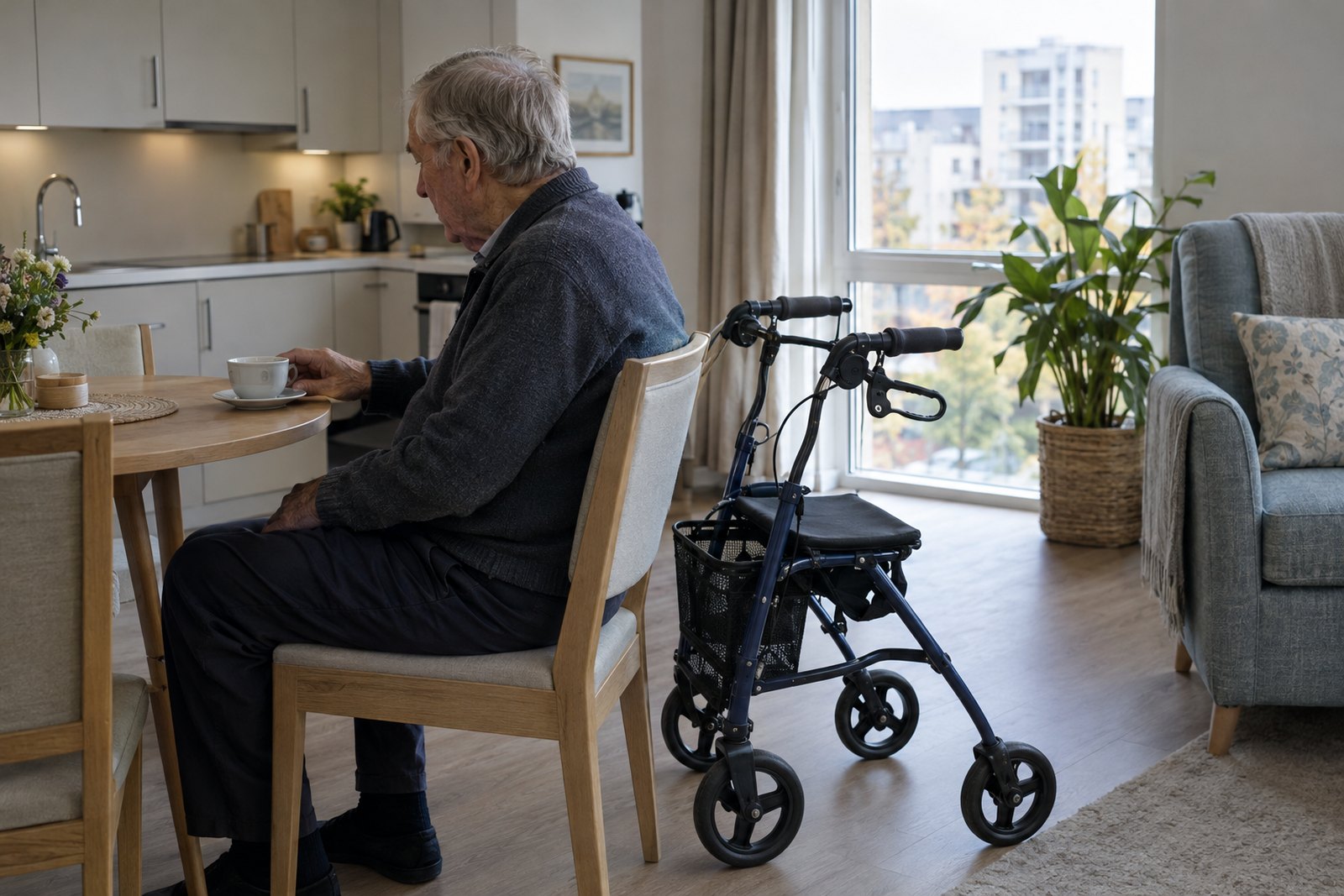
Extra care housing, often sold as assisted living or housing with care, is a flat or bungalow of your own, with your own front door and your own tenancy or lease, in a scheme that has a care team based on site. You live independently. You cook if you want to, have visitors when you like and lock your own door. When you need help with washing, dressing, medicines or getting up, it comes from staff who are already in the building rather than from an agency driving across town.
The short version of the difference is this. Sheltered housing gives you a safe, sociable building but no care team, so any care is brought in from outside, just as it would be at home. A care home gives you a room and round-the-clock care, but you give up your own household. Extra care sits between the two, and for many people it is the option that lets them stay in charge of their own life for longer. Whether it is right for you, or whether your current home could be made to work instead, is the real question. This guide tries to help you answer it.
How extra care housing works
The names vary, which does not help. Councils and housing associations tend to say extra care housing. Private developers often say assisted living, retirement living with care or integrated retirement community. Larger sites are sometimes called retirement villages. The model underneath is broadly the same.
- Your own home. A self-contained flat, usually with one or two bedrooms, a kitchen and an accessible bathroom, often with a level-access shower. You rent it, buy it on a lease or buy a share.
- A care team on site. Many schemes have staff on site day and night, although what that means at 3am varies a great deal. Ask.
- Care bought by need. You receive, and pay for, the care you have been assessed as needing. If you need none at first, you may get none. If you need four visits a day, you get four.
- An emergency call system in each flat, usually pull cords or a pendant, linked to the on-site team.
- Shared spaces. Typically a restaurant or café, a lounge and a garden, and often a hairdresser, activity room or guest suite.
The important point is that the building is your home, not a care home. In England the care is provided by a home care service registered with the Care Quality Commission, in the same way as care in an ordinary house. Scotland, Wales and Northern Ireland have their own regulators. That separation between housing and care matters: if your needs change, the care changes, but you do not lose your home.
Extra care, sheltered housing and care homes compared
Sheltered housing
Sheltered housing, also called retirement housing, is self-contained flats for older people. There is usually a scheme manager (some people still say warden) who may be on site during working hours or visit regularly, a community alarm and a communal lounge. It suits people who are managing well but want somewhere smaller, safer and less lonely. What it does not have is a care team. If you need personal care, it is arranged exactly as it would be in an ordinary house, through the council or a private agency, with carers visiting at set times.
Extra care housing
The same idea of your own flat, but designed for people who need, or are likely to need, regular care. Buildings tend to be more fully accessible, with lifts, wider doors and wet rooms, and the care staff can respond to calls and fit visits around you more flexibly because they are not travelling between houses.
Residential and nursing care homes
In a care home you have a room, often with an en suite, rather than a home. Meals, laundry, cleaning and personal care are provided, usually for one inclusive weekly fee. Nursing homes also have registered nurses on duty. Care homes are the right answer for some people, particularly those who need nursing care or constant supervision. But you do not run your own household, and some people who move into a care home could, with the right support in the right setting, have stayed more independent for longer.
A rough way to put it: sheltered housing is housing with a bit of support, extra care is housing with care, and a care home is care with accommodation.
Who extra care housing suits
- People who need some daily help, perhaps with washing, dressing or medicines, but want to keep cooking, going out and running their own life.
- People whose current home has become the problem: stairs they cannot manage, a bathroom that cannot sensibly be adapted, a garden they cannot keep up, or a location miles from shops and family.
- People who are lonely or isolated, especially after a bereavement.
- Couples where one partner needs a lot of care and the other does not. The flat stays shared and the care goes to the person who needs it.
- People whose needs are likely to increase, for example with Parkinson's or early dementia, who would rather move once, while they can still settle in and learn their way around.
Who it may not suit
Extra care is not a nursing home. If you need a nurse regularly through the day, or someone with you around the clock, most schemes will tell you honestly that they cannot meet that. Some schemes support people with dementia well and others less so, particularly where someone is at risk of leaving the building and getting lost.
And for plenty of people, moving is simply not necessary. If the real problem is a bath you cannot get out of or steps at the front door, adaptations may solve it with a fraction of the upheaval. The Disabled Facilities Grant exists for exactly that. It is worth ruling this out before you put your name down anywhere.
How places are allocated
Council and housing association places
Many extra care schemes are run by housing associations in partnership with the local council. The council usually has nomination rights to some or all of the rented flats, which means it decides who is offered them. Rules differ from council to council, but you will usually need:
- An assessment from adult social care showing you have care needs that the council considers eligible. In England this is a Care Act needs assessment.
- To meet the scheme's age criteria, often 55 or over, though some schemes take younger adults with care needs.
- Often, a local connection to the area.
- To apply through the council's housing register or its own extra care application route.
Applications often go to a panel that tries to keep a balance of people with low, medium and higher care needs, so the building does not quietly turn into a care home. That means you can be turned down not because your needs are wrong in general, but because of the mix at that particular moment. Ask the council how its panel works and roughly how long people wait for the scheme you are interested in.
The way in is normally to contact your council's adult social care team, ask for an assessment and say clearly that you are interested in extra care. If you already have a social worker, start with them.
Private schemes
Privately run schemes are usually open to anyone who meets the age criteria and can pay. You buy a lease outright, buy a share or rent. Some still ask about your care needs to check they can meet them. Care may come from the scheme's own care provider, and you may or may not be allowed to use a different one. That is worth knowing before you commit.
What extra care housing costs, in general terms
Costs vary so widely by area, landlord and type of tenure that any figure here would mislead you. What helps is understanding the separate parts of the bill, because they are paid for in different ways.
- Rent or purchase price. This might be social rent, affordable rent, market rent, a full leasehold purchase or shared ownership. If you rent and have a low income, Housing Benefit or the housing element of Universal Credit may help, depending on your age and circumstances.
- Service charge. This covers building maintenance, communal areas, the emergency call system and sometimes a scheme manager. Some of it may be covered by housing benefits and some will not.
- Care charge. This is for the personal care you are assessed as needing. If the council arranges it, it will do a financial assessment, broadly in the same way it charges for care at home.
- Core or wellbeing charge. Some schemes charge a fixed amount for the on-site team being available, including overnight, whether you use care or not.
- Meals and extras. Restaurant meals, hairdressing, activities and laundry are often pay as you go.
- Fees when you sell. Some leasehold schemes charge a fee when you sell, sublet or the flat passes to your estate, sometimes called an event fee, exit fee or deferred management fee. It can be substantial. Understand it in writing before you buy.
Benefits matter here. Attendance Allowance or the daily living part of PIP is not means tested and can go towards care costs, although the council will usually count it as income when it works out what you pay for care. Pension Credit can open the door to other help. Age UK and your council's welfare benefits team can check what you are entitled to. If you are buying, have a solicitor go through the lease, and consider independent financial advice from someone who specialises in later life.
What to check before you choose a scheme
Visit more than once, and at different times of day. A lunchtime tour shows you the restaurant. A weekday evening shows you how many staff are actually around.
About the care
- How many care staff are on site overnight, and how quickly do they usually answer a call?
- Can I choose my own care provider, or must I use yours?
- What happens if my needs increase? At what point would you say you could no longer meet them?
- Do you support people with dementia, and how, in practice?
- What does the latest inspection report from the regulator say about the care service?
About the flat itself
- Is the shower genuinely level access, with room for a shower chair and for someone helping?
- Are the doors wide enough for a walker or wheelchair, and is there room to turn?
- Can I reach the kitchen cupboards, the oven controls and the window catches?
- Is there space beside the bed for a carer, or for a profiling bed or hoist if one is ever needed?
- Where could a mobility scooter be stored and charged?
- How far is the flat from the lift, the restaurant and the front door, and can I manage that walk on a bad day?
About the money and the tenancy
- Get a written breakdown of rent, service charge, care, any core charge and meals, and ask how each has changed over recent years.
- Ask exactly what fees apply when you sell, move out or die.
- Check the rules on pets, overnight guests and decorating.
If you can, talk to residents. They will tell you things a brochure will not.
Where an occupational therapist fits
An occupational therapist looks at how you manage everyday life: washing and dressing, using the toilet, cooking, moving around the house, getting in and out of bed and getting out of the front door. That makes them useful at several points in this decision, though not all of it.
Before you decide to move. An occupational therapist can assess you in your current home and tell you honestly whether it could work with equipment, adaptations or a change in routine. Sometimes a level-access shower, a couple of rails and a rearranged kitchen mean there is no need to move at all. Sometimes the house genuinely cannot be made to work, and that is useful to know too. A home assessment covers this.
Evidence for an application. A clear written report on what you can and cannot do safely can support an application to the council for extra care or rehousing, alongside the council's own assessment. It does not guarantee a place, and the council makes its own decision, but it can make sure your needs are described accurately. See housing and rehousing.
Checking a particular flat. New flats are not always as accessible for you as the brochure suggests. An occupational therapist can look at a specific flat with you, or work from the floor plan and measurements, and tell you whether your walker will get through the bathroom door, whether you could use the shower and what equipment you would need on the first day.
Settling in. After a move, setting the flat up properly and learning new routes and routines can make the difference between thriving and struggling.
What an occupational therapist does not do: decide whether you get a council place (the council does), assess your finances, advise on a lease or provide medical care. Adult social care handles care assessments and nominations, your GP handles health concerns and a solicitor should read any lease. You can also ask your council for an occupational therapy assessment through adult social care, though waiting times vary by area.
Frequently asked questions
Is extra care housing the same as assisted living?
Broadly, yes. Assisted living is the term private developers tend to use, while councils and housing associations usually say extra care. In Scotland you may also hear very sheltered housing. Look past the name to what is actually provided: your own front door, a care team on site and care based on your assessed needs.
Can I move in if I do not need any care yet?
Often, for private schemes, as long as you meet the age criteria. Council-nominated places usually require an assessment showing care needs, although panels deliberately include some people with lower needs to keep a balance. Ask the council or the scheme directly.
Will I have to move again if my needs increase?
Not necessarily. Care can usually be increased as your needs change, and community nurses can visit just as they would at home. But if you come to need nursing care or someone with you all the time, a scheme may not be able to meet that. Ask each scheme where their limit is before you move in.
Can couples move in together?
Usually, yes, and this is one of the real strengths of extra care. Two-bedroom flats are common, and each person's care is assessed and provided separately, so one partner can have a lot of help while the other has none.
If I sell my house to move, does that affect council funding?
It can. While you live in your house, its value is not counted for care at home. Once it is sold, any money left over after buying a new home, or all of it if you rent, will normally be counted as savings when the council does a financial assessment for care charges. Giving money away to reduce charges can be treated as deprivation of assets. The rules are detailed, so ask your council or Age UK to explain how they would apply to you before you sell.
Is extra care the same everywhere in the UK?
The model exists across England, Scotland, Wales and Northern Ireland, but names, allocation rules and funding arrangements differ between nations and between councils. Your local council's adult social care or housing team is the place to find out what schemes exist near you and how to apply.
Next steps
If you are weighing up whether to move or stay put, our housing and rehousing and home assessment pages explain how a private occupational therapist can help, or see current guide prices, and choose your area below.

Talk to an occupational therapist near you
This guide is general information. For advice about your own situation - or someone you look after - a local occupational therapist can visit you at home and see it for themselves.
Choose your area: