

Dropped Kerb Outside Your Home: Permission, Parking And OT Help
By Mobile Occupational Therapist • 19 September 2026 • 15 min read
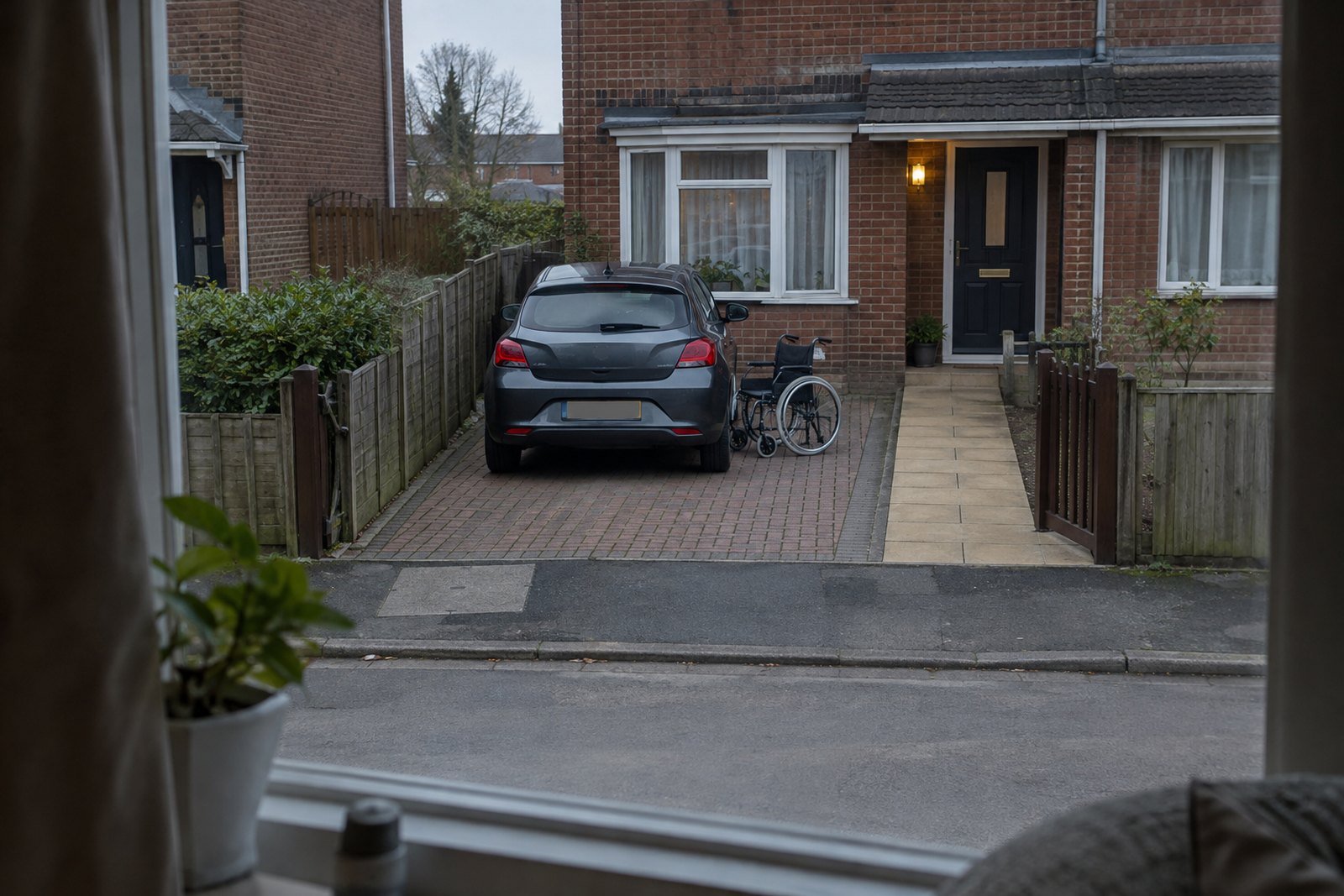
If you need to park closer to home because of disability, illness or caring, there are two common options people ask about: a dropped kerb (also called a vehicle crossover) so you can drive onto a driveway, or a disabled parking bay on the road outside the house. Both are controlled by the council, and both come with rules that are often misunderstood.
A dropped kerb for vehicles is not just a bit of lowered kerbstone. It is permission to drive across the pavement (the public highway) and a properly built strengthened crossing that protects the footway and any cables and pipes underneath. A disabled bay outside your house is also not automatically "yours". In many areas it is advisory only, and even where it is enforceable it is usually for any Blue Badge holder, not reserved for one household.
what a dropped kerb and a vehicle crossover are
When people say "dropped kerb" they can mean two different things:
- Vehicle dropped kerb (vehicle crossover): a strengthened section of pavement and lowered kerb so a car can cross safely to a driveway.
- Pedestrian dropped kerb: a kerb ramp to help wheelchair users, mobility scooter users, people with walking aids and pushchairs cross the road.
This article covers both, because many families need a parking solution and a safer way to get to the front door.
You might already have a driveway but no dropped kerb. Or you might have a dropped kerb but the driveway is too steep or too small for safe wheelchair transfers. Or you might not have off street parking at all and be exploring an on street disabled bay.
why you need council permission before you drive across the pavement
Even if the paving is outside your house, it is usually part of the public highway. Driving over the footway where there is no properly constructed and authorised vehicle crossover can damage the footway and what is underneath it, and it can create a trip hazard for other people if it breaks up.
The highway authority or roads authority is responsible for managing the public highway, and this is often the local council. That is why they usually require you to apply for a proper vehicle crossover, and to use an approved contractor (or a contractor working to their specification). They may also need to consult utility companies, check drainage and make sure the crossing will not block street features like gullies, lamp columns or street trees.
In practical terms, permission matters because:
- Safety: an incorrectly built crossover can crumble or rock under the weight of vehicles, or leave uneven surfaces that are risky for pedestrians.
- Drainage: councils may refuse if rainwater from your drive would run onto the pavement or into the road. They may require changes to the driveway surface or drainage.
- Visibility: if the access point is on a bend or near a junction, the council may decide it is not safe.
- Legal enforcement: councils can require unauthorised crossings to be removed and the footway put back to how it was.
If you are doing this because of disability, it is still the same process. Sometimes there are different criteria or supporting evidence that can help, but the highway still has to be safe for everyone using it.
before you apply: quick checks that save wasted fees
Every council has its own policy, but many refusals come down to the same handful of issues. These checks are worth doing before you fill in any forms.
is there enough space for a car without blocking the pavement?
A driveway needs to be deep enough that a parked car is fully within your boundary. If the bonnet or bumper will stick out over the footway, the council may refuse because it forces wheelchair users and pushchairs into the road.
Think about how you will actually use the space. If you need room to open doors wide or to bring out a wheelchair, you will need more than the bare minimum for a car to fit.
is the driveway level and usable in real life?
Some driveways look fine on paper but are awkward day to day. Common problems include:
- Too steep: difficult for a person walking with a stick, and risky for wheelchair transfers because the chair can roll.
- Uneven or loose surface: hard to push a wheelchair or roll a walking frame.
- Limited turning space: you may be forced to reverse in or out in a way that feels unsafe.
If you are creating a new hardstanding (for example by converting a front garden), also think about where the rainwater will go. Some councils require permeable surfaces or other drainage arrangements.
can you get from the car to the front door safely?
For many disabled people, the dropped kerb is only half the problem. You also need a workable route from the parking space to the door.
Look at:
- Thresholds and steps: is the entrance step-free, or could a small threshold ramp be used safely?
- Path width: can a wheelchair or mobility scooter pass without squeezing past bins or plant pots?
- Lighting: is the route well lit for evenings and winter afternoons?
- Handholds: if someone needs support, are there safe places for rails or a second handrail?
If your main aim is safer access into the house, you may find it useful to read the disabled facilities grant guide because in some situations the bigger issue is the entrance itself, not the kerb.
how to apply for a dropped kerb in the UK (general steps)
The details vary by council, but the overall process is usually similar.
- Find the right team: search your council website for "dropped kerb", "vehicle crossover" or "vehicle crossing". It is usually the highways team, sometimes called streets, roads or transport.
- Check eligibility rules: councils often have minimum driveway dimensions, rules about distance from junctions, and limits on how many crossovers are allowed close together.
- Ask whether planning permission is involved: some crossovers are handled entirely through highways permission, but planning may come into it in certain situations. This can include listed buildings, conservation areas, and some types of new or altered access. If you are unsure, ask the council to confirm in writing which permissions are needed.
- Provide basic information: typically photos, a simple plan, and measurements. Some councils will come out and inspect before they approve.
- Get quotes or use an approved contractor: some councils require you to use their framework contractor, others provide a list of approved contractors, and some allow any contractor who meets their specification. Do not start work until you have permission.
- Expect checks: the council may check for gullies, street trees, street furniture, and underground services. They may refuse if moving a lamp column or drain cover would be required.
- Work and sign off: once built, councils often inspect the crossover. Keep any paperwork for future house sales.
If you rent your home or you are a leaseholder, you may also need the landlord or freeholder to agree, even if the council approves the crossover.
If you are applying because of a disability related need, it can help to make that need clear, in plain terms. For example: "I cannot walk more than a short distance without stopping" or "I need space to transfer from the car to a wheelchair". Keep it factual, and focus on function, not diagnoses.
disabled parking bays outside your home: what is possible and what is not
People often ask for "a disabled bay outside my house" when a dropped kerb is not possible or there is no space for off street parking. Councils can mark bays, but there are important limits.
advisory disabled bays
An advisory bay is usually a marked bay on the road with no legal enforcement. It is meant to encourage neighbours and visitors to leave the space free for a disabled resident. Some communities respect it very well. Some do not.
Advisory bays can be quicker and simpler for councils to provide because they do not require the same legal steps as enforceable restrictions, but each council decides what it will and will not do.
enforceable disabled bays
An enforceable bay is backed by a legal order and is signed and marked so that parking enforcement can issue penalties when the bay is misused. In many areas, these bays are for any Blue Badge holder, not reserved for one named person. That means you may still find the space occupied by another badge holder.
Whether your council offers enforceable bays outside homes, and what evidence it requires, varies widely. Some councils restrict them to specific situations because they can be complex to set up and manage.
what councils usually look at
Criteria vary, but councils often consider:
- Whether you have off street parking that could be made usable.
- Whether the disabled person is the main driver or a frequent passenger.
- Whether parking is genuinely difficult near the property.
- Whether there is a Blue Badge (some councils require one, others use different evidence).
- Road safety factors such as junctions, bends and bus stops.
It is worth being clear about your day to day reality. For example, "I need the car close enough to manage the front door safely" is more useful than "parking is annoying". If the issue is managing steps, slopes or doors once you are out of the car, say that too, because it changes what the solution needs to be.
One hard truth: you do not own the road outside your home, even if the bay is marked. Try to think in terms of "making access possible" rather than "protecting my spot". It sounds small, but it can keep the conversation with the council more realistic.
pedestrian dropped kerbs for wheelchair users and pushchairs
If you do not need to drive onto a driveway, but you do need a kerb ramp for wheelchair access (for example to get from your home to the pavement opposite), you can ask the council about a pedestrian dropped kerb.
These are usually prioritised based on pedestrian routes and safety. Councils may focus on places like:
- Crossings near schools, shops, GP surgeries and bus stops.
- Routes that connect to existing accessible paths.
- Locations where the kerb height is a known barrier for wheelchair users and mobility scooters.
When you request one, it helps to provide:
- Exact location (street name and nearby house numbers).
- Photos showing the kerb and why it is not usable.
- Who needs it and what mobility aid is used (wheelchair, scooter, walking frame, pushchair).
- Whether there is a safer crossing point nearby (if there is not, say so).
Councils also have to consider other access needs. For example, some kerb layouts include tactile paving to support blind and partially sighted people. It is normal for the council to look at the whole picture, not just one household.
differences in Scotland, Wales and Northern Ireland
The principles are the same across the UK: pavements and roads are managed by the relevant road or highway authority, and you generally need permission for a vehicle crossing. The language and process can vary:
- England and Wales: usually your local council highways team.
- Scotland: usually your local council roads service. Guidance and criteria can differ between councils.
- Northern Ireland: roads are handled differently, often through a central roads authority rather than local councils, so the contact point and process can be different.
If you are unsure, start by checking who the road or highway authority is for your street. In Northern Ireland this is usually the Department for Infrastructure (DfI). If your local council is not responsible for the road, it should signpost you to the right body.
where an occupational therapist fits
An occupational therapist (OT) is not the person who decides whether a dropped kerb is allowed, and an OT cannot override highway safety rules. But an OT can be very useful when the council asks for evidence of need, or when you are trying to work out what will actually solve the problem.
A home visiting OT can help by:
- Assessing function: how far you can walk, what happens when you are fatigued, whether you can manage a slope, how you transfer in and out of a car, and what makes you most likely to fall.
- Looking at the whole route: car to gate, gate to path, path to threshold, threshold to the chair you actually sit in. Often the sticking point is not the parking itself but the entrance setup.
- Recommending practical changes: for example, changes to path layout, handrails, threshold solutions, lighting, or a different place to park that is safer.
- Writing a clear report: some councils, housing providers or case managers ask for an OT report to support an application for adaptations or access changes. A report can explain the day to day impact in a way that is easy to act on.
If your issue is really about adapting the entrance, not the road, an OT assessment may also feed into a bigger plan for home access. For a plain English overview of how OT assessments work for adaptations, see home adaptations and OT assessments. If funding is part of the question, the starting point is often how the disabled facilities grant works.
When an OT is not the right professional: if you need a medical opinion on symptoms, that is your GP. If the core problem is pain, strength, balance or gait training, a physiotherapist may take the lead (often alongside OT). If you need drawings and building design for major works, you may need an architect or surveyor.
how to make a stronger, calmer request to the council
Council processes can feel slow, and when you are already exhausted, it is hard to keep pushing. These steps can improve your chances without turning it into a battle.
be specific about the problem you need solved
Instead of "I need a dropped kerb", try:
- "I need to be able to park close enough to get indoors without stopping several times."
- "I need space to transfer from the car to a wheelchair and then reach the front door step-free."
- "I cannot safely step down from a high kerb with a walking frame."
This helps the council (and anyone supporting you) see whether the answer is a vehicle crossover, an on street bay, a pedestrian dropped kerb, or something else entirely.
include the practical details councils use to decide
Useful details include:
- Driveway width and depth, and whether a car would overhang the footway.
- Photos of the frontage and the approach from both directions.
- Whether there are street features in the way (trees, drains, lamp columns).
- Any near misses, falls or situations where you were stuck in the road because the kerb was too high.
If you are sharing information about disability, keep it to what is relevant for access and safety. You should not need to share your whole medical history to explain why you cannot walk from a distant parking space.
plan for the day after the work is done
Even a perfectly installed crossover will not help if the route to the door is still unsafe. Do a quick "day after" check:
- Where will bins go on collection day?
- Can a wheelchair get past a parked car and through the gate?
- Will carers be able to reach the door with equipment?
- Is there somewhere to wait if the door answer is slow?
This is also where an OT eye on the layout can save you from paying for something that does not actually make life easier.
Frequently asked questions
can I lower the kerb myself?
No. A vehicle dropped kerb is part of the public highway and needs council permission and proper construction. DIY work can be unsafe, can damage underground services, and councils can require it to be removed.
do I need planning permission for a dropped kerb?
Sometimes, yes. Many vehicle crossovers are handled through highways permission, but planning can be involved in certain situations (for example some types of new access, listed buildings or conservation areas). Ask your council to confirm what applies to your address.
will a disabled parking bay outside my house be mine?
Usually not. An advisory bay is not legally reserved, and even an enforceable bay is often for any Blue Badge holder. Councils set their own rules, so check what type of bay they offer and who can use it.
what if I have a Blue Badge but no driveway?
A Blue Badge can help with parking concessions, but it does not guarantee a bay outside your home. If you are applying for a residential disabled bay, your council will have its own criteria and may look at factors like local parking pressure and road safety.
can I request a pedestrian dropped kerb near my home?
Yes. Contact the council team responsible for roads or highways and explain the exact location and why the kerb is a barrier. Councils prioritise requests, so being clear about safety and daily impact can help.
can an occupational therapist write a report to support my application?
Sometimes. If the council or a housing provider is asking for evidence of functional need, an OT can assess how you manage walking, transfers, steps and access to the home, and can write this up clearly. It will not override highway safety rules, but it can support the case for reasonable access solutions.
Next steps
If you want help working out what would actually make access workable, see our home assessments and home adaptations pages, or current guide prices, and choose your area below.
Talk to an occupational therapist near you
This guide is general information. For advice about your own situation - or someone you look after - a local occupational therapist can visit you at home and see it for themselves.
Choose your area: