

Dementia and Driving: DVLA Rules and How to Have the Conversation
By Mobile Occupational Therapist • 10 October 2026 • 13 min read
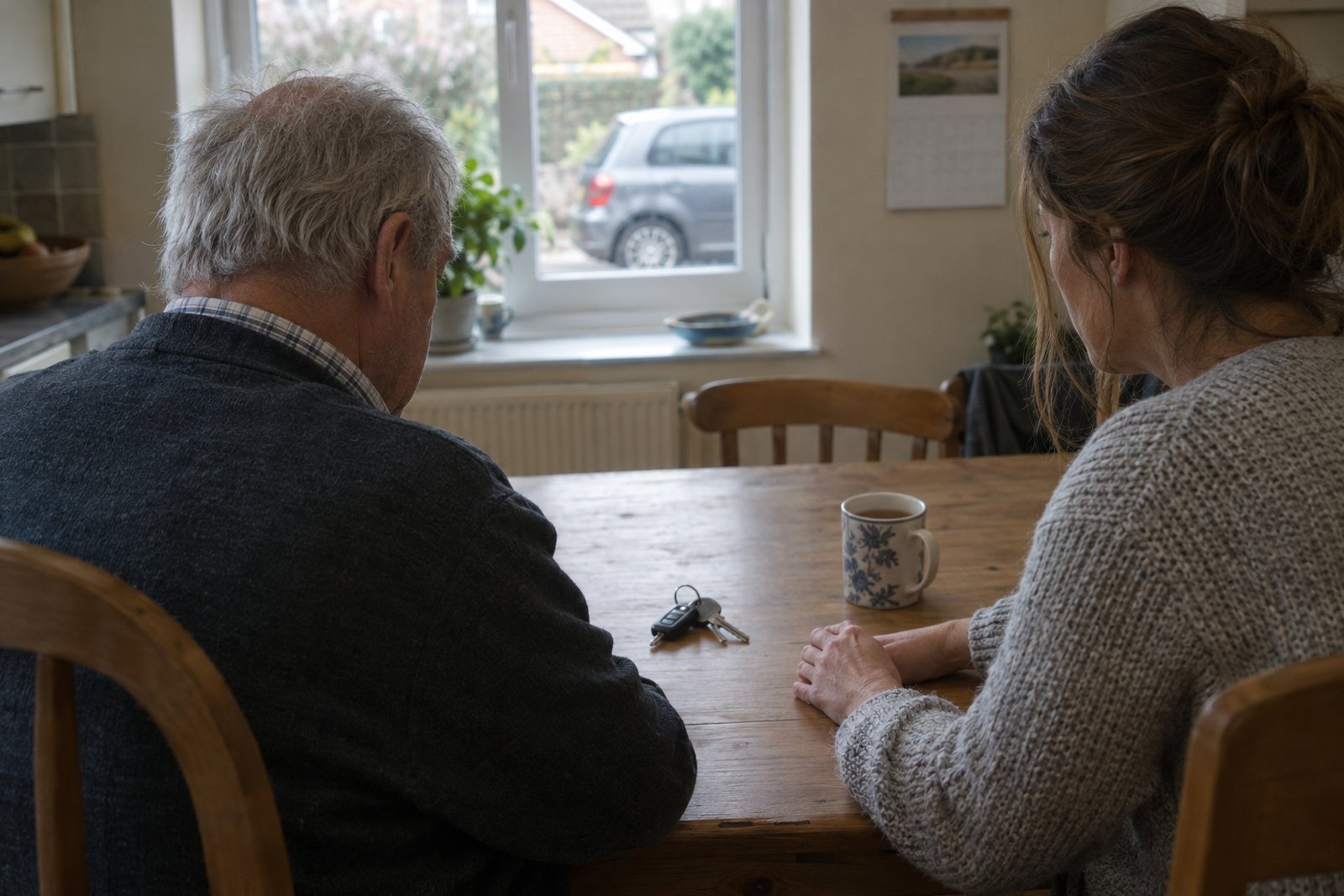
If you or someone close to you has been diagnosed with dementia, here is the short answer. A diagnosis does not automatically mean you must stop driving that day. But if you hold a driving licence you must tell the DVLA, and you should tell your car insurer too. The DVLA then decides whether you can carry on, usually after getting information from your doctors. Dementia is progressive, so for everyone who has it there will come a point when driving has to stop. The only real questions are when, and how well it is handled.
So when should someone with dementia stop driving? When the DVLA says so, when their doctor advises it, or when the people who ride with them see clear signs that driving has become unsafe, whichever comes first. Many families wait for the DVLA to make the decision for them. The warning signs below are the ones worth acting on sooner. This guide covers the rules, the signs, how to raise the subject without a row, what to do if someone refuses, and how to keep life going without the car.
What the law says: telling the DVLA and your insurer
Current GOV.UK guidance says you must tell the DVLA if you have dementia. For a car or motorcycle licence there is a specific medical questionnaire for dementia, which you can complete online or by post. If you hold a bus, coach or lorry licence, there is a separate form and the medical standards are stricter. In Northern Ireland, you tell the DVA rather than the DVLA. Forms and processes change, so check the GOV.UK page on dementia and driving for the current version before you start.
GOV.UK also states that you can be fined if you do not tell the DVLA about a medical condition that affects your driving, and you may be prosecuted if you are involved in an accident as a result. Separately, not telling your insurer about a relevant medical condition can invalidate your policy, which could leave you personally liable for damage or injury. A quick phone call to the insurer is worth making the same week you contact the DVLA.
Telling the DVLA is the licence holder's responsibility, not the doctor's. Family members can of course help fill in the form, and it is often easier done together while the diagnosis is fresh and everyone is still talking openly.
What the DVLA may do next
Once you have told them, the DVLA will usually ask for your permission to contact your GP or specialist. They may also ask you to have an eyesight check, a driving assessment or a driving test. After that, the outcome is usually one of these:
- You can keep your licence, sometimes with no change for now.
- You are given a shorter licence that has to be renewed after a set period, so your driving can be reviewed as the condition changes.
- You must stop driving and give up your licence.
Decisions can take time. In some circumstances you may be allowed to keep driving while the DVLA considers your case, but only if certain conditions are met, including your doctor agreeing that you are fit to drive. Do not assume this applies to you. Check the GOV.UK guidance first, and if your doctor has told you not to drive, do not drive.
You can also give up your licence voluntarily at any point, and GOV.UK explains how. Some people find this easier to live with because it feels like their own decision rather than something done to them.
Warning signs that driving is becoming unsafe
Dementia is often thought of as a memory problem, but driving depends just as much on attention, judgement, planning, spatial awareness and reaction speed. These can be affected before memory problems are obvious. The person driving may also genuinely not notice the changes. This is a feature of the illness, not stubbornness.
On the road
- Getting lost on routes they have driven for years.
- Missing or misreading road signs, traffic lights or give way lines.
- Hesitating badly at junctions and roundabouts, or pulling out when it is not safe.
- Drifting between lanes, straddling the centre line or clipping kerbs.
- Driving much too slowly or too fast for the road.
- Confusing the pedals, or struggling with gears and indicators.
- Becoming flustered, angry or frightened by ordinary traffic.
- Near misses, sudden braking or other drivers hooting more than usual.
Around the car and at home
- New dents and scrapes that nobody can explain.
- Penalty notices, parking tickets or a minor collision.
- Phone calls from the car because they do not know where they are.
- Quietly giving up longer trips, motorways or driving at night.
- Trips taking far longer than they should.
- Relying on a passenger to say when it is clear, or which way to turn.
That last one matters. If someone needs a co-pilot to drive safely, they are not driving safely on their own.
If you can, sit in the passenger seat on a familiar route and keep simple notes with dates: what happened, where, and how it was handled. One bad day can happen to anyone. A pattern is different, and written notes are far more useful to a GP than a general feeling of worry. If you have already witnessed a near miss, or you feel unsafe as a passenger, that is enough. Driving should stop now while you speak to the GP.
Driving assessments: what they are and what they are not
Driving Mobility is a national network of accredited centres that carry out independent driving assessments. An assessment is not a driving test in the usual sense. It typically involves a discussion of your health and driving, checks of vision, thinking skills, reaction times and physical ability, and usually a drive in a dual-control car with a specialist instructor and an assessor, who is often an occupational therapist. You receive a written report with recommendations.
The DVLA may arrange an assessment as part of its enquiries. People can also be referred by their GP or, at some centres, refer themselves. Some assessments carry a fee, so ask the centre directly.
Be realistic about what an assessment can tell you. It is a careful snapshot of one day. Dementia changes over time, and the DVLA still makes the licensing decision. What an assessment does offer is an expert, neutral opinion, which can take the heat out of a family argument. It is no longer you against your dad. It is a professional report that everyone can read.
How to have the conversation
This is one of the hardest conversations families have. For many people the car is not really transport. It is independence, competence, the weekly shop, the ability to visit friends and be the one who gives others a lift. Losing it can feel like losing a piece of themselves, and it is fair to treat it that way.
Start early, before it is urgent
The best time to talk is soon after diagnosis, while the person can take a full part in planning. Rather than arguing about today, agree what will happen later. Who do they trust to tell them when it is time? What signs would they want you to act on? Some families write this down as a simple agreement, signed by the person with dementia. It can be enormously helpful later, because it is their own decision you are honouring.
Choose the moment and the messenger
Pick a calm time in private. Not in the car, not straight after a near miss when everyone is rattled, and not in front of grandchildren. Think about who they will listen to. It is not always the adult child who does most of the caring. A GP, memory nurse, old friend or sibling may carry more weight, and it spares your relationship some of the strain.
Talk about safety and what stays the same
Avoid telling someone they are a bad driver. They may have been a good one for fifty years. Talk instead about the illness making driving riskier, and about protecting them and other people. Have a transport plan ready so the conversation is about how they will keep doing things, not just what they are losing. Acknowledge that it is sad and unfair. Then expect to have the conversation more than once. Memory problems mean they may forget it was agreed. Give the same calm answer each time, and a short note from the GP kept somewhere visible can help.
Things that tend to backfire
- Ambushing them with the whole family at once.
- Arguing over the details of each incident.
- Threats, ultimatums or making them feel foolish.
- Lying about why the car is unavailable as a first move.
If they refuse to stop
Refusal is common, and it often comes from the illness itself affecting someone's ability to recognise their own difficulties. Our guide on when a parent refuses help at home covers the wider picture. For driving specifically, these steps usually help:
- Speak to the GP or memory clinic. Share your notes. The GP can formally advise the person not to drive and record that advice.
- Know that professionals can inform the DVLA. Doctors are expected to advise patients about driving, and professional guidance allows them to tell the DVLA if a patient continues to drive when they are not fit to, usually after letting the patient know.
- Raise your concerns with the DVLA yourself. Family members can contact the DVLA about someone's fitness to drive. Give specific, dated examples. The DVLA may then make its own enquiries.
- Mention insurance. Some people respond to the practical point that an invalid policy could cost them their house more than to any safety argument.
- Practical measures as a last resort. Some families end up keeping the keys, moving or selling the car. These can cause real distress and do not settle the legal question, so try to have the GP involved first. Alzheimer's Society has advice on this situation.
If someone is driving in a way that puts them or others in immediate danger, or they have driven off and you cannot find them, call 999.
Life without the car
Stopping driving can lead to people staying in more and seeing fewer people, which is the opposite of what helps with dementia. Plan the replacements before the keys go, not after.
Blue Badge as a passenger
A Blue Badge belongs to the person, not the car, so it can be used in any vehicle they travel in as a passenger. In England the scheme covers non-visible conditions, and people with dementia may qualify depending on how it affects them. Your council handles applications. Our guide to Blue Badge applications explains the process.
Bus passes
Free older person's bus travel starts at State Pension age in England and at 60 in Scotland, Wales and Northern Ireland. Separately, in England, one of the qualifying grounds for a disabled person's bus pass is that your driving licence would be refused on medical grounds, other than for drug or alcohol misuse. That can include someone who has stopped driving because of dementia. Apply through your council, and ask whether a companion pass is available locally.
Community transport and other options
- Community transport and dial-a-ride schemes, which often use accessible minibuses.
- Council taxi card or subsidised taxi schemes, where they exist.
- NHS non-emergency patient transport for hospital appointments, if eligible.
- A lift rota of friends, neighbours, faith groups or volunteer drivers.
- Online shopping with deliveries, so the weekly shop is one less trip.
It is worth doing the sums. Money saved on insurance, tax, fuel, servicing and repairs can pay for a fair number of taxis.
Keep the purpose, not just the trips
Ask what the car actually gave them. Golf on Thursdays, visiting a sister, the garden centre with a friend. Replace each of those one by one, ideally on the same day and time, so the week keeps its shape.
Where an occupational therapist fits
To be clear about limits: the DVLA decides who can drive. A home-visiting occupational therapist does not make that decision and will not tell you someone is safe to drive. On-road driving assessments happen at specialist centres such as those in the Driving Mobility network, where specially trained occupational therapists often form part of the team.
Where a private occupational therapist visiting at home can help is with everything around driving. They can look at how dementia is affecting daily life, and plan with the person and family for life after the car: getting to shops, appointments and social activities, practising a bus route, setting up a simple way to book community transport, building routines and memory aids, and making the home easier to manage. A written functional report can also support a Blue Badge application, a council needs assessment or a conversation with the GP. See our older people's independence service and our page on dementia.
For medical questions and fitness to drive, the GP or memory clinic leads. For care and support needs, contact council adult social care. For emotional support and information, Alzheimer's Society is a good place to start.
Frequently asked questions
Do I have to stop driving as soon as I am diagnosed with dementia?
Not automatically. You must tell the DVLA and your insurer, and follow your doctor's advice. If your doctor tells you to stop, stop. Otherwise the DVLA will decide after looking at the medical information.
Who tells the DVLA, me or my doctor?
It is the licence holder's legal responsibility to tell the DVLA. Your doctor should advise you to do so, and family can help with the form.
Can a family member report someone to the DVLA?
Yes. Family members can contact the DVLA with concerns about someone's fitness to drive. Specific, dated examples are more useful than general worry. It usually helps to speak to the GP as well.
Will a driving assessment tell us whether someone is safe to drive?
It gives an expert opinion based on how someone performs on the day, with recommendations. It does not replace the DVLA's decision, and because dementia changes over time, it cannot predict how driving will be in months to come.
Is it all right if someone drives only with a passenger to help?
No. Needing a passenger to check junctions or give directions is itself a warning sign. The driver must be able to drive safely on their own. Speak to the GP if this is happening.
Does someone with dementia need to tell their car insurer?
Yes. Not disclosing a relevant medical condition can invalidate the policy. Tell the insurer at the same time as the DVLA.
Next steps
See our older people's independence or functional assessments and reports pages, or current guide prices, and choose your area below.
Talk to an occupational therapist near you
This guide is general information. For advice about your own situation - or someone you look after - a local occupational therapist can visit you at home and see it for themselves.
Choose your area: